
Dear Editor,
Tension-free anastomoses are required for a successful operation. Cartı et al.’s () trial is a useful addition to relieve tension on the anastomosis in hepaticojejunostomy by using a Bakri intrauterine hemostatic balloon between the diaphragm and the liver, pushing the liver caudad and thereby decreasing anastomotic tension. We have an addition and comment.
A contrivance to “fix” the Bakri balloon at the site (between the diaphragm and the superior liver surface) may be useful. We have some concern that the balloon may move postoperatively. In the worst scenario, the balloon could be dislodged anteriorly from the liver, preventing its function to decrease anastomotic tension or injuring surrounding tissue. Lateral motion can also occur, which might injure the falciform ligament or some surface vessels on the liver and/or diaphragm, causing bleeding.
A Bakri balloon is slippery and, with intrauterine use, it often descends caudally (“balloon prolapse” into the vagina). To prevent this descent, the balloon’s distal drainage hole is tied with a suture, placed at the abdominal wall, with appropriate tension () (). After hemostasis is achieved, the suture is cut and removed with the balloon. A similar procedure (“abdominal balloon-pulling”) may be applied after hepaticojejunostomy to fix the balloon (). Even without balloon prolapse, the balloon can move at the site (between the diaphragm and liver surface). Inappropriate pushing at the site may cause erosion into the liver and/or diaphragm. With the suture made at distal portion of the balloon, the balloon is anchored distally and proximally, by the suture and balloon shaft. This may enable delicate change of the balloon position, when necessary. The suture should be cut at the time of balloon removal, similar to intrauterine balloon placement.
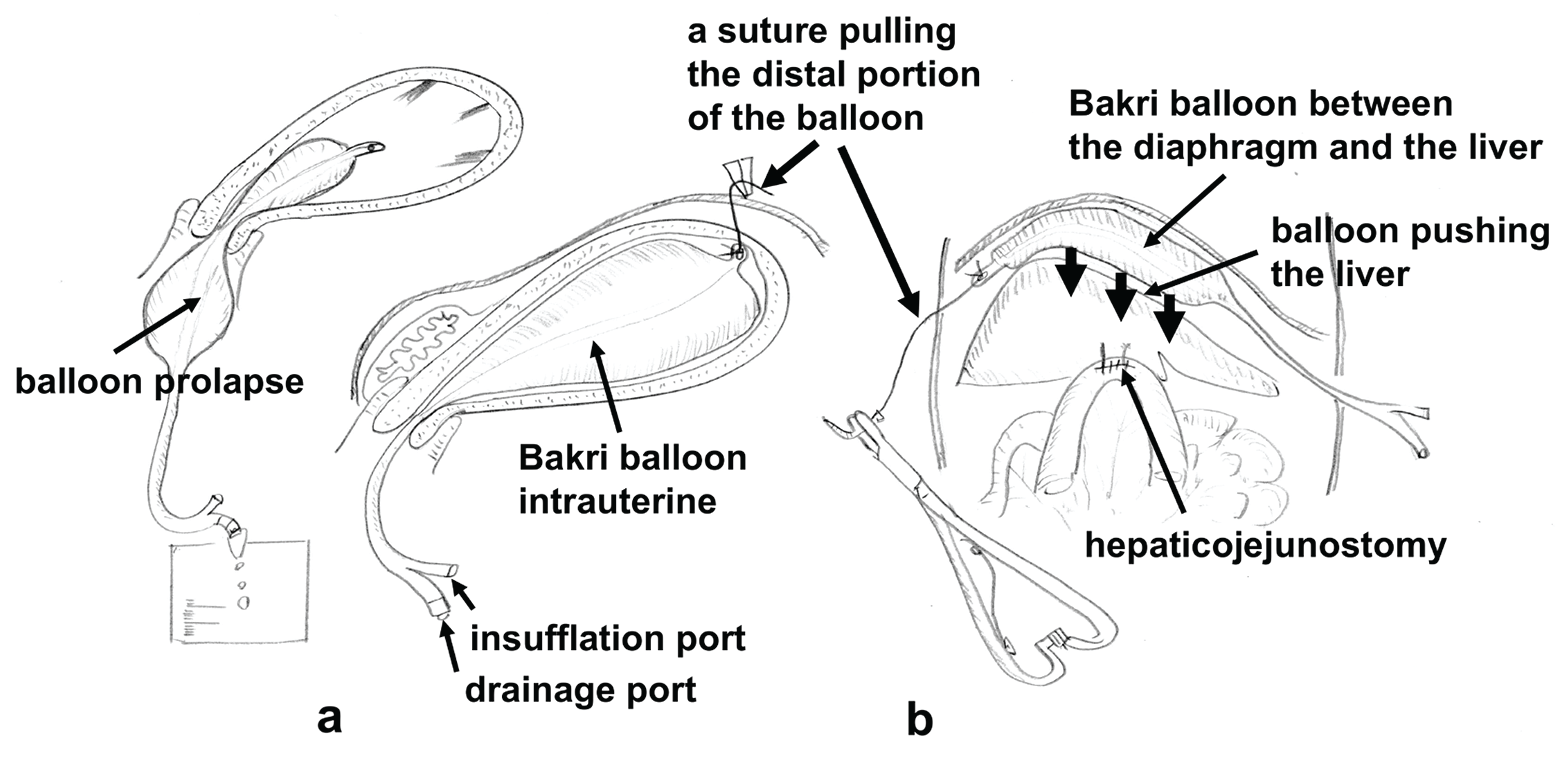
a): Bakri balloon, once placed within the uterine cavity, tends to move to the caudal side (balloon prolapse; left panel). To prevent this, a thread/suture is tied to the distal end of the Bakri balloon (draining hole), its end is placed on the abdominal wall, and it is fixed/pulled on/from the abdominal wall (right panel). b): The same can be done in Bakri-balloon’s liver-pushing. This may prevent balloon anterior dislodgement and lateral movement. In the latter, when some situations (for example, concern for erosion into the liver and/or diaphragm) require subtle balloon movement, pulling or loosing this suture/thread may be useful.
Obstetrics and gynecology (OBGYN) have “borrowed” various devices from surgery. The Sengstaken-Blakemore tube was used for hemostasis for obstetric uterine bleeding when a Bakri balloon was unavailable (). For ovarian cancer surgery, an “intestinal isolation bag” is used to retract the small intestine out of the operative field, facilitating access to deep pelvic lesions. A multi-blade table-mounted wound retractor offered better visualization of the lesion (). This time, surgery borrowed a device from OBGYN, a Bakri balloon. A Bakri balloon was also successfully used as a “pelvic spacer” for empty pelvic syndrome after pelvic exenteration for colorectal cancer (). We believe that there may be more opportunities for further exchanges between surgery and OBGYN. This may not be confined to “devices” but can be generalized to knowledge, concepts, and/or experiences.
Lastly, we touch on our concern. During 4-decades of practice in obstetrics (SM) and general surgery (AKL), we have long been taught that surgeons should watch operations, especially in other specialties. An obstetrician should watch a general surgery operation and vice versa. This triggered us to “borrow” some devices/techniques used in other fields. However, the times have changed and the trend in life-work balance may deprive doctors of time to watch operations. Some systems facilitating information exchange and continued communication between surgery and OBGYN may be needed.
Author Contributions
Concept - S.M., A.L.; Design - S.M.; Data Collection or Processing - S.M.; Analysis or Interpretation - S.M.; Literature Search - S.M.; Critical Review - S.M., A.L.; Writing - S.M.
Conflict of Interest: No conflict of interest was declared by the authors.
Financial Disclosure: The authors declared that this study received no financial support.
Footnotes
Author Contributions
Concept - S.M., A.L.; Design - S.M.; Data Collection or Processing - S.M.; Analysis or Interpretation - S.M.; Literature Search - S.M.; Critical Review - S.M., A.L.; Writing - S.M.
Conflict of Interest: No conflict of interest was declared by the authors.
Financial Disclosure: The authors declared that this study received no financial support.
References
Cartı EB, Şekerci UU, Aydoğan O, Uçar AD. The use of Bakri balloon to reduce the anastomosis tension in hepaticojejunostomy. Turk J Surg. 2022;38:312-313.
Matsubara S, Baba Y, Morisawa H, Takahashi H, Lefor AK. Maintaining the position of a Bakri balloon after caesarean section for placenta previa using an abdominal traction stitch. Eur J Obstet Gynecol Reprod Biol. 2016;198:177-178.
Ishii T, Sawada K, Koyama S, Isobe A, Wakabayashi A, Takiuchi T, et al. Balloon tamponade during cesarean section is useful for severe post-partum hemorrhage due to placenta previa. J Obstet Gynaecol Res. 2012;38:102-107.
Nakagoe T, Sawai T, Tsuji T, Jibiki M, Nanashima A, Yamaguchi H, et al. Colectomy for colon cancer via a 7-cm minilaparotomy. Surg Today. 2001;31:1113-1115.
Kazi M, Desouza A, Bankar S, Jajoo B, Dohale S, Vadodaria D, et al. The use of an obstetric balloon as a pelvic spacer in preventing empty pelvis syndrome after total pelvic exenteration in rectal cancers - A prospective safety and efficacy study for the Bakri balloon. Colorectal Dis. 2023;25:616-623.