
Abstract
Objective: Barrett’s oesophagus (BE) surveillance depends on adherence to the Seattle biopsy protocol and recommended endoscopic follow-up intervals, yet real-world performance varies, particularly in culturally and linguistically diverse (CALD) populations.
Material and Methods: A 10-year retrospective audit (2010-2019) of all patients with histologically confirmed BE (≥10 mm intestinal metaplasia) at Northern Health, Melbourne, was performed using the Northern Health Decision Support coding system and scanned medical records; the year 2020 was excluded to avoid coronavirus disease-2019 confounders. Follow-up frequency was assessed against Cancer Council Australia guidelines and biopsy practice against the Seattle protocol. Analyses used chi-square/Fisher’s exact tests, t-tests, Mann-Whitney U, and logistic regression in STATA v18.
Results: Of 377 patients identified (791 endoscopic procedures), only 38.1% endoscopies in 18.3% of individual patients adhered to the Seattle biopsy protocol. Delayed surveillance was associated with younger age [odds ratio (OR) 0.98; p=0.017] and residences in the more socioeconomically disadvantaged [(index of relative socioeconomic advantage and disadvantage [IRSAD]=1 or 2) (OR 1.80; p=0.013)]; the delayed cohort had a lower mean IRSAD score (2.0 vs. 2.5; p<0.001). For Seattle biopsy protocol non-adherence, lowest IRSAD score of 1 (OR 0.56; p=0.043) was negatively associated. On multivariable linear regression analysis, interpreter requirement was shown associated (OR 4.4, p=0.05) with non-adherence to Seattle biopsy protocol after adjusting other confounding variables including age, gender, IRSAD score and number of gastroscopies.
Conclusion: Despite comparable follow-up engagement, CALD patients, particularly those requiring interpreters, receive less stringent Seattle-protocol biopsies, indicating an unmet equity gap in BE surveillance.
Keywords: Barrett’s esophagus, CALD, cancer, esophageal cancer, gastric cancer, gastrointestinal surgery
INTRODUCTION
Barrett’s oesophagus (BE) is a condition characterised by a metaplastic change in the normal squamous epithelium lining of the oesophagus, resulting in the development of intestinalised columnar epithelium. BE is considered a complication of chronic gastro-oesophageal reflux disease (GERD), although it can also occur in asymptomatic individuals (). The prevalence of BE among those with GERD varies from 3% to 14%, and it is a premalignant condition that disproportionately affects males and carries a 30- to 40-fold increased risk for oesophageal adenocarcinoma transformation (-). The majority of studies examining the prevalence of BE development from GERD have been conducted in North America, Europe and the Middle East, revealing geographical variations in prevalence, with the highest rate reported in the United States of America at 29%, and the lowest in Türkiye at 0.6% (-).
The Seattle protocol is a globally recognised standard for biopsy recommendations in BE surveillance. This protocol mandates systematic biopsies, typically involving taking 4-quadrant specimens at 1-2 cm intervals along the length of the Barrett’s segment, targeted biopsies of visible lesions and documentation of Barrett’s extent, a practice vital for minimising the risk of BE underdiagnosis and under-detection of dysplasia or progression to cancer (-). The recommended endoscopic follow-up frequency is determined by the length of the Barrett’s segment and the dysplasia status (,). Adherence to guidelines correlates with earlier disease detection, enabling timely curative interventions for high grade dysplastic BE or adenocarcinoma, and for instance, a fourfold increase in dysplasia detection in a UK-based study (,). However, real-world adherence rates present a challenge in BE management, with studies reporting rates ranging from as low as 8% and as high as 91% (). This adherence issue is influenced by multiple factors such as the length of Barrett’s segments, salaried versus productivity-based employment models, university hospital settings, and the presence of dedicated surveillance programs (). In addition, several studies have also indicated disparities in cancer surveillance and detection among culturally and linguistically diverse (CALD) patients (,).
This study aims to examine the management of CALD patients within the BE surveillance program, and to identify potential improvements required, addressing the challenges of maintaining high-quality service in a region mirroring real-world demographic patterns.
MATERIAL and METHODS
This retrospective study was conducted at a single centre at Northern Health, Melbourne, Australia. Northern Health, located in the northern suburbs of Melbourne, operates a Transcultural and Language Services Department (TALS) that offers interpreting services, medical material translation, serving a diverse local metropolitan CALD population. This study was approved by the Northern Health Quality Improvement/Audit process (ALR no. 34.2021; approval date: 25 May 2021). Given the retrospective audit nature of the study, informed consent was deemed not required.
The study population included all patients with a definitive histopathological diagnosis of BE, characterized by the presence of intestinal metaplasia and a minimum length of 10 mm, identified through the Northern Health Decision Support (NHDS) team using the hospital coding system. The study period spanned from the 1st of January 2010 to the 31st of December 2019, allowing for inclusion of follow-up data while avoiding potential confounding factors arising from the coronavirus disease-2019 pandemic in 2020, which significantly impacted outpatient services. Patient information including demographics, outpatient follow-up details, and endoscopic history, was obtained from the scanned medical record system. The cohort was further subdivided based on the socioeconomic status of their residential area, utilising the index of relative socioeconomic advantage and disadvantage (IRSAD) provided by the Australian Bureau of Statistics (). The use of language interpreters (used as a proxy for the patient’s primary spoken language) was extracted from the outpatient clinic notes and documentation on previous procedure consent forms. Endoscopic reports, details of oesophageal mucosa appearance, length of BE, histopathology results were collected from the scanned medical record system. The adherence to recommended frequency of follow-up endoscopy, early (earlier or precisely as per guideline) versus delayed procedure, was studied using the national guidelines by the Cancer Council Australia (). The Seattle protocol was employed for the assessment of biopsy process.
Table 1. Barrett’s oesophagus endoscopic surveillance guideline by Cancer Council Australia
No dysplasia on endoscopic assessment and Seattle biopsy protocol (4-quadrant at 1-2 cm interval AND targeted biopsies of any mucosal irregularity) | |
|---|---|
Short segment (<3 cm) | Repeat in 3-5 years |
Long segment (≥3 cm) | Repeat in 2-3 years |
Note: If there has been previous low-grade dysplasia, then follow low grade dysplasia protocol | |
Indefinite for dysplasia on biopsy | |
1. Confirm by a second pathologist, ideally expert gastrointestinal pathologist. 2. Repeat endoscopy in 6 months with Seattle biopsy protocol for suspected dysplasia (any mucosal irregularity and 4-quadrant biopsy at 1 cm interval) on maximal acid suppression. 3. If repeat shows no dysplasia, then follow as per non-dysplastic protocol above. 4. If repeat shows indefinite dysplasia, then repeat number 2. 5. If repeat shows dysplasia or cancer, then follow as per protocol below. | |
Low grade dysplasia on biopsy | |
1. Confirm by a second pathologist, ideally expert gastrointestinal pathologist. 2. Repeat endoscopy every 6 months with Seattle biopsy protocol for dysplasia (any mucosal irregularity and 4-quadrant biopsies at 1 cm interval). 3. If two consecutive 6-monthly endoscopies with Seattle biopsy protocol show no dysplasia, then revert to a less frequent schedule. | |
High grade dysplasia or adenocarcinoma | |
Referral to a subspecialized unit (Joint upper gastrointestinal surgery and gastroenterology unit) for discussion of further treatment.
Statistical Analysis
Statistical analyses were performed using STATA (StataCorp. 2023. Stata: Statistical Software: Release 18.0 College Station, TX: StataCorp LLC.). χ2 or Fisher tests were used for categorical variables (all p-values for categorical variables were calculated using Fisher’s exact test). Student’s t-test, and Mann-Whitney U test were used for normally and non-normally distributed continuous variables. Univariable and multivariable logistic regression analyses were undertaken to investigate factors associated with non-adherence to the Seattle biopsy protocol (at least once) and delayed subsequent gastroscopy procedures (at least once). Multivariable regression models adjusted for the number of gastroscopies per patient. Odds ratios (ORs) with 95% confidence intervals (CIs) were reported. Area under the ROC curve was used to analyse multivariable model discrimination performance.
RESULTS
A total of 377 patients were identified from the NHDS search over the 10-year study period. Comparative analysis of patients with no delayed surveillance gastroscopies and those with at least one delayed procedure demonstrated no statistically significant differences in gender, country of birth, English as a second language or interpreter requirements. However, patients residing in more socioeconomically disadvantaged regions, as indicated by lower IRSAD scores, experienced a higher frequency of delayed endoscopies than those living in more affluent areas (33.3% vs. 21.8% in IRSAD 1 group, 37.5% vs. 35.4% in IRSAD 2 group, whereas 6.7% vs. 20.2% in IRSAD 4 group and 0.8% vs. 2.3% in IRSAD 5 group, p=0.03). Notably, the delayed endoscopy group showed a median of 3.0 endoscopies, compared with 1.0 in the non-delayed group (p<0.001). The mean IRSAD score for those with delayed gastroscopies was 2.0, compared with those non-delayed at 2.5 (p<0.001) (, ).
Table 2. Comparison of patients with delayed (at least once) follow-up gastroscopies
Variables | No delayed gastroscopies | Has delayed gastroscopies | p-value |
|---|---|---|---|
- | 257 | 120 | |
Age, median (IQR) | 65.0 (54.0, 74.0) (n=257) | 60.0 (52.5, 69.0) (n=120) | 0.01 |
Gender | - | - | 0.64 |
Male | 172 (66.9%) | 77 (64.2%) | - |
Female | 85 (33.1%) | 43 (35.8%) | - |
Country of origin | - | - | 0.40 |
Australia | 130 (50.6%) | 65 (54.2%) | - |
Overseas | 73 (28.4%) | 45 (37.5%) | - |
Missing data | 54 (21.0%) | 10 (8.3%) | - |
Language | - | - | 0.86 |
English as first language | 231 (89.9%) | 107 (89.2%) | - |
English as second language | 26 (10.1%) | 13 (10.8%) | - |
Interpreter required | 20 (7.8%) | 13 (10.8%) | 0.33 |
IRSAD socioeconomic region scores | - | - | 0.03 |
1 (Most disadvantaged) | 56 (21.8%) | 40 (33.3%) | - |
2 | 91 (35.4%) | 45 (37.5%) | - |
3 | 51 (19.8%) | 26 (21.7%) | - |
4 | 52 (20.2%) | 8 (6.7%) | - |
5 (Most advantaged) | 6 (2.3%) | 1 (0.8%) | - |
Missing data | 1 (0.4%) | 0 (0.0%) | - |
IRSAD group score, mean (SD) | 2.5 (1.1) (n=256) | 2.0 (0.9) (n=120) | <0.001 |
Cancer detected | 10 (3.9%) | 3 (2.5%) | 0.76 |
Number of endoscopies, median (IQR) | 1.0 (1.0, 2.0) (n=257) | 3.0 (2.0, 4.0) (n=120) | <0.001 |
IRSAD: Index of relative socioeconomic advantage and disadvantage, SD: Standard deviation, IQR: Interquartile range.
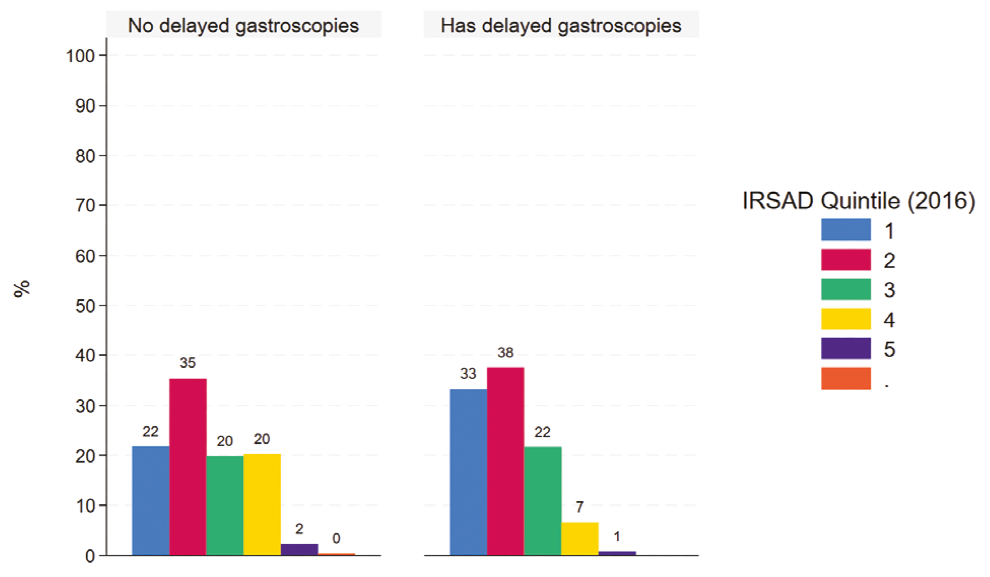
Delayed gastroscopies (at least once) patient demographics by IRSAD scores.
IRSAD: Index of relative socioeconomic advantage and disadvantage.
A comparison of patients who adhered to the Seattle biopsy protocol with those who did not adhere, showed that the non-adherent group included a higher proportion of female patients (36.0% vs. 24.6%, p=0.09) and patients requiring interpreter services (10.1% vs. 2.9%, p=0.06), however these findings were not statistically significant. The median number of endoscopies was 1.0 [interquartile range (IQR) 1.0, 2.0] in the adherence group, compared with 2.0 (IQR 1.0, 3.0, p=0.003) in the non-adherence group. The mean IRSAD score for the adherence group was 2.2, compared with 2.4 in the other group (p=0.32) ().
Table 3. Comparison of patients with non-adherence (at least once) to Seattle biopsy protocol
Variables | Adherence | Non-adherence | p-value |
|---|---|---|---|
- | 69 | 308 | - |
Age, median (IQR) | 61.0 (56.0, 68.0) (n=69) | 63.5 (53.0, 73.0) (n=308) | 0.63 |
Gender | - | - | 0.09 |
Male | 52 (75.4%) | 197 (64.0%) | - |
Female | 17 (24.6%) | 111 (36.0%) | - |
Born in Australia | - | - | 1.0 |
Australia | 33 (47.8%) | 162 (52.6%) | - |
Overseas | 20 (29.0%) | 98 (31.8%) | - |
Missing data | 16 (23.2%) | 48 (15.6%) | - |
Language | - | - | 0.20 |
English as first language | 65 (94.2%) | 273 (88.6%) | - |
English as second language | 4 (5.8%) | 35 (11.4%) | - |
Interpreter required | 2 (2.9%) | 31 (10.1%) | 0.06 |
IRSAD scores | - | - | 0.30 |
1 (Most disadvantaged) | 24 (34.8%) | 72 (23.4%) | - |
2 | 19 (27.5%) | 117 (38.0%) | - |
3 | 13 (18.8%) | 64 (20.8%) | - |
4 | 11 (15.9%) | 49 (15.9%) | - |
5 (Most advantaged) | 1 (1.4%) | 6 (1.9%) | - |
Missing data | 1 (1.4%) | 0 (0.0%) | - |
IRSAD, mean (SD) | 2.2 (1.1) (n=68) | 2.4 (1.1) (n=308) | 0.32 |
Cancer detection | 3 (4.3%) | 10 (3.2%) | 0.71 |
Number of endoscopies | 1.0 (1.0, 2.0) (n=69) | 2.0 (1.0, 3.0) (n=308) | 0.003 |
IRSAD: Index of relative socioeconomic advantage and disadvantage, SD: Standard deviation, IQR: Interquartile range.
Univariable linear regression analyses were conducted for two outcomes, i.e., delayed surveillance gastroscopy (at least once) and non-adherence to the Seattle biopsy protocol (at least once). Younger age (OR 0.98, p=0.017) and low IRSAD score (score =1, i.e., most disadvantaged region) (OR 1.79, p=0.013) were associated with delayed surveillance gastroscopies. In addition, the need for interpreter services had an OR of 3.7 (p=0.078), and gender (male) showed an OR of 0.58 (p=0.07) in predicting the outcome of non-adherence to Seattle biopsy protocol, however these results were not statistically significant. Lowest IRSAD score (score =1, i.e., most disadvantaged region) (OR 0.56, p=0.043) were negatively associated with non-adherence to the biopsy protocol. Number of gastroscopies was positively correlated with both outcomes (OR 2.7, p<0.001 for delayed gastroscopies, and OR 1.5, p=0.002 for non-adherence to Seattle biopsy protocol) ().
Table 4. Univariable logistic regression analysis of variables in predicting delayed gastroscopies and non-adherence to the Seattle biopsy protocol
Variables | Odds ratio | 95% CI | p-value |
|---|---|---|---|
For delayed gastroscopies | |||
Younger age | 0.98 | 0.96-1.00 | 0.017 |
Gender | - | - | - |
Female | 1.0 | - | - |
Male | 0.89 | 0.56-1.4 | 0.60 |
Country of birth | - | - | - |
Australia | 1.0 | - | - |
Overseas | 1.23 | 0.77-1.99 | 0.39 |
English as a second language | - | - | - |
No | 1.0 | - | - |
Yes | 1.08 | 0.53-2.18 | 0.83 |
Interpreter requirement | - | - | - |
No | 1.0 | - | - |
Yes | 1.4 | 0.69-3.0 | 0.34 |
IRSAD score data | 0.68 | 0.55-0.85 | 0.001 |
IRSAD score =1 (Most disadvantaged) | - | - | - |
No | 1.0 | - | - |
Yes | 1.79 | 1.1-2.87 | 0.013 |
IRSAD score =1 or 2 | - | - | - |
No | 1.0 | - | - |
Yes | 1.8 | 1.1-2.9 | 0.013 |
Number of gastroscopies | 2.7 | 2.2-3.4 | <0.001 |
For non-adherence to Seattle biopsy protocol | |||
Younger age | 1.0 | 0.99-1.02 | 0.68 |
Gender | - | - | - |
Female | 1.0 | - | - |
Male | 0.58 | 0.32-1.05 | 0.07 |
Country of birth | - | - | - |
Australia | 1.0 | - | - |
Overseas | 1.0 | 0.54-1.84 | 1.0 |
English as a second language | - | - | - |
No | 1.0 | - | - |
Yes | 2.08 | 0.72-6.07 | 0.18 |
Interpreter requirement | - | - | - |
No | 1.0 | - | - |
Yes | 3.7 | 0.86-15.8 | 0.078 |
IRSAD score | 1.1 | 0.89-1.5 | 0.32 |
IRSAD score =1 (Most disadvantaged) | - | - | - |
No | 1.0 | - | - |
Yes | 0.56 | 0.32-0.98 | 0.043 |
IRSAD score =1 or 2 | - | - | - |
No | 1.0 | - | - |
Yes | 0.92 | 0.54-1.6 | 0.77 |
Number of gastroscopies | 1.5 | 1.2-1.9 | 0.002 |
IRSAD: Index of relative socioeconomic advantage and disadvantage, CI: Confidence interval.
Multivariable logistic regression was used to examine the association of general and CALD-specific variables with two outcomes: delayed gastroscopies and non-adherence to the Seattle biopsy protocol. After adjustment for age, sex, number of gastroscopies, and interpreter requirement, socioeconomic disadvantage (IRSAD score of 1 or 2) was associated with higher odds of delayed gastroscopies (OR=2.0, 95% CI 1.1-3.5, p=0.021) and lower odds of non-adherence to the Seattle biopsy protocol (OR=0.45, 95% CI 0.25-0.82, p=0.009). Interpreter requirement was also associated with non-adherence to the Seattle biopsy protocol (OR=4.4, p=0.05), after adjustment for the other variables ().
Table 5. Multivariable logistic regression analysis of variables in predicting delayed gastroscopies and non-adherence to the Seattle biopsy protocol
Variables | Odds ratio | 95% CI | p-value |
|---|---|---|---|
For delayed gastroscopies | |||
Younger age | 0.96 | 0.94-0.99 | 0.001 |
Gender | - | - | - |
Female | 1.0 | - | - |
Male | 0.72 | 0.41-1.3 | 0.25 |
IRSAD score =1 or 2 | - | - | - |
No | 1.0 | - | - |
Yes | 2.0 | 1.1-3.5 | 0.021 |
Number of gastroscopies | 2.9 | 2.3-3.7 | <0.001 |
Interpreter requirement | - | - | - |
No | 1.0 | - | - |
Yes | 1.4 | 0.5-3.5 | 0.52 |
For non-adherence to Seattle biopsy protocol | |||
Younger age | 1.0 | 0.99-1.03 | 0.61 |
Gender | - | - | - |
Female | 1.0 | - | - |
Male | 0.63 | 0.34-1.2 | 0.13 |
IRSAD score =1 or 2 | - | - | - |
No | 1.0 | - | - |
Yes | 0.45 | 0.25-0.82 | 0.009 |
Number of gastroscopies | 1.5 | 1.2-1.9 | 0.002 |
Interpreter requirement | - | - | - |
No | 1.0 | - | - |
Yes | 4.4 | 1.0-19.8 | 0.05 |
IRSAD: Index of relative socioeconomic advantage and disadvantage, CI: Confidence interval.
DISCUSSION
The study highlights the present state of care delivery of BE surveillance within a CALD diverse region. The findings indicate a comparable patient engagement in BE surveillance among CALD population; however, with patients requiring interpreter services or needing more surveillance endoscopies falling behind in receiving the endoscopic biopsy treatment according to the Seattle protocol. Notably, more disadvantaged socioeconomic status, as measured by IRSAD scores and younger age were observed to be statistically associated with surveillance endoscopy delays.
Language barrier, health literacy, and accessibility to public healthcare are crucial determinants of hospital experiences and clinical outcomes for CALD patients (-). Numerous studies have reported significant delays in CALD patients’ engagement with health surveillance programs, or a reduced propensity to utilise health services (,-). The findings of this study reveal that 66.7% (26/39) of patients using English as a second language, 60.6% (20/33) of patients requiring interpreter services, and 61.9% (73/118) of overseas-born patients adhered to surveillance endoscopy frequency guidelines, representing a comparably outcome to other studies (ranging from 36-66%) (). This outcome could be attributable to the fact that interpreter service used in this study was appropriate, while previously recorded a higher coverage of approximately 88% for all clinic appointments, potentially mitigating communication barriers to a greater extent (). In addition, one contemporary study from the Netherlands also indicates that language proficiency among CALD patients is sometimes under-documented, with their results showing that 30% of patients who self-reported low proficiency in Dutch were recorded as having no language barrier in their health profile, and professional interpreters were hardly utilised ().
This study showed strong correlation between interpreter requirement and non-adherence to the Seattle biopsy protocol. The underlying reasons are complex and difficult to determine due to the absence of documented consent process, pre-procedure discussions, and inconsistencies between the endoscopists performing the procedure and the clinicians who initially consulted with the patients. Potential explanations encompass factors related to clinicians, patients and the healthcare facility itself. First of all, the availability of advanced imaging techniques, such as narrow band imaging, and variation in endoscopists’ preferences may contribute to inconsistencies in BE detection and adherence to biopsy protocol (,). While global economic modelling studies present conflicting findings regarding the cost-effectiveness of the current surveillance programs, particularly concerning short procedural intervals accompanied by low disease detection rates, there is more evidence that doctors tend to communicate less effectively with CALD patients and spend less time discussing intricate issues possibly because it is viewed as resource- and effort-demanding (-).
Moreover, the univariable linear regression analysis in this study revealed that the Australian socioeconomic status surrogate, an IRSAD score of 1, was positively associated (OR 1.79, p=0.013) with delayed gastroscopy but negatively associated (OR 0.56, p=0.043) with non-adherence to the Seattle biopsy protocol. Interpreter requirement was the only CALD prominent positive predictor (OR 4.4, p=0.05) of non-adherence to the biopsy protocol on the multivariable linear regression analysis. These findings provide insight into treatment patterns among the local metropolitan CALD patient cohort. While professional interpreters can facilitate communication, healthcare workers often overlook the significant impact of cultural and religious beliefs on a patients’ decision-making. For instance, in some cultures, mistrust of invasive procedures, preference for alternative medicine, or religious beliefs may influence attitudes towards medical interventions, leading to delays or avoidance of biopsies (). Health literacy, shaped by cultural background, also plays a crucial role in patients’ comprehension of the necessity for biopsies (). Despite the effort of the interpreter service, leading to comparable follow-up rates, healthcare organisations can implement additional strategies, such as face-to-face appointments, multiple clinic visits with interpreters, and support from surveillance nurses and family members during consultation, considering a single encounter may not be possible to adequately address all patient concerns. Furthermore, providing more linguistic and cultural training for doctors as well as increasing the diversity of the medical workforce, may improve patient-provider interactions, ensuring they are meaningful, comprehensive, and not time-constrained.
Study Limitations
Although the TALS may possess greater resources compared to similar departments elsewhere, this establishment was driven by substantial local demand (). Consequently, the findings of this study are likely more applicable to healthcare organisations serving larger CALD populations. Given the retrospective cohort design of this study, the data collection concerning the rationale behind the aforementioned clinical questions and decision-making was not feasible. To address this limitation, a prospective study design incorporating pre-decision-making questionnaires or interviews with both clinicians and patients throughout the surveillance program may mitigate participant-induced bias.
CONCLUSION
This study demonstrated that while interpreter services in a CALD region facilitate comparable overall engagement in the BE surveillance, disparities persist in adherence to the Seattle biopsy protocol. Future prospective studies should explore patients and clinician perspectives to address these nuanced differences and challenges.
Ethics
Ethics Committee Approval: As a result of the retrospective audit nature of this study, informed consent was deemed not required by the ethics committee. This study was approved by the Northern Health Quality Improvement/Audit process (ALR no. 34.2021; approval date: 25 May 2021).
Informed Consent: Given the retrospective audit nature of the study, informed consent was deemed not required.
Footnotes
Author Contributions
Concept - S.T., R.H.; Design - S.T., R.H.; Data Collection or Processing - S.T., Y.L., R.R.; Analysis or Interpretation - Y.L., R.H., M.S.; Literature Search - Y.L.; Writing - Y.L., J.B., R.H., M.S.
Conflict of Interest
No conflict of interest was declared by the authors.
Financial Disclosure
The authors declared that this study received no financial support.
References
Shaheen NJ, Richter JE. Barrett’s oesophagus. Lancet. 2009;373:850-861.
Ege B, Dinc T, Yildiz BD, Balci Z, Bozkaya H. Utility of endoscopy for diagnosis of Barrett in a non-Western society: endoscopic and histopathologic correlation. Int Surg. 2015;100:720-725.
Clark GW, Ireland AP, Peters JH, Chandrasoma P, DeMeester TR, Bremner CG. Short-segment Barrett’s esophagus: a prevalent complication of gastroesophageal reflux disease with malignant potential. J Gastrointest Surg. 1997;1:113-122.
Bayrakci B, Kasap E, Kitapcioglu G, Bor S. Low prevalence of erosive esophagitis and Barrett esophagus in a tertiary referral center in Turkey. Turk J Gastroenterol. 2008;19:145-151.
Schneider JL, Corley DA. A review of the epidemiology of Barrett’s oesophagus and oesophageal adenocarcinoma. Best Pract Res Clin Gastroenterol. 2015;29:29-39.
Whiteman DC, Appleyard M, Bahin FF, Bobryshev YV, Bourke MJ, Brown I, et al. Australian clinical practice guidelines for the diagnosis and management of Barrett’s esophagus and early esophageal adenocarcinoma. J Gastroenterol Hepatol. 2015;30:804-820.
Shaheen NJ, Falk GW, Iyer PG, Gerson LB; American College of Gastroenterology. ACG clinical guideline: diagnosis and management of Barrett’s esophagus. Am J Gastroenterol. 2016;111:30-50; quiz 51. Erratum in: Am J Gastroenterol. 2016;111:1077.
Lee SW, Lien HC, Chang CS, Lin MX, Chang CH, Ko CW. Benefits of the Seattle biopsy protocol in the diagnosis of Barrett’s esophagus in a Chinese population. World J Clin Cases. 2018;6:753-758.
Fitzgerald RC, di Pietro M, Ragunath K, Ang Y, Kang JY, Watson P, et al. British Society of Gastroenterology guidelines on the diagnosis and management of Barrett’s oesophagus. Gut. 2014;63:7-42.
American Gastroenterological Association; Spechler SJ, Sharma P, Souza RF, Inadomi JM, Shaheen NJ. American Gastroenterological Association medical position statement on the management of Barrett’s esophagus. Gastroenterology. 2011;140:1084-1091.
Ghuman S, Asghar K, Evans J, Kakhi S, Hawkes N. PTH-028 Real world surveillance of Barrett’s oesophagus – does it make a difference using the prague classification or following seattle biopsy protocol? Gut. 2015;64(Suppl 1):A418.1-A.
Abrams JA, Kapel RC, Lindberg GM, Saboorian MH, Genta RM, Neugut AI, et al. Adherence to biopsy guidelines for Barrett’s esophagus surveillance in the community setting in the United States. Clin Gastroenterol Hepatol. 2009;7:736-742; quiz 10.
Roumans CAM, van der Bogt RD, Steyerberg EW, Rizopoulos D, Lansdorp-Vogelaar I, Sharma P, et al. Adherence to recommendations of Barrett’s esophagus surveillance guidelines: a systematic review and meta-analysis. Endoscopy. 2020;52:17-28.
Goldsbury DE, Yap S, Weber MF, Veerman L, Rankin N, Banks E, et al. Health services costs for cancer care in Australia: estimates from the 45 and up study. PLoS One. 2018;13:e0201552.
Hodgson R, Albatat B, Tacey M, Zucchi E, Strugnell N, Lee B. An integrated interpreting service normalizes access to care for culturally and linguistically diverse (CALD) patients with colorectal cancer. Asia Pac J Clin Oncol. 2023;19:559-565.
Socio-economic indexes for Areas, Australia: Australian Bureau of Statistics. Available from: https://www.abs.gov.au/statistics/people/people-and-communities/socio-economic-indexes-areas-seifa-australia/2021.
Beagley J, Hlavac J, Zucchi E. Patient length of stay, patient readmission rates and the provision of professional interpreting services in healthcare in Australia. Health Soc Care Community. 2020;28:1643-1650.
Smith A, Agar M, Delaney G, Descallar J, Dobell-Brown K, Grand M, et al. Lower trial participation by culturally and linguistically diverse (CALD) cancer patients is largely due to language barriers. Asia Pac J Clin Oncol. 2018;14:52-60.
Soon PS, Ruban S, Mo HTJ, Lee R, Saliba L, Shah A, et al. Understanding patient choices regarding breast reconstruction after mastectomy for breast cancer. Support Care Cancer. 2019;27:2135-2142.
Diaz JA, Roberts MB, Goldman RE, Weitzen S, Eaton CB. Effect of language on colorectal cancer screening among Latinos and non-Latinos. Cancer Epidemiol Biomarkers Prev. 2008;17:2169-2173.
Mazza D, Lin X, Walter FM, Young JM, Barnes DJ, Mitchell PL, et al. Do ethnic patients report longer lung cancer intervals than Anglo-Australian patients?: Findings from a prospective, observational cohort study. Eur J Cancer Care (Engl). 2021;30:e13492.
Evans SM, Earnest A, Bower W, Senthuren M, McLaughlin P, Stirling R. Timeliness of lung cancer care in Victoria: a retrospective cohort study. Med J Aust. 2016;204:75.
Kang SY, Howard D, Kim J, Payne JS, Wilton L, Kim W, et al. English language proficiency and lifetime mental health service utilization in a national representative sample of Asian Americans in the USA. J Public Health (Oxf). 2010;32:431-439.
van Rosse F, de Bruijne M, Suurmond J, Essink-Bot ML, Wagner C. Language barriers and patient safety risks in hospital care. A mixed methods study. Int J Nurs Stud. 2016;54:45-53.
Zilberstein N, Godbee M, Mehta NA, Waxman I. Advanced endoscopic imaging for detection of Barrett’s esophagus. Clin Endosc. 2024;57:1-10.
ASGE Standards of Practice Committee; Qumseya B, Sultan S, Bain P, Jamil L, Jacobson B, et al.; ASGE Standards of Practice Committee Chair. ASGE guideline on screening and surveillance of Barrett’s esophagus. Gastrointest Endosc. 2019;90:335-359.e2.
Gordon LG, Eckermann S, Hirst NG, Watson DI, Mayne GC, Fahey P, et al. Healthcare resource use and medical costs for the management of oesophageal cancer. Br J Surg. 2011;98:1589-1598.
Gordon LG, Mayne GC, Hirst NG, Bright T, Whiteman DC; Australian Cancer Study Clinical Follow-Up Study; Watson DI. Cost-effectiveness of endoscopic surveillance of non-dysplastic Barrett’s esophagus. Gastrointest Endosc. 2014;79:242-256.e6.
Hirst NG, Gordon LG, Whiteman DC, Watson DI, Barendregt JJ. Is endoscopic surveillance for non-dysplastic Barrett’s esophagus cost-effective? Review of economic evaluations. J Gastroenterol Hepatol. 2011;26:247-254.
Butow P, Bell M, Goldstein D, Sze M, Aldridge L, Abdo S, et al. Grappling with cultural differences; communication between oncologists and immigrant cancer patients with and without interpreters. Patient Educ Couns. 2011;84:398-405.
Peters FP, Curvers WL, Rosmolen WD, de Vries CE, Ten Kate FJ, Krishnadath KK, et al. Surveillance history of endoscopically treated patients with early Barrett’s neoplasia: nonadherence to the Seattle biopsy protocol leads to sampling error. Dis Esophagus. 2008;21:475-479.
Hong YR, Tauscher J, Cardel M. Distrust in health care and cultural factors are associated with uptake of colorectal cancer screening in Hispanic and Asian Americans. Cancer. 2018;124:335-345.
McKinlay E, Graham S, Horrill P. Culturally and linguistically diverse patients’ views of multimorbidity and general practice care. J Prim Health Care. 2015;7:228-235.
Hlavac J GA, Orlando M, Zucchi E, Pappas A. Translation as a subset of public and social policy and a consequence of multiculturalism: the provision of translation and interpreting services in Australia. Int J Soc Lang. 2018;2018:55-88.