
Abstract
Objective: Proximal gastrectomy has traditionally been reserved for early proximal gastric adenocarcinoma, while total gastrectomy remains the standard approach for locally advanced disease. However, evidence regarding the oncological adequacy of proximal gastrectomy following neoadjuvant therapy remains limited. This study evaluated the long-term oncological outcomes of proximal gastrectomy in patients with locally advanced proximal gastric adenocarcinoma.
Material and Methods: A retrospective analysis was performed of patients with proximal gastric adenocarcinoma who underwent curative-intent proximal gastrectomy between 2008 and 2016 at a tertiary cancer centre. Patients were selected according to predefined institutional criteria following multidisciplinary tumour board discussion. Clinicopathological characteristics, neoadjuvant and adjuvant treatment details, postoperative outcomes, recurrence patterns, and long-term survival were analysed. Reconstruction was performed using conventional oesophagogastrostomy with a 25-mm circular stapler. Overall survival (OS) and recurrence-free survival (RFS) were estimated using the Kaplan-Meier method, and prognostic factors were identified using Cox proportional hazards regression analysis.
Results: Ninety-four patients were included, of whom 89.4% had node-positive disease and 89.4% received neoadjuvant chemotherapy. R0 resection was achieved in all patients, with a mean lymph node yield of 15. Major postoperative complications (Clavien-Dindo Grade IIIb) occurred in four patients (4.3%). The 3-, 5-, and 10-year OS rates were 55.3%, 40.1%, and 23.8%, respectively, while the 3- and 5-year RFS rates were 87.8% and 82.6%, respectively. On multivariable analysis, age ≥56 years [hazard ratio (HR) 6.43, 95% confidence interval (CI) 1.57-26.33; p=0.010] and major postoperative complications (HR 35.15, 95% CI 4.98-248.27; p<0.001) independently predicted inferior OS.
Conclusion: In carefully selected patients with locally advanced proximal gastric adenocarcinoma, proximal gastrectomy achieved acceptable long-term oncological outcomes following neoadjuvant therapy. Although these findings support the oncological feasibility of proximal gastrectomy in selected patients, prospective comparative studies incorporating functional outcomes are required before definitive comparisons with total gastrectomy can be made.
Keywords: Proximal gastrectomy, proximal gastric adenocarcinoma, neoadjuvant therapy, overall survival, recurrence-free survival
INTRODUCTION
Gastric adenocarcinoma remains a major global health burden and continues to be one of the leading causes of cancer-related mortality worldwide (). Proximal gastric adenocarcinomas, in particular, are frequently associated with advanced presentation, aggressive tumour biology, and poor long-term survival despite advances in multimodality treatment ().
Surgical resection remains the cornerstone of curative treatment for gastric adenocarcinoma. Traditionally, total gastrectomy with radical lymphadenectomy has been considered the standard surgical approach for proximal gastric adenocarcinoma because of concerns regarding oncological adequacy and locoregional recurrence (). However, proximal gastrectomy continues to be selectively performed in several East Asian centres, particularly in Japan and Korea, where favourable oncological outcomes have been reported in appropriately selected patients (,).
Most available literature evaluating proximal gastrectomy has focused predominantly on early-stage disease. Consequently, concerns remain regarding its oncological feasibility in patients with locally advanced proximal gastric adenocarcinoma, particularly in the contemporary era where neoadjuvant chemotherapy has become an integral component of multimodality treatment.
The present study aimed to evaluate the long-term oncological outcomes of proximal gastrectomy in a cohort predominantly comprising patients with locally advanced proximal gastric adenocarcinoma treated in the neoadjuvant era. Particular emphasis was placed on overall survival (OS), recurrence-free survival (RFS), recurrence patterns, lymph node yield, and the oncological adequacy of resection.
MATERIAL and METHODS
Study Design and Patient Selection
This retrospective single-centre study included consecutive patients with histologically confirmed proximal gastric adenocarcinoma who underwent curative-intent proximal gastrectomy at the Regional Cancer Centre, Thiruvananthapuram, India, between January 2008 and December 2016. Institutional Ethics Committee of Regional Cancer Centre, Thiruvananthapuram Medical College Campus (date: 29.09.2022, SRC number: 9/2022/10) approval was obtained before commencement of the study.
Patients with true proximal gastric adenocarcinoma and Siewert type III adenocarcinoma of the oesophagogastric junction who were considered suitable for proximal gastrectomy were included. Selection for proximal gastrectomy was based on multidisciplinary tumour board recommendations and institutional surgical protocol. Proximal gastrectomy was selected instead of total gastrectomy when the tumour was confined to the proximal one-third of the stomach, an R0 resection with an adequate distal gastric remnant was considered feasible, and there was no significant preoperative involvement of distal perigastric lymph node stations 5 or 6. Proximal gastrectomy was considered in patients with tumours confined to the proximal one-third of the stomach, where an R0 resection with an adequate distal gastric remnant was considered feasible. Patients with radiological evidence of significant distal perigastric lymph node involvement (stations 5 and 6), diffuse gastric involvement, distant metastasis, or those requiring palliative surgery were not considered candidates for proximal gastrectomy. Patients with incomplete clinicopathological records or non-curative (R1/R2) resections were excluded from the analysis.
Data Collection
Clinicopathological variables including age, sex, smoking history, tumour location, Siewert classification, pathological stage, lymphovascular invasion (LVI), perineural invasion (PNI), neoadjuvant and adjuvant treatment details, postoperative complications, recurrence patterns, and survival outcomes were retrieved from institutional records. Pathological staging was performed according to the American Joint Committee on Cancer (AJCC) 7th edition tumor, node, metastasis staging system used during the study period. Because the cohort spanned 2008-2016, the original stage documented in the institutional records was retained for analysis and patients were not retrospectively restaged according to the AJCC 8th edition.
Treatment Details
Treatment decisions were made following multidisciplinary tumour board discussion. Neoadjuvant chemotherapy was administered according to prevailing institutional protocols during the study period, with the majority of patients receiving EOX-based chemotherapy, while a smaller proportion received CAPEOX or other regimens. Adjuvant systemic therapy was administered based on final histopathology and multidisciplinary recommendations.
All patients underwent radical proximal gastrectomy with curative intent. Standard lymphadenectomy included stations 1, 2, 3a, 4sa, 4sb, 7, 8a, 9, 11p, and 11d. Lower mediastinal lymph node dissection (stations 19, 20, and 110) was performed in patients with >3 cm oesophageal extension. Intraoperative frozen-section assessment of the proximal resection margin was performed routinely. Patients with a positive proximal margin on the frozen section underwent conversion to Ivor Lewis oesophagogastrectomy to achieve an R0 resection and were therefore excluded from the present study. Reconstruction following proximal gastrectomy was performed using conventional oesophagogastrostomy with a 25-mm circular stapler (CDH-25).
Follow-up
Patients were followed according to institutional surveillance protocols with regular outpatient visits. Follow-up included clinical evaluation, contrast-enhanced computed tomography of the thorax, abdomen and pelvis (CECT TAP), and upper gastrointestinal endoscopy at scheduled intervals or whenever recurrence was clinically suspected. OS was calculated from the date of surgery to death from any cause or last follow-up. RFS was calculated from the date of surgery to the first documented recurrence or last follow-up.
Statistical Analysis
Continuous variables were summarised as mean ± standard deviation or median (interquartile range), as appropriate. Categorical variables were expressed as frequencies and percentages. OS and RFS were estimated using the Kaplan-Meier method and compared using the log-rank test. Variables associated with survival on univariable analysis were entered into multivariable Cox proportional hazards regression to identify independent prognostic factors. Hazard ratios (HRs) with 95% confidence intervals (CIs) were calculated. A two-sided p-value <0.05 was considered statistically significant. Statistical analyses were performed using IBM SPSS Statistics version 25.0.
RESULTS
Baseline Demographic and Clinicopathological Characteristics
A total of 94 patients with proximal gastric adenocarcinoma who underwent curative-intent proximal gastrectomy were included in the final analysis. The cohort comprised 80 males (85.1%) and 14 females (14.9%), with a median age of 56 years. Forty-six patients (48.9%) were aged <56 years, while 48 patients (51.1%) were aged ≥56 years. A history of smoking was present in 42 patients (44.7%).
The majority of patients presented with locally advanced disease. Pathological T stage distribution was T2 in 10 patients (10.6%), T3 in 58 (61.7%), and T4 in 26 (27.7%). Node-positive disease was identified in 84 patients (89.4%). LVI and PNI were observed in 6 (6.4%) and 16 (17.0%) patients, respectively. The baseline demographic and clinicopathological characteristics are summarised in .
Table 1. Baseline demographic and clinicopathological characteristics
Variable | Value |
|---|---|
Total patients | 94 |
Male | 80 (85.1%) |
Female | 14 (14.9%) |
Median age | 56 years |
Smoking history | 42 (44.7%) |
LVI positive | 6 (6.4%) |
PNI positive | 16 (17.0%) |
T2 disease | 10 (10.6%) |
T3 disease | 58 (61.7%) |
T4 disease | 26 (27.7%) |
Node positive disease | 84 (89.4%) |
LVI: Lymphovascular invasion, PNI: Perineural invasion.
Treatment and Operative Characteristics
Neoadjuvant chemotherapy was administered to 84 patients (89.4%) before surgery. EOX was the predominant regimen, followed by CAPEOX and cisplatin-etoposide-based chemotherapy. Adjuvant systemic therapy was also administered to 84 patients (89.4%). The distribution of neoadjuvant and adjuvant treatment regimens is summarised in .
Table 2. Treatment, operative and postoperative characteristics
Variable | n (%) |
|---|---|
Neoadjuvant chemotherapy | 84 (89.4) |
• EOX | 74 |
• CAPEOX | 6 |
• Cisplatin-etoposide | 2 |
• Chemotherapy deferred | 2 |
Adjuvant therapy | 84 (89.4) |
Reconstruction | Conventional oesophagogastrostomy (CDH-25) |
R0 resection | 94 (100) |
Mean lymph node yield | 15 |
Clavien-Dindo Grade I | 46 |
Grade II | 44 |
Grade IIIb | 4 |
CDH-25: Conventional oesophagogastrostomy with a 25-mm circular stapler.
All patients underwent radical proximal gastrectomy with curative intent. CDH-25 was performed in all patients. Standard lymphadenectomy was undertaken in accordance with institutional protocol, with a mean lymph node yield of 15. An R0 resection was achieved in all patients.
Postoperative Outcomes
Postoperative complications were graded according to the Clavien-Dindo classification. Grade I complications occurred in 46 patients (48.9%), Grade II complications in 44 (46.8%), and major complications (Grade IIIb) in 4 patients (4.3%). Grade IIIb complications comprised two anastomotic leaks and two cases of surgical site infection with burst abdomen requiring reoperation.
Survival Outcomes
At the time of analysis, 42 patients (44.7%) had died, while 52 patients (55.3%) remained alive. The estimated 3-year, 5-year, and 10-year OS rates were 55.3%, 40.1%, and 23.8%, respectively. The corresponding 3-year and 5-year RFS rates were 87.8% and 82.6%, respectively. Kaplan-Meier survival curves for OS and RFS are presented in and .
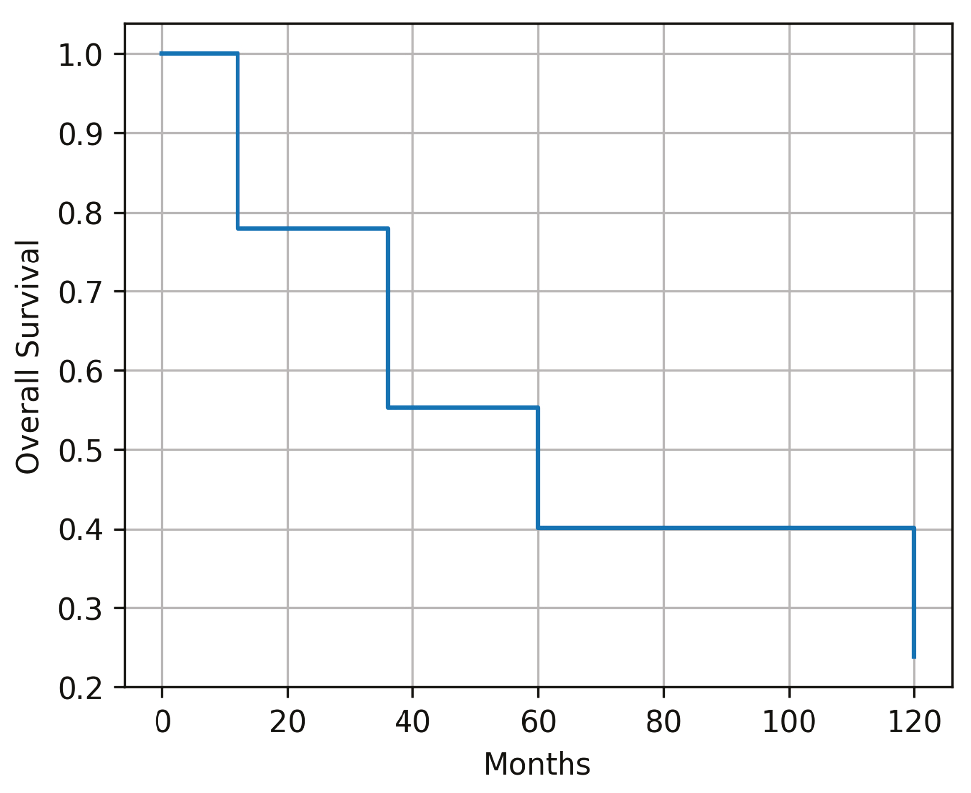
Kaplan-Meier overall survival curve for the entire cohort.
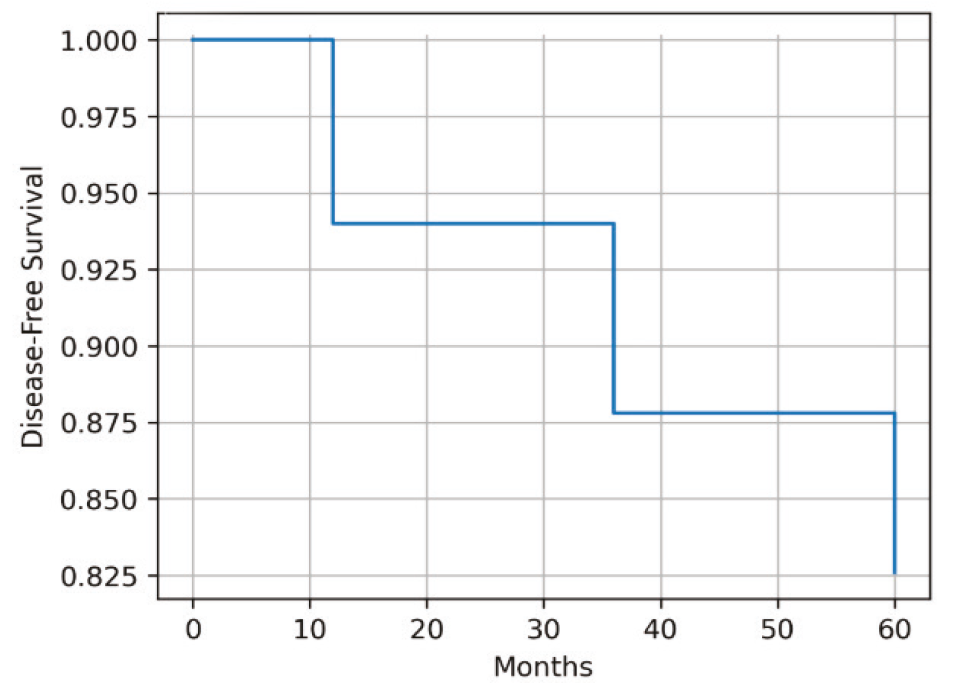
Kaplan-Meier recurrence-free survival curve for the entire cohort.
Comparative Survival Analysis
Patients aged <56 years demonstrated significantly superior OS compared with those aged ≥56 years (3-year OS: 73.9% vs. 37.5%; p=0.009). Patients who developed major postoperative complications had significantly poorer survival outcomes than those without major complications (p=0.020).
Pathological T stage significantly influenced OS (p<0.001). The 3-year OS rates were 80.0% for T2 disease, 72.4% for T3 disease, and 41.7% for T4 disease. Although node-negative patients demonstrated better survival than node-positive patients (80.0% vs. 61.7%), this difference did not reach statistical significance (p=0.557). No significant association with OS was observed for sex, smoking history, neoadjuvant therapy, adjuvant therapy, LVI, or PNI.
Disease Recurrence
Disease recurrence was documented in 10 patients (10.6%). Peritoneal recurrence was the predominant pattern, occurring either as isolated peritoneal disease or in association with liver metastasis. Other sites of recurrence included the oesophagus, left axillary lymph nodes, pleura, brain with rib metastasis, and supraclavicular/mediastinal/retroperitoneal lymph nodes. The recurrence patterns are summarised in .
Table 3. Patterns of recurrence
Site | n |
|---|---|
Peritoneum | 6 |
Oesophagus | 1 |
Pleura | 1 |
Brain + rib | 1 |
Axillary node | 1 |
Supraclavicular/mediastinal/RP nodes | 1 |
Liver (with peritoneum) | 1 |
Some patients developed recurrence at more than one site; therefore totals exceed the number of patients with recurrence.
Cox Proportional Hazards Analysis
Comparative survival analyses according to clinicopathological variables are summarised in . On multivariable Cox proportional hazards regression analysis, age ≥56 years (HR 6.43, 95% CI 1.57-26.33; p=0.010) and major postoperative complications (HR 35.15, 95% CI 4.98-248.27; p<0.001) were identified as independent predictors of inferior OS. The results of the multivariable analysis are presented in and .
Table 4. Univariate analysis of factors associated with 3-year overall survival
Variable | 3-year overall survival (%) | p-value |
|---|---|---|
Age | ||
<56 years | 73.9 | - |
≥56 years | 37.5 | 0.009 |
Pathological T stage | ||
T2 | 80.0 | - |
T3 | 72.4 | - |
T4 | 41.7 | <0.001 |
Pathological nodal status | ||
N0 | 80.0 | - |
N+ | 61.7 | 0.557 |
Major postoperative complications (Clavien-Dindo Grade IIIb) | ||
Absent | 66.7 | - |
Present | 0 | 0.020 |
Table 5. Multivariable cox proportional hazards regression analysis for overall survival
Variable | HR | 95% CI | p-value |
Age ≥56 years | 6.43 | 1.57-26.33 | 0.01 |
Major postoperative complications | 35.15 | 4.98-248.27 | <0.001 |
Variables entered into the multivariable model included age, pathological T stage, pathological nodal status, lymphovascular invasion, perineural invasion, and major postoperative complications. Variables with p<0.10 on univariate analysis were considered for multivariable Cox regression. CI: Confidence interval.
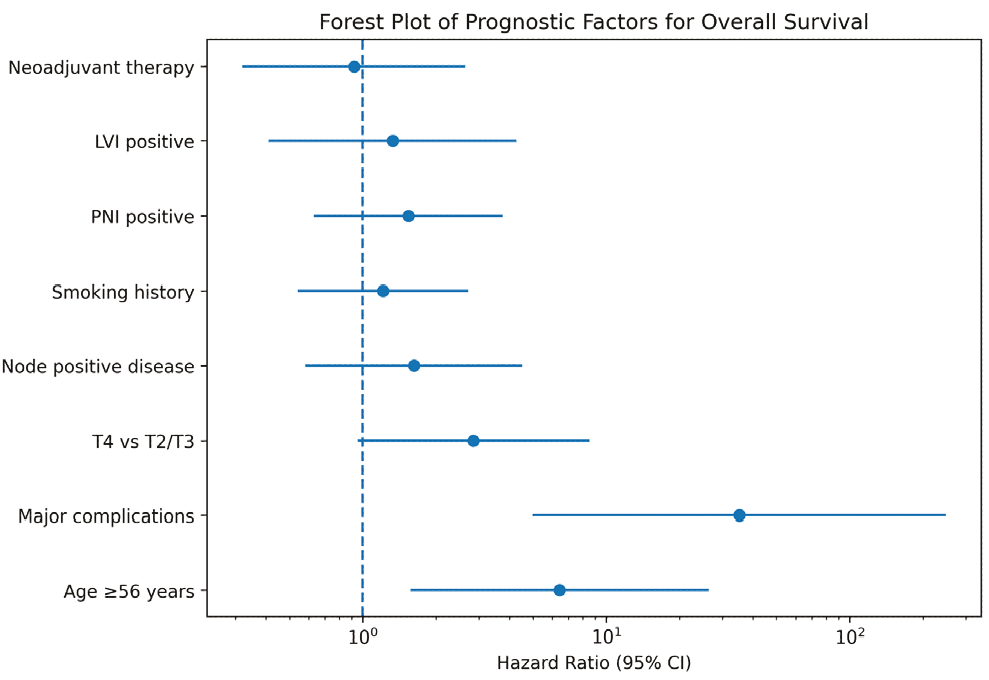
Forest plot of multivariable Cox proportional hazards regression for overall survival.
CI: Confidence interval, LVI: Lymphovascular invasion, PNI: Perineural invasion.
DISCUSSION
The present study demonstrates that proximal gastrectomy achieved acceptable long-term oncological outcomes in a carefully selected cohort of patients with predominantly locally advanced proximal gastric adenocarcinoma treated in the neoadjuvant era. To our knowledge, this represents one of the largest single-centre Indian experiences reporting long-term outcomes following proximal gastrectomy in locally advanced disease, with survival data extending to 10 years.
Nearly 90% of patients in the present cohort had locally advanced disease and received neoadjuvant chemotherapy before surgery. Despite the advanced disease profile, all patients underwent curative (R0) resection following meticulous patient selection, routine intraoperative frozen-section assessment of the proximal resection margin, and standardized lymphadenectomy. CDH-25 was performed in all patients. These findings suggest that, in carefully selected patients, proximal gastrectomy can achieve satisfactory oncological clearance without compromising the principles of radical cancer surgery.
Total gastrectomy has traditionally been regarded as the standard surgical treatment for proximal gastric adenocarcinoma because of concerns regarding adequate resection margins, lymph node clearance, and locoregional recurrence (,). However, proximal gastrectomy continues to be selectively employed in specialised centres, particularly in East Asia, where favourable oncological outcomes have been reported in appropriately selected patients (,). Most published evidence, however, is derived from early gastric cancer, and data evaluating proximal gastrectomy following neoadjuvant therapy for locally advanced disease remain limited. Our findings therefore contribute valuable real-world evidence from a high-volume tertiary cancer centre in India.
The survival outcomes observed in the present study are encouraging considering the advanced stage distribution of the cohort. The 5-year and 10-year OS rates were 40.1% and 23.8%, respectively, which compare favourably with previously reported outcomes for patients with locally advanced gastric cancer undergoing multimodality treatment (,). Rather than demonstrating superiority over total gastrectomy, these findings indicate that proximal gastrectomy can provide favourable long-term oncological outcomes in carefully selected patients when appropriate oncological principles are maintained.
The 5-year RFS of 82.6% further supports the oncological feasibility of this approach. Disease recurrence occurred in only 10 patients, with peritoneal dissemination representing the predominant pattern of failure. This observation is biologically plausible given the established frequency and adverse prognosis of peritoneal carcinomatosis in gastric cancer ().
Pathological T stage significantly influenced survival, with progressively poorer outcomes observed in patients with T4 disease. This finding is consistent with previous reports identifying tumour depth as one of the strongest prognostic determinants following curative gastrectomy (,). Nevertheless, acceptable long-term survival was achieved even in this predominantly locally advanced cohort, supporting the role of proximal gastrectomy in carefully selected patients following multidisciplinary evaluation.
Although node-negative patients demonstrated superior survival, nodal status did not achieve statistical significance in multivariable analysis. This finding should be interpreted cautiously. The relatively small number of node-negative patients and the predominance of node-positive disease reduced the statistical power to detect differences between groups. In addition, the widespread use of neoadjuvant chemotherapy may have resulted in nodal downstaging, thereby attenuating the prognostic impact of pathological nodal status within this cohort.
Increasing age independently predicted inferior OS. This observation is consistent with previous studies demonstrating poorer long-term outcomes among elderly patients because of reduced physiological reserve, greater comorbidity burden, and reduced tolerance to multimodality treatment ().
Major postoperative complications also independently predicted inferior OS. Patients experiencing Clavien-Dindo Grade IIIb complications had substantially poorer long-term outcomes, emphasising the importance of meticulous perioperative care and complication prevention. Major postoperative morbidity may adversely influence oncological outcomes through delayed recovery, prolonged systemic inflammation, impaired nutritional status, and delayed or incomplete delivery of adjuvant therapy (). The wide CI observed for major postoperative complications likely reflects the small number of patients experiencing Grade IIIb complications and should therefore be interpreted with caution.
One notable observation in the present study was the difference between RFS and OS. Although the 5-year RFS was 82.6%, OS at the same time point was 40.1%. Because cause-specific mortality data were not consistently available in this retrospective cohort, the exact causes of death could not be reliably determined. Nevertheless, the independent adverse effects of increasing age and major postoperative complications suggest that non-cancer-related mortality may have contributed to this difference and should be considered when interpreting the survival outcomes.
The mean lymph node yield in the present study was 15, which is marginally below the currently recommended benchmark for pathological staging. Although a standard D2 lymphadenectomy was routinely performed according to institutional protocol, this relatively lower nodal yield should be acknowledged as a limitation because it may have introduced the possibility of stage migration. Accordingly, the oncological adequacy of proximal gastrectomy should be interpreted in the context of careful patient selection and multidisciplinary management rather than lymph node yield alone. Although the present cohort was analysed using the AJCC 7th edition staging system recorded during the study period, the AJCC 8th edition provides the contemporary framework for gastric cancer staging and prognostic interpretation ().
Study Limitations
The present study has several limitations. Its retrospective, single-centre design introduces the potential for selection bias. The absence of a contemporaneous total gastrectomy comparator precludes direct comparison between the two surgical approaches, and therefore no conclusions regarding oncological equivalence can be drawn. Furthermore, postoperative functional and nutritional outcomes, including reflux symptoms, anastomotic stricture, body weight, and quality-of-life measures, were not evaluated and represent important areas for future investigation.
Despite these limitations, the present study provides valuable long-term real-world evidence supporting the use of proximal gastrectomy in a selected cohort with locally advanced proximal gastric adenocarcinoma treated in the neoadjuvant era. Prospective multicentre studies incorporating functional outcomes and comparative analyses with total gastrectomy are warranted to further define the role of proximal gastrectomy in contemporary gastric cancer management.
CONCLUSION
Proximal gastrectomy achieved favourable long-term oncological outcomes in appropriately selected patients with locally advanced proximal gastric adenocarcinoma treated in the neoadjuvant era. Although direct comparison with total gastrectomy cannot be made from the present retrospective study, these findings support proximal gastrectomy as a reasonable organ-preserving surgical option in selected patients. Prospective multicentre comparative studies incorporating functional and nutritional outcomes are warranted.
Ethics
Ethics Committee Approval: Institutional Ethics Committee of Regional Cancer Centre, Thiruvananthapuram Medical College Campus (date: 29.09.2022, SRC number: 9/2022/10) approval was obtained before commencement of the study.
Informed Consent: The requirement for informed consent was waived by the Institutional Ethics Committee owing to the retrospective nature of the study.
For transparency, the authors note that an artificial intelligence-assisted language model (ChatGPT, OpenAI) was utilized to support language correction. This assistance was limited to linguistic refinement; all scientific content, critical analysis, and final editorial decisions were made exclusively by the authors.
Footnotes
Author Contributions
Surgical and Medical Practices - M.M., M.W., J.H.M.S.; Concept - M.M., J.H.M.S.; Design - A.S., J.H.M.S.; Data Collection or Processing - J.H.M.S.; Analysis or Interpretation - M.W., J.H.M.S.; Literature Search - A.S., J.H.M.S.; Writing - M.M., J.H.M.S.
Conflict of Interest
No conflict of interest was declared by the authors.
Financial Disclosure
The authors declared that this study received no financial support.
References
Sung H, Ferlay J, Siegel RL, Laversanne M, Soerjomataram I, Jemal A, et al. Global cancer statistics 2020: GLOBOCAN estimates of incidence and mortality worldwide for 36 cancers in 185 countries. CA Cancer J Clin. 2021;71:209-249.
Ajani JA, D’Amico TA, Bentrem DJ, Chao J, Cooke D, Corvera C, et al. Gastric cancer, version 2.2022, NCCN clinical practice guidelines in oncology. J Natl Compr Canc Netw. 2022;20:167-192.
Japanese Gastric Cancer Association. Japanese gastric cancer treatment guidelines 2021 (6th edition). Gastric Cancer. 2023;26:1-25.
Katai H, Morita S, Saka M, Taniguchi H, Fukagawa T. Long-term outcome after proximal gastrectomy with jejunal interposition for suspected early cancer in the upper third of the stomach. Br J Surg. 2010;97:558-562.
Hwang SH, Park DJ, Kim HH, et al. Short-term outcomes of laparoscopic proximal gastrectomy with double-tract reconstruction versus laparoscopic total gastrectomy for upper early gastric cancer: a KLASS-05 randomized clinical trial. J Gastric Cancer. 2022;22:94-106.
Bang YJ, Kim YW, Yang HK, Chung HC, Park YK, Lee KH, et al. Adjuvant capecitabine and oxaliplatin for gastric cancer after D2 gastrectomy (CLASSIC): a phase 3 open-label, randomised controlled trial. Lancet. 2012;379:315-321.
Thomassen I, van Gestel YR, van Ramshorst B, Luyer MD, Bosscha K, Nienhuijs SW, et al. Peritoneal carcinomatosis of gastric origin: a population-based study on incidence, survival and risk factors. Int J Cancer. 2014;134:622-628.
Edge SB, Byrd DR, Compton CC, Fritz AG, Greene FL, Trotti A, editors. AJCC cancer staging manual. 7th ed. New York: Springer; 2010.
Saito H, Osaki T, Murakami D, Sakamoto T, Kanaji S, Tatebe S, et al. Effect of age on prognosis in patients with gastric cancer. ANZ J Surg. 2006;76:458-461.
Clavien PA, Barkun J, de Oliveira ML, Vauthey JN, Dindo D, Schulick RD, et al. The Clavien-Dindo classification of surgical complications: five-year experience. Ann Surg. 2009;250:187-196.
Amin MB, Edge SB, Greene FL, Byrd DR, Brookland RK, Washington MK, et al. editors. AJCC Cancer staging manual. 8th ed. New York: Springer; 2017.