
Abstract
Objective: To compare 6 month recurrence and selected clinical outcomes after marsupialization and silver nitrate application in women treated for symptomatic Bartholin gland cysts or abscesses.
Material and Methods: This multicenter retrospective cohort study included women treated between September 2022 and September 2025. Only patients with complete 6 month follow-up data were included in the final analysis. The primary outcome was recurrence of cyst or abscess within 6 months. Secondary outcomes included procedure duration, anesthesia type, early postoperative findings, return to daily activity, epithelial healing time, visible scar formation, dyspareunia among sexually active women, persistent or recurrent vulvar pain, need for repeat intervention, late secondary infection, and readmission. Recurrence was additionally evaluated using Kaplan-Meier analysis with log-rank testing and univariable Cox regression, and multivariable logistic regression was used for recurrence and visible scar formation.
Results: Three hundred forty-two patients were analyzed, including 189 in the marsupialization group and 153 in the silver nitrate group. Recurrence within 6 months occurred in 29/189 patients (15.3%) after marsupialization and 19/153 patients (12.4%) after silver nitrate application, with no statistically significant difference [relative risk (RR) 0.81, 95% confidence interval (CI) 0.47-1.39; p=0.439]. Kaplan-Meier analysis showed no significant difference in 6 month recurrence-free survival (84.7% vs. 87.6%; log-rank p=0.426; hazard ratio 0.79, 95% CI 0.44-1.41), and the adjusted treatment effect remained non-significant [adjusted odds ratio (aOR) 0.81, 95% CI 0.42-1.55; p=0.521]. Silver nitrate application was associated with shorter procedure duration (12.7±5.6 vs. 20.4±6.9 minutes; mean difference -7.70 minutes, 95% CI -9.03 to -6.37; p<0.001), a 1-day shorter median time to return to daily activity, and shorter epithelial healing time (15.3±5.9 vs. 17.2±6.2 days; mean difference -1.90 days, 95% CI -3.19 to -0.61; p=0.004). Visible scar formation was less frequently documented after silver nitrate application (8.5% vs. 17.5%; RR 0.49, 95% CI 0.27-0.89; p=0.016) and remained lower after adjustment (aOR 0.43, 95% CI 0.22-0.86; p=0.017), although this secondary finding was exploratory. Chemical mucosal irritation or superficial burn occurred only in the silver nitrate group (10/153, 6.5%; 95% CI 3.2-11.7). Dyspareunia, persistent vulvar pain, repeat intervention, late infection, and readmission showed no statistically significant between-group differences.
Conclusion: Silver nitrate application and marsupialization showed no statistically significant difference in 6 month recurrence. Silver nitrate was associated with shorter procedure duration and modestly shorter recovery measures; the lower documented scar rate should be interpreted as exploratory, but local chemical irritation remains a relevant limitation.
Keywords: Bartholin’s glands, cysts, abscess, marsupialization, silver nitrate, treatment outcome
INTRODUCTION
Bartholin gland cysts and abscesses are familiar problems in everyday gynecologic practice, yet they are often more troublesome for the patient than their benign nature might suggest. The Bartholin glands are small mucus-secreting glands located bilaterally in the posterior vestibule, classically opening at the 4 and 8 o’clock positions near the hymenal ring. In the absence of disease they are usually not visible or palpable. When the duct becomes obstructed by local inflammation, edema, trauma, or scarring, retained mucus may gradually form a cyst. If the retained fluid becomes infected, the same process may evolve into a painful abscess. Recent reviews continue to describe this condition as predominantly affecting women in the reproductive years, with an estimated lifetime occurrence of approximately 2% and a reported frequency of acute abscess in the range of 1-3% of women (-).
The clinical presentation is highly variable. A small cyst may be noticed only as a painless unilateral swelling, whereas an abscess can produce severe vulvar pain, erythema, tenderness, fever, difficulty sitting or walking, and dyspareunia. The microbiology is usually polymicrobial and reflects the vaginal and perineal flora; Escherichia coli, Staphylococcus aureus, anaerobes, and, less frequently, sexually transmitted pathogens may be isolated (,). Because many patients are young and sexually active, treatment should not be judged solely by immediate drainage. A durable result also requires attention to recurrence, healing time, scarring, pain during intercourse, and the likelihood of needing another procedure.
In practice, management is shaped by the size and character of the lesion, the presence of acute infection, recurrence history, patient preference, local resources, and the type of anesthesia available (). A French national survey of university hospitals demonstrated marked variation in surgical practice, with incision and drainage, marsupialization, and gland excision remaining among the best-known techniques (). This variability mirrors the uncertainty in the literature. Simple incision and drainage can rapidly relieve pressure in an acutely painful abscess, but it does not maintain a new drainage pathway and is therefore vulnerable to reclosure of the duct. For this reason, gland-preserving procedures include marsupialization, Word catheter placement, silver nitrate application, alcohol sclerotherapy, and carbon dioxide laser treatment (). Marsupialization is one of the most established options. After opening and draining the cyst or abscess cavity, the cyst wall is sutured to the vestibular mucosa to create a permanent epithelialized opening. The technique is familiar, inexpensive, and widely available, and it is often preferred for recurrent or large symptomatic lesions. However, it is not a perfect solution. It may require regional or general anesthesia in some settings, takes longer than very simple drainage procedures, and can be followed by postoperative discharge, local discomfort, visible scar formation, or dyspareunia. In the WoMan randomized trial, marsupialization and Word catheter treatment produced comparable recurrence rates (), while later retrospective and meta-analytic data also failed to establish a consistent advantage of one method over the other ().
Silver nitrate application offers a different logic. Instead of suturing the cyst wall to the mucosa, the cavity is chemically cauterized after drainage, allowing collapse of the epithelial lining and secondary healing. The procedure is technically simple, inexpensive, and suitable for outpatient or short-stay conditions when reliable return for the scheduled 48-hour pack removal is feasible. Its appeal is particularly clear in busy clinics where operating room access is limited and in patients for whom a shorter procedure is desirable. Recent office-based data have suggested that silver nitrate may be associated with lower recurrence than simple incision and drainage and may be useful especially in recurrent cases, although local chemical irritation, mucosal burns, and short-term edema remain relevant concerns (). The increasing emphasis on patient-centered outcomes is important in this field. For a benign vulvar condition, an apparently small difference in scar formation, persistent pain, or dyspareunia may matter as much to the patient as recurrence itself. Randomized evidence comparing marsupialization with gland excision showed that sexual function can improve after treatment but also highlighted the need to consider dyspareunia and postoperative comfort rather than recurrence alone (). Similarly, studies evaluating CO2 laser treatment have used validated sexual-function instruments, reflecting a broader shift from purely technical success toward functional and cosmetic recovery (). Despite many available techniques, there is still no universally accepted first-line procedure for symptomatic Bartholin gland cysts and abscesses. A recent systematic review of randomized trials concluded that existing evidence does not support the superiority of any single surgical intervention (), and a 2024 meta-analysis similarly found no clear recurrence advantage when comparing Word catheter placement with marsupialization (). Direct randomized evidence comparing marsupialization with silver nitrate has previously been reported by Ozdegirmenci et al. (), while earlier randomized work also evaluated intracavitary silver nitrate against gland excision (). However, contemporary multicenter real-world evidence directly comparing silver nitrate with marsupialization remains sparse. Accordingly, the present study was designed as a multicenter real-world replication and extension of the earlier randomized comparison, evaluating recurrence within six months as the primary endpoint together with procedural and patient-centered secondary outcomes.
MATERIAL and METHODS
Patients and Study Design
This multicenter retrospective observational study was conducted in three hospitals and included women treated for symptomatic Bartholin gland cyst or abscess between September 2022 and September 2025. The study was reported in accordance with the STROBE recommendations for observational studies.. Ethical approval was obtained from the relevant Institutional Clinical Research Ethics Committee of University of Health Sciences Türkiye, Gazi Yaşargil Training and Research Hospital (date: 24.04.2026, decision no: 159). Because the study used data recorded during routine care, no additional intervention was performed for research purposes. The requirement for written informed consent was waived due to the retrospective design of the study and the use of anonymized routine clinical data. Eligibility was restricted to women aged 18-40 years to define an adult reproductive-age cohort; patients outside this age range were excluded during initial screening.
Hospital records from the three participating centers were screened for eligible patients. Women who underwent marsupialization or silver nitrate application for a symptomatic, clinically diagnosed Bartholin gland cyst or abscess were considered for inclusion. Diagnosis was based on clinical examination and was supported by ultrasonography when clinically indicated. Patients were excluded before treatment allocation if the diagnosis or preprocedural information was insufficient. In both treatment groups, a small biopsy specimen obtained from the cyst or abscess wall during the procedure was routinely submitted for histopathological examination. Patients without complete 6 month follow-up data were not included in the complete-case analysis. Overall, 471 patients were assessed for eligibility. Fifty-one patients were excluded before treatment allocation, including 3 patients younger than 18 years, 11 patients older than 40 years, and 37 patients with insufficient diagnostic or preprocedural information. A total of 420 remained after screening. The initial treatment groups included 233 patients treated with marsupialization and 187 treated with silver nitrate application. After excluding patients with incomplete 6 month follow-up data, final analyses included 189 and 153 patients, respectively.
Surgical Procedures
Treatment choice was made during routine clinical care, considering the size and character of the lesion, pain severity, inflammatory findings, patient preference, and the usual practice of the treating center. All procedures were performed under sterile conditions. The type of anesthesia was selected individually according to lesion size, pain severity, inflammatory findings, patient tolerance, and procedural difficulty; local anesthesia or sedation/analgesia was used according to clinical need. After vulvar antisepsis, the incision was placed on the vestibular mucosa close to the hymenal ring to avoid a visible scar on the external labial skin. The cyst or abscess cavity was opened, completely drained, and gently irrigated with sterile saline. Bleeding points, when present, were controlled with compression or limited hemostatic suturing. For histopathological examination, a small biopsy specimen was obtained from the incised or everted cyst or abscess wall during marsupialization and from the cavity wall immediately before placement of the silver nitrate pack in the silver nitrate group; all specimens were submitted to the pathology laboratory.
In the marsupialization group, the mucosal opening was enlarged to approximately 1.5-2 cm after drainage. The wall of the cyst or abscess cavity was everted and fixed to the adjacent vestibular mucosa with interrupted absorbable sutures, leaving a wide drainage opening to reduce the risk of early closure.
In the silver nitrate group, after drainage and irrigation, an approximately 0.5-cm segment of a commercially available solid silver nitrate pencil (AQUA Medical, Türkiye) was used. The approximately 0.5-cm segment length was verified by re-examining a contemporaneous procedural photograph taken during the study period, which documented the prepared silver nitrate-gauze pack beside a metric scale. The segment was enclosed within the distal end of a small sterile gauze strip, leaving a gauze tail for later removal, and the prepared pack was gently placed into the Bartholin gland cavity. Care was taken to keep the silver nitrate within the cavity and to avoid direct contact with the surrounding vestibular mucosa. The pack was removed after 48 hours, and the cavity was inspected for residual collection, bleeding, mucosal irritation, or superficial burn. No procedure-specific 48-hour visit was routinely scheduled after marsupialization. Postoperative analgesics, antibiotics, other early control visits were arranged according to clinical findings. Antibiotics were not prescribed routinely; they were mainly used in patients with fever, cellulitis, marked inflammatory findings, diabetes mellitus, immunosuppression, pregnancy, or suspected sexually transmitted infection. All patients in both treatment groups were counselled regarding the risk of recurrence and routinely scheduled for a 6 month postoperative outpatient visit. Recurrence and other clinical outcomes were assessed during this visit, and histopathology results were also reviewed. The scheduled 48-hour silver nitrate visit provided an additional opportunity for early outcome documentation.
Outcomes
The primary outcome was recurrence of a Bartholin gland cyst or abscess within 6 months after the index procedure. Recurrence was defined as reappearance of a clinically diagnosed cyst or abscess on the same side during follow-up. Secondary outcomes included recurrence-free survival through 6 months, need for repeat intervention, procedure duration, anesthesia type, intraoperative bleeding requiring additional hemostasis, early postoperative complications, time to return to daily activity, time to epithelial healing, documented absence of ongoing symptoms at 6 months, visible scar formation, dyspareunia among women documented as sexually active during follow-up, persistent or recurrent vulvar pain, late infection, and readmission. Visible scar formation was accepted when a scar, adhesion, or mucosal distortion was documented at pelvic examination. Because of the retrospective design, pain and dyspareunia were based on follow-up documentation rather than standardized prospective scales.
Statistical Analysis
Data were analyzed using IBM SPSS Statistics for Windows, version 32.0 (IBM Corp., Armonk, NY, USA). The analysis was performed on a complete-case basis, including only patients with available 6 month follow-up data. Continuous variables were presented as mean ± standard deviation when they showed an approximately normal distribution and as median when the distribution was skewed. Categorical variables were expressed as n/N (%). Comparisons between the marsupialization and silver nitrate groups were performed using the independent-samples t-test for normally distributed continuous variables and the Mann-Whitney U test for non-normally distributed continuous variables. Categorical variables were compared using the Pearson chi-square test, while Fisher’s exact test was used when expected cell counts were small. For binary outcomes, risk ratios (RRs) with 95% confidence intervals (CIs) were reported; for continuous outcomes, mean differences with 95% CIs were reported where applicable. Chemical mucosal irritation/superficial burn, which occurred only in the silver nitrate group, was summarized descriptively with an exact 95% CI and without a comparative p-value. Because treatment allocation was not randomized, baseline comparisons were interpreted descriptively rather than as confirmatory tests. Recurrence-free survival through 6 months was estimated using Kaplan-Meier methods and compared between groups with the log-rank test. Patients without recurrence were administratively censored at 6 months. An univariable Cox proportional hazards model was used to estimate the hazard ratio (HR) and 95% CI for silver nitrate versus marsupialization. Multivariable logistic regression models were fitted for 6 month recurrence and visible scar formation, including treatment, lesion type, lesion diameter, previous Bartholin episode, fever/marked inflammatory findings, and treating centre; adjusted odds ratios (aORs) with 95% CIs were reported. Exploratory subgroup analyses of recurrence were performed by lesion type (cyst vs. abscess), lesion diameter (≤4 vs. >4 cm), and previous intervention status, using centre-adjusted treatment-by-subgroup interaction terms. Attrition sensitivity analyses assigned recurrence or no recurrence to missing 6 month outcomes under symmetric and extreme differential assumptions. No formal multiplicity correction was applied to secondary outcomes; these analyses were considered exploratory and hypothesis-generating. All tests were two-sided, and a p-value <0.05 was considered statistically significant. As this retrospective cohort included all eligible patients during the predefined study period, no a priori sample-size calculation was performed.
RESULTS
A total of 471 patients were assessed for eligibility during the study period. Fifty-one patients were excluded before treatment allocation, including 3 patients younger than 18 years, 11 patients older than 40 years, and 37 patients with insufficient diagnostic or preprocedural information. A total of 420 patients remained after initial screening. Of these, 233 underwent marsupialization and 187 underwent silver nitrate application. Patients without complete 6 month follow-up data were excluded from the complete-case analysis, including 44 patients in the marsupialization group and 34 patients in the silver nitrate group. The final analysis therefore included 342 patients: 189 in the marsupialization group and 153 in the silver nitrate group ().
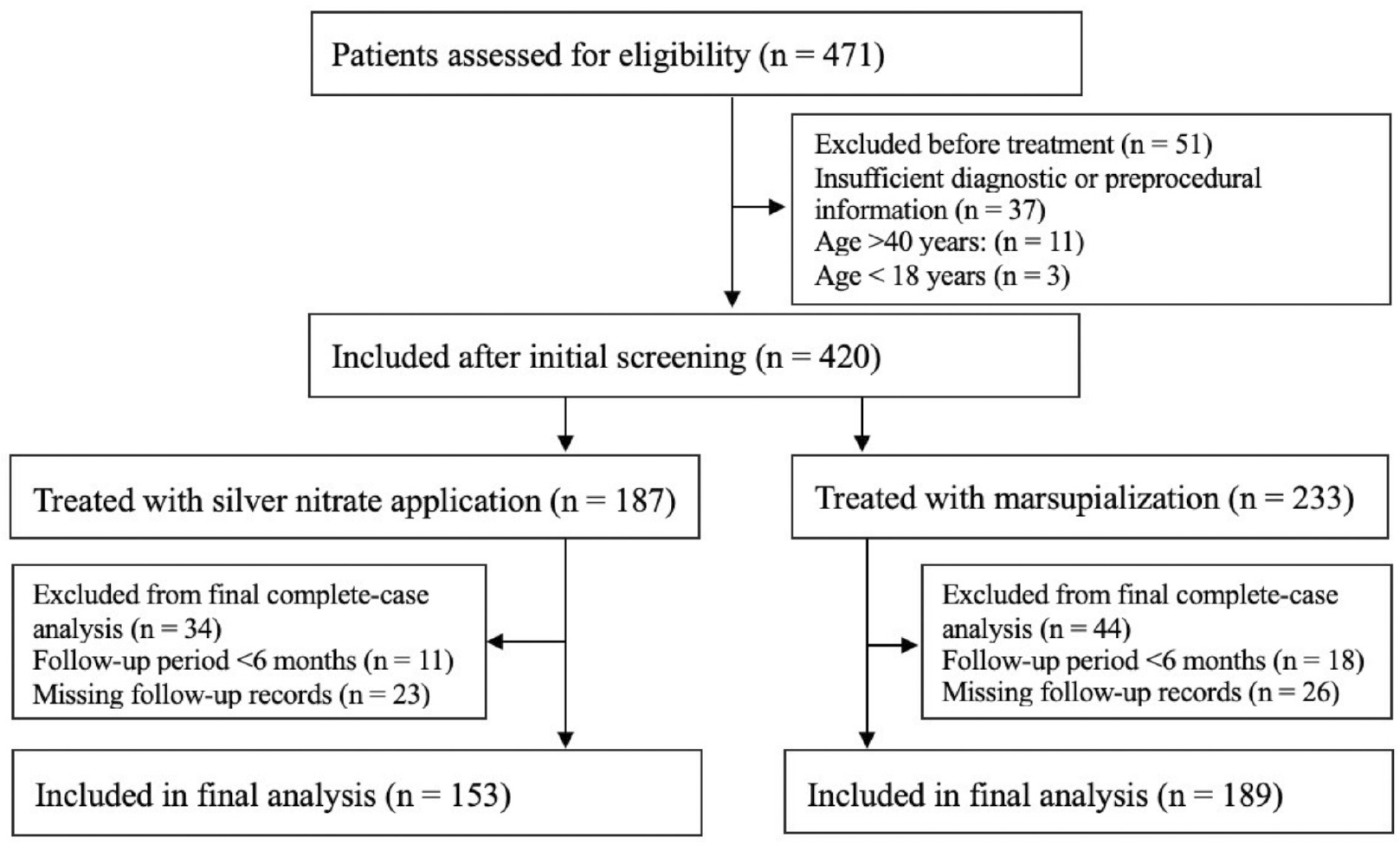
STROBE flow diagram of patient screening, treatment, follow-up, and inclusion in the final complete-case analysis.
Baseline demographic and lesion-related characteristics of the patients included in the 6 month analysis are presented in . The number of previous episodes was summarized only among patients with a documented previous Bartholin cyst/abscess episode (n=43 in the marsupialization group and n=29 in the silver nitrate group). No large descriptive imbalances were observed in age, obstetric history, sexual activity, smoking status, diabetes mellitus, previous Bartholin cyst or abscess episode, previous intervention history, lesion side, lesion size, and inflammatory findings. The mean age was 29.8±7.3 years in the marsupialization group and 30.5±7.1 years in the silver nitrate group. The age range was 18-40 years in both groups. Abscess was the predominant lesion type in both groups, accounting for 117/189 patients (61.9%) in the marsupialization group and 88/153 patients (57.5%) in the silver nitrate group. Mean lesion diameter was 3.6±1.1 cm and 3.8±1.2 cm, respectively. Because treatment allocation was not randomized, baseline p-values were interpreted descriptively; treatment distribution by center is reported in .
Table 1. Baseline demographic and lesion-related characteristics of the study groups
Variables | Marsupialization (n=189) mean ± SD, n/N (%) | Silver nitrate (n=153) mean ± SD, n/N (%) | p-value |
|---|---|---|---|
Age, years | 29.8±7.3 | 30.5±7.1 | 0.371 |
Gravida | 3.34±1.88 | 3.18±1.76 | 0.418 |
Parity | 2.12±1.39 | 2.03±1.33 | 0.542 |
Number of previous episodes | 1.46±0.73 (n=43) | 1.38±0.64 (n=29) | 0.625 |
Nulliparity | 24/189 (12.7) | 16/153 (10.5) | 0.521 |
Sexually active | 171/189 (90.5) | 140/153 (91.5) | 0.742 |
Current smoking | 20/189 (10.6) | 11/153 (7.2) | 0.277 |
Diabetes mellitus | 7/189 (3.7) | 4/153 (2.6) | 0.760 |
Previous Bartholin cyst/abscess episode | 43/189 (22.8) | 29/153 (19.0) | 0.392 |
Previous intervention for Bartholin lesion | 28/189 (14.8) | 19/153 (12.4) | 0.522 |
Lesion type cyst | 72/189 (38.1) | 65/153 (42.5) | 0.410 |
Lesion type abscess | 117/189 (61.9) | 88/153 (57.5) | |
Left-sided lesion | 91/189 (48.1) | 82/153 (53.6) | 0.316 |
Lesion diameter, cm | 3.6±1.1 | 3.8±1.2 | 0.113 |
Lesion diameter >4 cm | 54/189 (28.6) | 38/153 (24.8) | 0.439 |
Fever or marked inflammatory findings | 40/189 (21.2) | 29/153 (19.0) | 0.613 |
Treating centre: Centre 1 | 116/189 (61.4) | 102/153 (66.7) | 0.511 |
Treating centre: Centre 2 | 32/189 (16.9) | 25/153 (16.3) | |
Treating centre: Centre 3 | 41/189 (21.7) | 26/153 (17.0) |
Baseline p-values are descriptive because treatment assignment was not randomized. Continuous-variable p-values were recalculated from the final analysis dataset. The number of previous episodes is summarized only among patients with a documented previous Bartholin cyst/abscess episode. SD: Standard deviation. The age range was 18-40 years in both groups.
Procedural and early postoperative findings are summarized in . The distribution of anesthesia type was similar between groups. Sedation/analgesia was used in 78/189 patients (41.3%) in the marsupialization group and 55/153 patients (35.9%) in the silver nitrate group, while local anesthesia was used in 111/189 (58.7%) and 98/153 (64.1%) patients, respectively (RR 0.87, 95% CI 0.66-1.14; p=0.315). Silver nitrate application was associated with a significantly shorter procedure duration compared with marsupialization (12.7±5.6 vs. 20.4±6.9 minutes; mean difference -7.70 minutes, 95% CI -9.03 to -6.37; p<0.001). Intraoperative bleeding requiring additional hemostasis was numerically less frequent after silver nitrate application (RR 0.49, 95% CI 0.20-1.24; p=0.124). Postoperative analgesic requirement (RR 0.85, 95% CI 0.60-1.20; p=0.339), labial edema within the first week (RR 0.81, 95% CI 0.47-1.39; p=0.439), hematoma (RR 0.49, 95% CI 0.10-2.51; p=0.467), secondary infection (RR 0.62, 95% CI 0.19-2.01; p=0.558), antibiotic use (RR 0.97, 95% CI 0.76-1.22; p=0.769), and unplanned early visits (RR 0.78, 95% CI 0.39-1.56; p=0.479) also showed no statistically significant between-group differences. Chemical mucosal irritation or superficial burn was observed only in the silver nitrate group, affecting 10/153 patients (6.5%) (95% CI 3.2-11.7); no comparative p-value was calculated because this event occurred in only one treatment arm. Absolute differences in recovery-related outcomes were modest. The median time to return to daily activity was shorter in the silver nitrate group than in the marsupialization group (3.0 vs. 4.0 days, median difference -1.0 day). Time to complete epithelial healing was also shorter after silver nitrate application (15.3±5.9 vs. 17.2±6.2 days; mean difference -1.90 days, 95% CI -3.19 to -0.61; p=0.004). Histopathology reports were available for all 342 patients included in the final analysis. Examination of the submitted cyst or abscess wall tissue showed benign findings in all patients, and no malignancy was identified.
Table 2. Procedural characteristics and early postoperative outcomes
Anesthesia and procedural variables | Marsupialization (n=189) | Silver nitrate (n=153) | Effect estimate (95% CI) | p-value |
|---|---|---|---|---|
Sedation/analgesia (vs. local anesthesia) | 78/189 (41.3) | 55/153 (35.9) | RR 0.87 (0.66-1.14) | 0.315 |
Procedure duration, min | 20.4±6.9 | 12.7±5.6 | MD -7.70 (-9.03 to -6.37) | <0.001 |
Intraoperative bleeding requiring additional hemostasis | 15/189 (7.9) | 6/153 (3.9) | RR 0.49 (0.20-1.24) | 0.124 |
Postoperative analgesic requirement | 57/189 (30.2) | 39/153 (25.5) | RR 0.85 (0.60-1.20) | 0.339 |
Labial edema within first week | 29/189 (15.3) | 19/153 (12.4) | RR 0.81 (0.47-1.39) | 0.439 |
Chemical mucosal irritation/superficial burn | 0/189 (0.0) | 10/153 (6.5) | Silver nitrate risk 6.5% (3.2-11.7) | - |
Hematoma | 5/189 (2.6) | 2/153 (1.3) | RR 0.49 (0.10-2.51) | 0.467 |
Secondary infection | 8/189 (4.2) | 4/153 (2.6) | RR 0.62 (0.19-2.01) | 0.558 |
Antibiotic use after procedure | 87/189 (46.0) | 68/153 (44.4) | RR 0.97 (0.76-1.22) | 0.769 |
Unplanned early visit within 7 days | 19/189 (10.1) | 12/153 (7.8) | RR 0.78 (0.39-1.56) | 0.479 |
Time to return to daily activity, days | 4.0 [3.0-6.0] | 3.0 [2.0-5.0] | Median difference -1.0 day | <0.001 |
Time to complete epithelial healing, days | 17.2±6.2 | 15.3±5.9 | MD -1.90 (-3.19 to -0.61) | 0.004 |
Effect estimates compare silver nitrate with marsupialization. RR: Risk ratio, MD: Mean difference (silver nitrate minus marsupialization), CI: Confidence interval, IQR: Interquartile range, SD: Standard deviation. Chemical irritation/superficial burn occurred only after silver nitrate application and is therefore presented descriptively with an exact 95% CI, without a comparative p-value. The p-value for return to daily activity was recalculated from the final raw dataset using the Mann-Whitney U test.
Six-month clinical outcomes are shown in . Recurrence within 6 months occurred in 29/189 patients (15.3%) after marsupialization and 19/153 patients (12.4%) after silver nitrate application, with no statistically significant difference between groups (RR 0.81, 95% CI 0.47-1.39; p=0.439). The 6 month recurrence-free survival estimates were 84.7% (95% CI 78.7-89.1) after marsupialization and 87.6% (95% CI 81.2-91.9) after silver nitrate application. There was no significant between-group difference (log-rank p=0.426), and the univariable Cox model similarly showed no significant treatment effect (HR 0.79, 95% CI 0.44-1.41). The need for repeat did not differ significantly between groups, occurring in 22/189 patients (11.6%) and 13/153 patients (8.5%), respectively (RR 0.73, 95% CI 0.38-1.40; p=0.340). At the 6 month follow-up, documented absence of ongoing symptoms was recorded in 154/189 patients (81.5%) in the marsupialization group and 130/153 patients (85.0%) in the silver nitrate group (RR 1.04, 95% CI 0.95-1.15; p=0.393). Visible scar formation was significantly less frequent after silver nitrate application than after marsupialization (13/153 vs. 33/189; RR 0.49, 95% CI 0.27-0.89; p=0.016). Dyspareunia among sexually active did not differ significantly between groups, occurring in 15/171 patients (8.8%) in the marsupialization group and 10/140 patients (7.1%) in the silver nitrate group (RR 0.81, 95% CI 0.38-1.76; p=0.599). Persistent or recurrent vulvar pain (RR 0.86, 95% CI 0.38-1.95; p=0.709), late secondary infection (RR 0.49, 95% CI 0.10-2.51; p=0.467), and readmission (RR 0.41, 95% CI 0.04-3.92; p=0.631) were uncommon and did not differ significantly between groups. Secondary-outcome comparisons were considered exploratory.
Table 3. Six-month clinical outcomes after marsupialization and silver nitrate application
Outcomes | Marsupialization (n=189) | Silver nitrate (n=153) | Effect estimate (95% CI) | p-value |
|---|---|---|---|---|
Recurrence within 6 months | 29/189 (15.3) | 19/153 (12.4) | RR 0.81 (0.47-1.39) | 0.439 |
6 month recurrence-free survival, Kaplan-Meier estimate | 84.7% (78.7-89.1) | 87.6% (81.2-91.9) | HR 0.79 (0.44-1.41) | 0.426 |
Need for repeat intervention | 22/189 (11.6) | 13/153 (8.5) | RR 0.73 (0.38-1.40) | 0.340 |
Documented absence of ongoing symptoms at 6 months | 154/189 (81.5) | 130/153 (85.0) | RR 1.04 (0.95-1.15) | 0.393 |
Visible scar formation at 6 months | 33/189 (17.5) | 13/153 (8.5) | RR 0.49 (0.27-0.89) | 0.016 |
Dyspareunia at 6 months among sexually active women | 15/171 (8.8) | 10/140 (7.1) | RR 0.81 (0.38-1.76) | 0.599 |
Persistent or recurrent vulvar pain | 13/189 (6.9) | 9/153 (5.9) | RR 0.86 (0.38-1.95) | 0.709 |
Late secondary infection | 5/189 (2.6) | 2/153 (1.3) | RR 0.49 (0.10-2.51) | 0.467 |
Readmission | 3/189 (1.6) | 1/153 (0.7) | RR 0.41 (0.04-3.92) | 0.631 |
Effect estimates compare silver nitrate with marsupialization. The hazard ratio (HR) for recurrence-free survival was estimated using an univariable Cox proportional hazards model; the corresponding p-value was obtained from the log-rank test. RR: Risk ratio, HR: Hazard ratio, CI: Confidence interval. Secondary-outcome comparisons were considered exploratory; the visible-scar finding should therefore be interpreted as hypothesis-generating rather than confirmatory.
In multivariable models (), silver nitrate was not independently associated with 6 month recurrence (aOR 0.81, 95% CI 0.42-1.55; p=0.521), whereas a previous Bartholin episode was associated with higher recurrence odds (aOR 2.48, 95% CI 1.27-4.87; p=0.008). Silver nitrate remained associated with lower odds of documented visible scar formation (aOR 0.43, 95% CI 0.22-0.86; p=0.017), but this secondary finding was interpreted as exploratory.
Table 4. Multivariable logistic regression for 6 month recurrence and visible scar formation
Predictor | Recurrence aOR (95% CI) | p-value | Visible scar aOR (95% CI) | p-value |
|---|---|---|---|---|
Silver nitrate vs. marsupialization | 0.81 (0.42-1.55) | 0.521 | 0.43 (0.22-0.86) | 0.017 |
Abscess vs. cyst | 1.71 (0.82-3.57) | 0.150 | 1.03 (0.53-2.01) | 0.937 |
Lesion diameter, per 1-cm increase | 1.23 (0.94-1.61) | 0.126 | 0.99 (0.74-1.32) | 0.928 |
Previous Bartholin episode: yes vs. no | 2.48 (1.27-4.87) | 0.008 | 1.32 (0.63-2.76) | 0.459 |
Fever/marked inflammatory findings: yes vs. no | 1.43 (0.69-2.97) | 0.341 | 0.65 (0.27-1.56) | 0.333 |
Centre 2 vs. Centre 1 | 1.23 (0.53-2.87) | 0.630 | 1.02 (0.43-2.39) | 0.972 |
Centre 3 vs. Centre 1 | 1.54 (0.70-3.39) | 0.286 | 0.67 (0.28-1.62) | 0.372 |
Both models included treatment, lesion type, lesion diameter, previous Bartholin cyst/abscess episode, fever or marked inflammatory findings, and treating centre. Marsupialization, cyst, no previous episode, no marked inflammatory findings, and Centre 1 were the reference categories. n=342; recurrence events =48; visible scar events =46. aOR: Adjusted odds ratio, CI: Confidence interval.
Exploratory subgroup analyses (), with subgroup-specific RRs and 95% CIs, showed no evidence that the treatment effect on recurrence differed by lesion type (interaction p=0.950), lesion diameter (interaction p=0.360), or previous intervention status (interaction p=0.423).
Table 5. Subgroup analysis of 6 month recurrence according to lesion characteristics and previous intervention
Subgroup | Marsupialization recurrence | Silver nitrate recurrence | RR (95% CI) | Interaction p-value |
|---|---|---|---|---|
Lesion type: Cyst | 7/72 (9.7) | 5/65 (7.7) | 0.79 (0.26-2.37) | 0.950 |
Lesion type: Abscess | 22/117 (18.8) | 14/88 (15.9) | 0.85 (0.46-1.56) | |
Lesion diameter ≤4 cm | 19/135 (14.1) | 11/115 (9.6) | 0.68 (0.34-1.37) | 0.360 |
Lesion diameter >4 cm | 10/54 (18.5) | 8/38 (21.1) | 1.14 (0.49-2.61) | |
No previous intervention | 23/161 (14.3) | 14/134 (10.4) | 0.73 (0.39-1.36) | 0.423 |
Previous intervention | 6/28 (21.4) | 5/19 (26.3) | 1.23 (0.44-3.45) |
RRs compare silver nitrate with marsupialization within each subgroup. Interaction p-values test whether the treatment effect differs across levels of the subgroup variable. These subgroup analyses are exploratory. RR: Risk ratio, CI: Confidence interval. Interaction p-values were obtained from logistic-regression interaction terms adjusted for treating centre.
Attrition sensitivity analyses accounted for 44/233 (18.9%) patients with incomplete 6 month follow-up after marsupialization and 34/187 (18.2%) after silver nitrate application (follow-up schedule summarized in ). Assuming that all missing patients in both groups did not recur yielded RR 0.82 (95% CI 0.47-1.41; p=0.464), whereas assuming that all missing patients recurred yielded RR 0.90 (95% CI 0.67-1.22; p=0.507). Extreme differential assumptions reversed the direction of the estimate (best-case RR 0.32, 95% CI 0.20-0.52; worst-case RR 2.28, 95% CI 1.51-3.43), indicating that attrition remains a relevant limitation.
Table 6. Follow-up schedule by treatment group
Follow-up point | Marsupialization | Silver nitrate application |
Procedure-specific 48-hour visit | No procedure-specific 48-hour visit | Scheduled for pack removal and cavity inspection |
Other early postoperative visits | According to clinical findings | According to clinical findings |
Subsequent clinical follow-up | Routine follow-up documentation of healing and complications | Routine follow-up documentation of healing and complications |
Six-month outcome assessment | Scheduled postoperative outpatient visit; required for inclusion in the complete-case analysis | Scheduled postoperative outpatient visit; required for inclusion in the complete-case analysis |
The scheduled 48-hour visit in the silver nitrate group provided an additional opportunity for early outcome documentation and was therefore considered a potential source of differential ascertainment. Patients without complete 6 month follow-up were excluded from the complete-case analysis.
Overall, silver nitrate application was associated with shorter procedure duration and modestly shorter recovery measures; documented visible scar formation was less frequent at 6 months, although this was an exploratory secondary finding. However, no statistically significant differences were detected in recurrence, need for repeat intervention, dyspareunia, persistent vulvar pain, late infection, or readmission between marsupialization and silver nitrate application.
DISCUSSION
In this multicenter retrospective cohort, marsupialization and silver nitrate application showed no statistically significant difference in 6 month recurrence in women treated for symptomatic Bartholin gland cysts or abscesses. Recurrence was numerically lower after silver nitrate application, but the difference was not statistically significant; this remained the case after multivariable adjustment (aOR 0.81, 95% CI 0.42-1.55; p=0.521). A previous Bartholin episode was independently associated with higher recurrence odds (aOR 2.48, 95% CI 1.27-4.87; p=0.008). The observed recovery-related differences were modest in absolute magnitude: procedure duration was shorter after silver nitrate application, the median return to daily activity was 1 day shorter, mean epithelial healing was 1.9 days shorter, and visible scar formation was less frequently documented. The lower scar frequency persisted after adjustment (aOR 0.43, 95% CI 0.22-0.86; p=0.017), but this secondary finding should be regarded as exploratory. However, chemical mucosal irritation or superficial burn occurred only in the silver nitrate group. No statistically significant differences were detected in need for repeat intervention, dyspareunia among sexually active women, persistent vulvar pain, late infection, or readmission between groups.
Our findings should be interpreted in the context of the prospective randomized trial by Ozdegirmenci et al. (), the most directly comparable prior study. At 6 months, that trial reported recurrence rates of 24.1% after marsupialization and 26.3% after silver nitrate (p=0.67), no statistically significant difference in dyspareunia, and more frequent complete healing without scar formation after silver nitrate (55.7% vs. 31.3%; p=0.007). These findings are broadly consistent with the direction of our recurrence, dyspareunia, and scar results, but our absolute recurrence rates were lower (15.3% and 12.4%, respectively). This discrepancy should not be interpreted as evidence of superior effectiveness in our cohort. In the earlier trial, 53 of 212 enrolled patients were unavailable for 6 month reevaluation, planned follow-up visits were scheduled on days 3 and 7 and at months 1 and 6, and four technical failures were reported in the silver nitrate arm. The authors also noted that patients attending follow-up might have represented more problematic cases. Differences in patient selection, procedural technique, follow-up intensity, outcome ascertainment, and clinical practice across eras may therefore contribute to the lower absolute recurrence rates observed in our cohort. Earlier randomized evidence also supports the feasibility of intracavitary silver nitrate. Mungan et al. () compared silver nitrate stick insertion with gland excision and found significantly shorter operation and healing times in the silver nitrate group (both p<0.001), with no recurrence in either group during 2 years of follow-up. More recent office-based data have also supported silver nitrate as a practical treatment option (). Taken together, these studies support positioning the present work as a multicenter real-world replication and extension of the earlier efficacy literature rather than as the first direct comparison.
The lack of a significant recurrence difference is consistent with the broader literature. The WoMan randomized trial found comparable recurrence after Word catheter placement and marsupialization, and later reviews similarly concluded that the available evidence does not clearly support one universally superior procedure for Bartholin cysts or abscesses (). A recent meta-analysis also showed no clear recurrence advantage between Word catheter placement and marsupialization (). Although our comparison was different, the message is similar: recurrence is important, but it should not be the only factor used to choose treatment for a benign vulvar condition. Our baseline data also reflect the population served by the participating hospitals. Gravida and parity appeared higher than might be expected in some Western cohorts. This is probably related to the fact that the study was conducted in provinces with relatively high fertility rates, and should be interpreted as a regional demographic feature rather than a characteristic specific to Bartholin gland disease (). Gravida, parity, previous Bartholin episodes, lesion type, lesion diameter, inflammatory findings, and treating-centre distribution showed no large descriptive imbalances between groups; however, the non-randomized design means residual confounding cannot be excluded. This concern is particularly relevant in real-world Bartholin cohorts, where treatment allocation is often influenced by clinical presentation, physician preference, and patient choice rather than random assignment. A recent prospective observational study comparing Word catheter placement, silver nitrate application, and marsupialization similarly reflected this non-random treatment selection process (). In our cohort, such routine-care decision-making may have introduced confounding by indication, whereby unmeasured differences in lesion complexity, symptom severity, or clinician judgment could have influenced both treatment selection and clinical outcomes despite multivariable adjustment.
Procedure duration is a notable point of divergence from the 2009 randomized trial. Ozdegirmenci et al. () reported a median procedure duration of 15 minutes in both groups [15 (-30) minutes after marsupialization and 15 (-30) minutes after silver nitrate; p=0.70], whereas in our cohort mean duration was 20.4±6.9 vs. 12.7±5.6 minutes, respectively (mean difference -7.70 minutes, 95% CI -9.03 to -6.37; p<0.001). The earlier trial used a different silver nitrate technique, in which a 0.5×0.5-cm solid silver nitrate piece was placed in the cavity and cyst-wall sutures were tied to prevent leakage, whereas our routine-care technique used a silver nitrate-gauze pack without routine cyst-wall suturing. The studies also summarized procedure duration differently (median versus mean) and were conducted in different clinical settings and eras. Differences in procedural technique, timing definitions, operator experience, and workflow may therefore account for the discrepancy. Accordingly, the shorter procedure duration observed in our study should be interpreted as a context-dependent real-world finding rather than an intrinsic or universally reproducible advantage of silver nitrate over marsupialization. The shorter operation time reported for silver nitrate versus excision by Mungan et al. () supports its potential procedural efficiency relative to more extensive surgery but does not resolve the direct comparison with marsupialization.
From a practical perspective, the shorter duration of silver nitrate application may be clinically relevant in our setting. Bartholin abscesses often present in emergency or short-stay gynecology settings, where pain relief, anesthesia availability, clinic workload, and rapid discharge matter. Studies from hospital and office-based settings have shown that management of Bartholin gland disease varies considerably and that outpatient-friendly techniques remain attractive when safe follow-up is possible (,). In our study, silver nitrate application was associated with a 1-day shorter median return-to-activity time and a 1.9-day shorter mean epithelial-healing time; no statistically significant differences were detected in readmission, late infection, persistent pain, or repeat intervention. These modest recovery differences, together with the shorter procedure duration, may support consideration of silver nitrate as a practical option in patients for whom a shorter outpatient procedure is preferred and reliable return for the scheduled 48-hour pack removal is feasible. Conversely, marsupialization may be preferable when a surgically created drainage opening is desired or when chemical cauterization or scheduled pack removal is unsuitable. Because no significant treatment-by-subgroup interaction was identified for lesion type, lesion diameter, or previous intervention, our data do not support selecting either technique on the basis of these characteristics alone.
The lower frequency of documented visible scar formation after silver nitrate application is another relevant finding, but it should be interpreted carefully. Because marsupialization creates a sutured epithelialized opening, this normal postoperative appearance may have been preferentially coded as a scar, adhesion, or mucosal distortion in routine clinical documentation. Still, scar assessment in this study was based on routine follow-up documentation rather than a standardized cosmetic scale. For this reason, the scar finding should be considered clinically suggestive rather than definitive. The association persisted after multivariable adjustment (aOR 0.43, 95% CI 0.22-0.86; p=0.017), but it arose from multiple exploratory secondary comparisons and should therefore be regarded as hypothesis-generating. The scheduled 48-hour pack-removal visit in the silver nitrate group represents a separate ascertainment issue; by providing an additional opportunity to document local findings, it would, if anything, be expected to increase rather than decrease scar documentation in that group.
Patient-centered outcomes deserve emphasis in this field. For many patients, dyspareunia, persistent discomfort, cosmetic appearance, and the speed of returning to normal activity may be as important as recurrence. Recent studies evaluating Word catheter treatment, gland excision, marsupialization, and CO2 laser treatment have increasingly included satisfaction or sexual-function outcomes, reflecting this shift toward functional recovery (). In our cohort, dyspareunia among sexually active women and persistent or recurrent vulvar pain were similar between groups. However, because standardized sexual-function and pain scales were not available retrospectively, these findings should be confirmed in prospective studies.
The main trade-off with silver nitrate was local chemical injury. Chemical mucosal irritation or superficial burn occurred only in the silver nitrate group. Although no statistically significant differences were observed in the measured late outcomes, the small number of events and the 6 month follow-up period do not permit firm conclusions regarding longer-term safety. Local chemical injury therefore remains clinically relevant. Silver nitrate should therefore not be considered simply a minor drainage procedure. Correct placement inside the cavity, protection of surrounding mucosa, careful removal, patient counseling, and early follow-up are important parts of the technique.
Study Limitations
This study has the advantage of reflecting real-world practice across three hospitals and includes outcomes beyond recurrence, such as procedure duration, healing, scar formation, pain, dyspareunia, and repeat intervention. Its limitations should also be acknowledged. The retrospective design creates a risk of selection bias, because treatment choice was influenced by lesion characteristics, physician judgment, patient preference, and local practice. Although the multivariable models included lesion type, lesion diameter, previous Bartholin episode, inflammatory findings, and treating centre, residual confounding remains possible. In particular, unmeasured differences in lesion complexity, symptom burden, or clinician preference may have influenced both treatment selection and outcomes. Furthermore, the recurrence and scar models included seven degrees of freedom with 48 and 46 outcome events, respectively, corresponding to approximately 6.9 and 6.6 events per degree of freedom. This relatively low event-to-parameter ratio may have increased the risk of model overfitting and reduced the precision of the adjusted estimates. Patients without complete 6 month follow-up were excluded (18.9% after marsupialization and 18.2% after silver nitrate application). Symmetric missing-outcome assumptions did not materially alter the primary comparison, whereas extreme differential assumptions could reverse the direction of the estimate; attrition therefore remains a relevant limitation. In addition, pain, dyspareunia, and scar formation were assessed from routine clinical documentation rather than using standardized or validated prospective assessment tools, which may have introduced measurement variability and limited the comparability of these patient-centered outcomes. Separately, the scheduled 48-hour visit in the silver nitrate group provided an additional opportunity for outcome documentation and would, if anything, be expected to increase the detection of local findings in that group. Multiple secondary outcomes were evaluated without formal multiplicity correction, so isolated secondary associations should be interpreted as exploratory. Only local anesthesia or sedation/analgesia was used, with no regional or general anesthesia. This may reflect selection toward patients with smaller or less complex lesions and may limit the generalizability of our findings to patients requiring regional/general anesthesia or more complex surgical management. In addition, eligibility was restricted to patients aged 18-40 years; therefore, the findings may not be generalizable to patients younger than 18 years or women older than 40 years, in whom diagnostic evaluation and management pathways may differ. Follow-up was limited to 6 months, so later recurrences may not have been captured. Accordingly, the absence of a statistically significant recurrence difference should not be interpreted as evidence of equivalence, and the study may have been insufficiently powered to exclude a clinically meaningful difference between treatments.
CONCLUSION
In this multicenter retrospective cohort, silver nitrate application and marsupialization showed no statistically significant difference in 6 month recurrence rates in women treated for Bartholin gland cysts or abscesses. Silver nitrate application was associated with a shorter procedure duration, modestly shorter return-to-activity and epithelial-healing times and less frequently documented visible scar formation. However, local chemical mucosal irritation or superficial burn was observed only in the silver nitrate group. These findings suggest that silver nitrate application may be considered a practical alternative to marsupialization when a shorter outpatient procedure is preferred and reliable 48-hour follow-up is feasible; however, the lower documented scar rate should be interpreted as exploratory. Because both techniques have distinct advantages and limitations, treatment choice should remain individualized according to lesion characteristics, patient preference, clinical setting, and physician experience. Prospective studies using standardized pain, sexual-function, cosmetic, and satisfaction measures are needed to better define the optimal patient-centered approach.
Ethics
Ethics Committee Approval: Ethical approval was obtained from the relevant Institutional Clinical Research Ethics Committee of University of Health Sciences Türkiye, Gazi Yaşargil Training and Research Hospital (date: 24.04.2026, decision no: 159).
Informed Consent: The requirement for written informed consent was waived due to the retrospective design of the study and the use of anonymized routine clinical data.
Footnotes
Acknowledgments
For transparency, the authors note that an artificial intelligence-assisted language model (ChatGPT, OpenAI) was utilized to support language correction. This assistance was limited to linguistic refinement; all scientific content, critical analysis, and final editorial decisions were made exclusively by the authors.
Author Contributions
Surgical and Medical Practices - M.N.D., A.S., K.Ç.Y.; Concept - M.N.D., K.Ç.Y.; Design - M.N.D., A.S., K.Ç.Y.; Data Collection or Processing - M.N.D., K.Ç.Y.; Analysis or Interpretation - A.S., K.Ç.Y.; Literature Search - A.S.; Writing - M.N.D., K.Ç.Y.
Conflict of Interest
No conflict of interest was declared by the authors.
Financial Disclosure
The authors declared that this study received no financial support.
References
Charavil A, Miquel L, Tourette C, Pivano A, Castel P, Crochet P, et al. Acute Bartholin’s gland abscess treatment by simple needle aspiration: a prospective study. Eur J Obstet Gynecol Reprod Biol. 2022;276:92-97.
Bati-Paracha A, Sharma M. Management of Bartholin’s cyst and abscess. The Obstetrician & Gynaecologist. 2023;25:72-77.
Omole F, Kelsey RC, Phillips K, Cunningham K. Bartholin duct cyst and gland abscess: office management. Am Fam Physician. 2019;99:760-766.
Lee MY, Dalpiaz A, Schwamb R, Miao Y, Waltzer W, Khan A. Clinical pathology of Bartholin’s glands: a review of the literature. Curr Urol. 2015;8:22-25.
Long N, Morris L, Foster K. Bartholin gland abscess diagnosis and office management. Prim Care. 2021;48:569-582.
Dole DM, Nypaver C. Management of Bartholin duct cysts and gland abscesses. J Midwifery Womens Health. 2019;64:337-343.
Cardaillac C, Dochez V, Gueudry P, Vaucel E, Ploteau S, Winer N, et al. Surgical management of Bartholin cysts and abscesses in French university hospitals. J Gynecol Obstet Hum Reprod. 2019;48:631-635.
Illingworth B, Stocking K, Showell M, Kirk E, Duffy J. Evaluation of treatments for Bartholin’s cyst or abscess: a systematic review. BJOG. 2020 May;127:671-678.
Kroese JA, van der Velde M, Morssink LP, Zafarmand MH, Geomini P, van Kesteren P, et al. Word catheter and marsupialisation in women with a cyst or abscess of the Bartholin gland (WoMan-trial): a randomised clinical trial. BJOG. 2017;124:243-249.
Rotem R, Diamant C, Rottenstreich M, Goldgof M, Barg M, Greenberg N, et al. Surgical treatment of Bartholin’s gland abscess: is word catheter superior to marsupialization? J Minim Invasive Gynecol. 2021;28:1211-1215.
Goklu MR, Tunc S, Andan C, Aksin S. Approach to Bartholin’s abscesses and recurrences under office conditions. J Gynecol Obstet Hum Reprod. 2021;50:102186.
Aydogan Mathyk B, Aslan Cetin B, Cetin H. Sexual function after Bartholin gland abscess treatment: a randomized trial of the marsupialization and excision methods. Eur J Obstet Gynecol Reprod Biol. 2018;230:188-191.
Di Donato V, Vena F, Casorelli A, Marchetti C, Musella A, Tomao F, et al. The impact of CO2 laser for treatment of Bartholin’s gland cyst or abscess on female sexual function: a pilot study. Gynecol Endocrinol. 2019;35:150-154.
Bakouei F, Zolfaghari F, Mirabi P, Farhadi Z, Delavar MA. Comparison of word catheter and marsupialization in the management of Bartholin’s glands: a systematic review and meta-analysis. J Obstet Gynaecol Can. 2024;46:102357.
Ozdegirmenci O, Kayikcioglu F, Haberal A. Prospective randomized study of marsupialization versus silver nitrate application in the management of Bartholin gland cysts and abscesses. J Minim Invasive Gynecol. 2009;16:149-152.
Mungan T, Uğur M, Yalçin H, Alan S, Sayilgan A. Treatment of Bartholin’s cyst and abscess: excision versus silver nitrate insertion. Eur J Obstet Gynecol Reprod Biol. 1995;63:61-63.
Keskin F, Çavlin A. Cohort fertility heterogeneity during the fertility decline period in Turkey. J Biosoc Sci. 2023;55:779-794.
Ayçiçek S, Kayaalp H. Impact of treatment modality on pain, sexual function, and psychological well-being in patients with Bartholin’s duct cyst and abscess: a prospective observational cohort study. Med Sci Monit. 2026;32:e952422.
Riche VP, Schirr-Bonnans S, Cardaillac C, Le Thuaut A, Dert C, Mauduit N, et al. Hospital care pathway of women treated for Bartholin’s gland abscess and budget impact analysis of outpatient management: a national hospital database analysis. J Gynecol Obstet Hum Reprod. 2020;49:101689.
Worrall AP, Alaya F, Fullston E, Geary MP, Salameh F. Impact of an outpatient word catheter program for Bartholin cysts and abscesses: a retrospective cohort study. Int J Gynaecol Obstet. 2025;168:244-252.
Psilopatis I, Emons J, Levidou G, Hildebrandt T, Pretscher J, Kehl S. Feasibility and satisfaction with the word catheter in treatment of Bartholin’s cyst and abscess. In Vivo. 2024;38:1292-1299.