
Abstract
Objective
To characterize early perioperative outcomes after esophagectomy for esophageal or gastroesophageal junction cancer and explore whether the association between red-blood-cell transfusion and major morbidity varies by transfusion timing.
Material and Methods
Consecutive resections performed between September 2018 and January 2026 were reviewed retrospectively. Sixty-one of 66 screened patients were included. Major morbidity was defined as Clavien-Dindo grade IIIa or higher. Transfusion was categorized as none, intraoperative only, postoperative only, or both. Sparse categorical comparisons used exact tests.
Results
Neoadjuvant treatment was administered to 56 patients (91.8%). R0 resection was achieved in 57 (93.4%); median lymph node yield was 13 (interquartile range 10-18). Major morbidity occurred in 26 patients (42.6%), anastomotic leak in 11 (18.0%), pneumonia in 20 (32.8%), and 90-day mortality in 6 (9.8%). Major morbidity occurred in 22.9% without transfusion, 33.3% with intraoperative-only transfusion, 72.7% with postoperative-only transfusion, and 88.9% with both (global exact p<0.001). Intraoperative-only transfusion was not associated with major morbidity versus no transfusion [odds ratio (OR) 1.69, 95% confidence interval (CI) 0.26-10.97; p=0.622], whereas postoperative-only transfusion was associated with major morbidity (OR 9.00, 95% CI 1.92-42.14; p=0.004).
Conclusion
Margin-negative resection was comparable with international benchmarks, whereas perioperative morbidity remained substantial. The transfusion signal was concentrated after surgery and should be interpreted as a marker of a complicated perioperative course rather than evidence of a causal transfusion effect.
Keywords: Esophageal neoplasms, esophagogastric junction, esophagectomy, postoperative complications, blood transfusion, morbidity
INTRODUCTION
Esophageal cancer remains a major global health problem. GLOBOCAN 2022 estimated approximately 511,000 new cases and 445,000 deaths worldwide, ranking esophageal cancer eleventh for incidence and seventh for cancer mortality (). Curative treatment for locally advanced disease is multimodal. The CROSS regimen established neoadjuvant carboplatin-paclitaxel chemoradiotherapy followed by surgery as a standard option for resectable esophageal and junctional cancer, with a survival advantage persisting at 10 years (,). For resectable gastroesophageal junction adenocarcinoma, perioperative FLOT chemotherapy is another established strategy (). Despite advances in systemic therapy, anesthesia, critical care and surgical technique, esophagectomy remains one of the most physiologically demanding operations in gastrointestinal oncology.
Reliable institutional evaluation requires standardized outcome definitions. The Clavien-Dindo classification provides treatment-based grading of postoperative complications (), while the Esophagectomy Complications Consensus Group (ECCG) established esophagectomy-specific definitions and a standardized data platform (). Before such frameworks, outcome reporting after esophagectomy was markedly heterogeneous: a systematic review found wide variation in whether complications were defined at all and in the definitions used for anastomotic leak and mortality (). The first international ECCG benchmark subsequently provided contemporary reference rates for R0 resection, anastomotic leak, pneumonia and mortality (), and the larger Esodata experience demonstrated how standardized prospective data can track changes in operative practice and quality outcomes over time ().
The surgical approach itself has evolved substantially. Randomized trials have demonstrated selected perioperative benefits with totally minimally invasive, hybrid and robot-assisted techniques compared with open surgery (-). Anastomotic location is also relevant: the ICAN randomized trial showed lower clinically relevant leak and recurrent laryngeal nerve palsy rates with intrathoracic rather than cervical anastomosis after transthoracic minimally invasive esophagectomy (). At the same time, older randomized evidence comparing transhiatal with extended transthoracic resection illustrates that different operative routes carry distinct trade-offs between perioperative morbidity and oncological extent (). Consequently, a single-center cohort containing several operation types and approaches should be interpreted as a real-world quality assessment rather than as a comparative-effectiveness trial.
Perioperative allogeneic red-blood-cell transfusion is another potentially important quality marker. Observational studies have linked transfusion after esophagectomy with morbidity, mortality and poorer long-term outcomes, while preoperative anemia is closely intertwined with transfusion exposure and patient blood-management practice (-). A central interpretive problem is temporality: postoperative transfusion may be administered after bleeding, reoperation, pneumonia or other complications have already developed. Treating all perioperative transfusion as a single baseline-style exposure can therefore mix potential cause, treatment response and consequence. The present dataset allowed intraoperative and postoperative transfusion to be separated, providing an opportunity to examine this issue directly.
The primary aim of this study was to provide a standardized description of early perioperative outcomes after esophageal and gastroesophageal junction cancer resection at a tertiary oncology center and to contextualize those outcomes against international reference data. A secondary, explicitly exploratory aim was to examine factors associated with major morbidity, with particular attention to the timing of perioperative transfusion.
MATERIAL and METHODS
Study Design and Patients
This single-center retrospective observational cohort study was conducted at the department of surgical oncology of a tertiary oncology training and research hospital. Esophageal resection records from September 2018 through January 2026 were screened consecutively. Of 66 records assessed for eligibility, 5 were excluded: 3 because records were insufficient to ascertain postoperative outcomes, 1 because resection was performed for benign esophageal disease, and 1 because postoperative follow-up was conducted entirely at another center. The final cohort therefore comprised 61 patients (). The manuscript was prepared in accordance with the STROBE statement ().
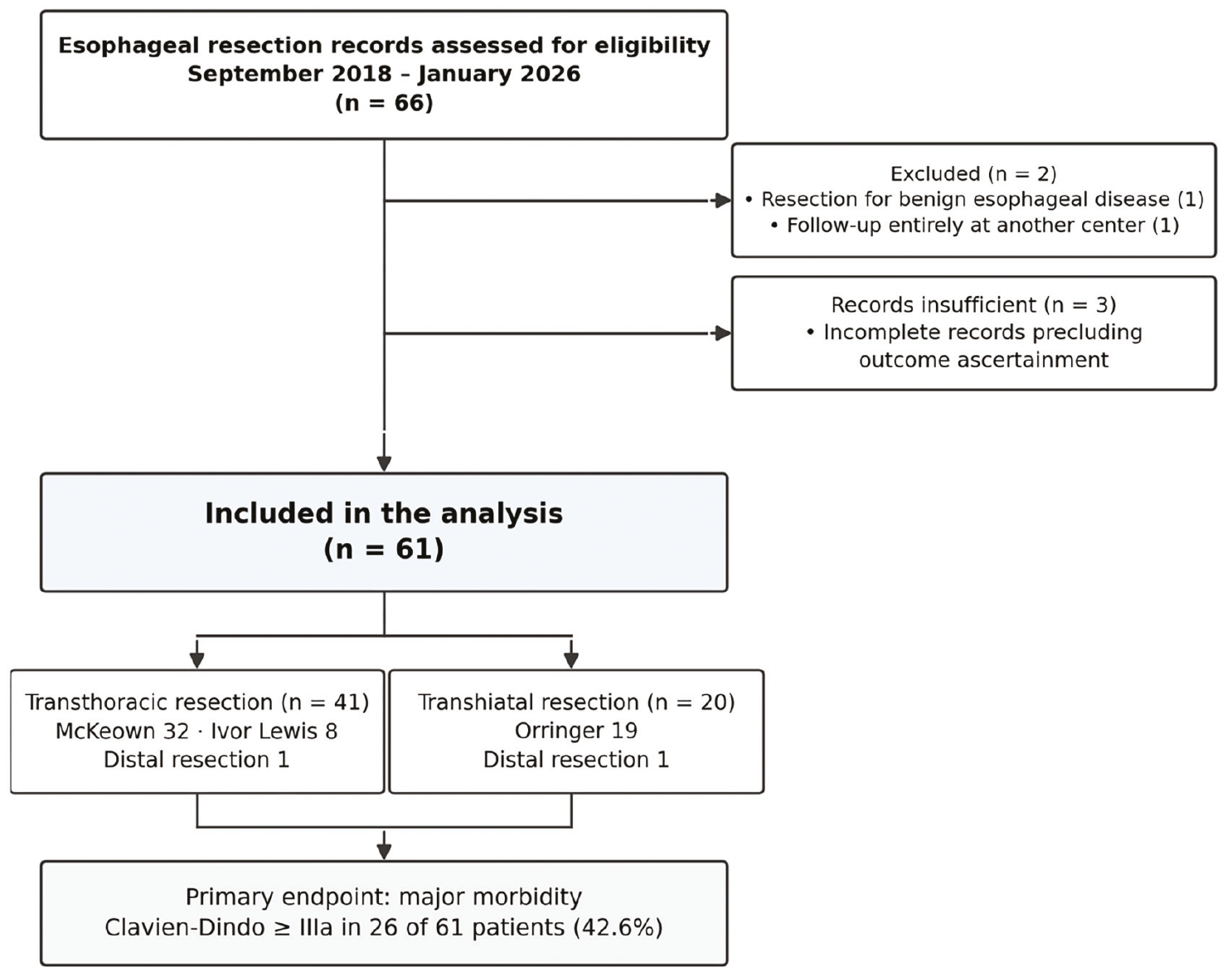
Flow of records through the study. Of 66 esophageal resection records assessed for eligibility, five were excluded and 61 formed the final cohort: 41 resections with a thoracic phase and 20 transhiatal resections. The primary endpoint was major morbidity, defined as Clavien-Dindo grade IIIa or higher during the index admission or within 30 postoperative days.
Data Collection and Audit
Demographic characteristics, American Society of Anesthesiologists (ASA) physical status, Eastern Cooperative Oncology Group (ECOG) performance status, smoking exposure, comorbidities, preoperative laboratory values, tumor location and histology, clinical stage, neoadjuvant treatment, operative technique, anastomotic characteristics, conduit type, pathological stage, resection margin, lymph node yield, tumor regression grade and postoperative outcomes were abstracted from electronic medical records, operative reports, anesthesia documentation, pathology reports and follow-up records. The final dataset underwent repeated source-document review. Derived variables were recomputed after source corrections rather than carried forward from earlier versions. Before analysis, the final dataset underwent predefined internal consistency checks across dates, treatment fields, pathological variables, postoperative outcomes and derived variables.
Treatment and Operative Classification
Neoadjuvant treatment was categorized as chemotherapy, chemoradiotherapy or none. Regimens were recorded as CROSS, FLOT or cisplatin plus 5-fluorouracil-based chemoradiotherapy. Pathological tumor regression after neoadjuvant therapy was graded according to Mandard (), and pathological complete response was defined as ypT0N0 and analyzed only among the 56 patients who received neoadjuvant treatment. Operations were categorized as McKeown, Ivor Lewis, Orringer/transhiatal or distal resection. The operative approach was classified as open, hybrid or totally minimally invasive according to the thoracic and abdominal phases documented in the operative record. Anastomoses were categorized as cervical or intrathoracic and as hand-sewn, circular stapled or linear stapled. A feeding jejunostomy was not placed routinely. It was placed selectively at the discretion of the operating surgeon, on the basis of preoperative nutritional risk together with the intraoperative course of the operation; no written threshold or institutional protocol governed this decision during the study period.
Outcomes and Definitions
The primary outcome was major morbidity, defined as a highest Clavien-Dindo grade of IIIa or higher during the index admission or within 30 postoperative days (). Anastomotic leak was defined according to ECCG criteria (); because two retrospective subtype assignments remained potentially sensitive to how reintervention was categorized, presence of any ECCG-defined leak rather than leak subtype was used in inferential analyses. A pulmonary complication composite was defined as pneumonia and/or acute respiratory distress syndrome. Atelectasis and pleural effusion were tabulated separately but excluded from the pulmonary composite because their ascertainment was not standardized across the entire study period. Thirty-day and 90-day mortality were calculated from the date of surgery and reported separately, as 30-day mortality alone may underestimate surgery-related mortality after esophagectomy (). One leak was diagnosed on clinical grounds, from bilious drain content with intra-abdominal sepsis, and was not confirmed radiologically or endoscopically; it is counted as a leak because the ECCG definition applies irrespective of the method of identification.
Transfusion Exposure
Allogeneic packed red-blood-cell transfusion was recorded separately for the intraoperative and postoperative periods of the index admission. In addition to the conventional binary variable indicating any perioperative transfusion, a four-level mutually exclusive timing variable was defined: no transfusion, intraoperative only, postoperative only, and both intraoperative and postoperative transfusion. Because the exact clock-time relationship between postoperative transfusion and the onset of postoperative complications was not consistently available, postoperative transfusion was treated as a descriptive marker of perioperative course rather than as a prespecified causal exposure.
Statistical Analysis
Normality was assessed with the Shapiro-Wilk test. Normally distributed continuous variables are summarized as mean ± standard deviation and non-normally distributed variables as median [interquartile range (IQR)]; categorical variables are presented as n (%). The proportion with major morbidity is accompanied by a Wilson 95% confidence interval. Binary variables were compared with Fisher’s exact test and continuous variables with the Mann-Whitney U test. Sparse multi-category contingency tables were evaluated with the Fisher-Freeman-Halton exact test. Odds ratios are reported with 95% confidence intervals; the Haldane-Anscombe correction was used when a zero cell prevented conventional odds-ratio estimation.
Association analyses were exploratory. A screen of 31 clinically available variables against the primary endpoint was performed, with a focused subset selected for concise presentation in the Results. Multiplicity was evaluated with both the Benjamini-Hochberg false-discovery-rate procedure and the Bonferroni threshold (0.05/31=0.0016). The fragility index was calculated for nominally significant binary associations. No multivariable causal model containing postoperative transfusion was fitted because postoperative transfusion may occur after the complication that defines the primary outcome; conditioning on such a post-treatment variable could introduce temporal and post-treatment bias. Missing values were not imputed; no missing values were present in the variables used for the reported primary and exploratory comparisons. All tests were two-sided with alpha=0.05. Analyses were performed in Python 3.11 using pandas, SciPy and statsmodels.
Ethics
The study was approved by the Institutional Non-Interventional Clinical Research Ethics Committee of the University of Health Sciences Türkiye, Dr. Abdurrahman Yurtaslan Ankara Oncology Training and Research Hospital (approval no: 2026-07/163, date: 23.07.2026). The requirement for individual informed consent was waived because of the retrospective design. The study was conducted in accordance with the Declaration of Helsinki.
RESULTS
Patient and Treatment Characteristics
Median follow-up for the whole cohort was 25.3 months by the reverse Kaplan-Meier method; among the 39 patients alive at last contact, median observed follow-up was 18.3 months (IQR 8.5-29.6). The final cohort comprised 61 patients with a mean age of 58.7±10.8 years; 41 (67.2%) were men. Squamous cell carcinoma was present in 41 patients (67.2%) and adenocarcinoma in 20 (32.8%). Twenty-six patients (42.6%) were ASA class III, 10 (16.4%) had ECOG performance status 2, and 42 (68.9%) were current or former smokers. Thirty-nine patients (63.9%) had clinical T3-T4a disease and 48 (78.7%) were clinically node-positive. Neoadjuvant treatment was administered to 56 patients (91.8%): chemoradiotherapy in 49 (80.3% of the cohort) and chemotherapy alone in 7 (11.5%). Among neoadjuvantly treated patients, CROSS accounted for 46 regimens (82.1%), FLOT for 7 (12.5%), and cisplatin plus 5-fluorouracil-based chemoradiotherapy for 3 (5.4%) ().
Table 1. Baseline patient and tumor characteristics (n=61)
Characteristic | Value |
|---|---|
Age, years (mean ± SD) | 58.7±10.8 |
Sex | |
Female | 20 (32.8) |
Male | 41 (67.2) |
ASA physical status | |
II | 35 (57.4) |
III | 26 (42.6) |
ECOG performance status | |
0 | 24 (39.3) |
1 | 27 (44.3) |
2 | 10 (16.4) |
Smoking status | |
Never | 19 (31.1) |
Current | 22 (36.1) |
Former | 20 (32.8) |
Alcohol use | 8 (13.1) |
Diabetes mellitus | 9 (14.8) |
Hypertension | 16 (26.2) |
Chronic obstructive pulmonary disease | 5 (8.2) |
Coronary artery disease | 9 (14.8) |
At least one comorbidity | 21 (34.4) |
Albumin, g/dL (mean ± SD) | 3.6±0.7 |
Hemoglobin, g/dL (mean ± SD) | 12.6±2.0 |
C-reactive protein, mg/L (median, IQR) | 5 (2-14) |
Dysphagia score | |
0 (none) | 6 (9.8) |
1 (solids) | 20 (32.8) |
2 (soft foods) | 24 (39.3) |
3 (liquids) | 7 (11.5) |
4 (saliva) | 4 (6.6) |
Tumor location | |
Middle third | 13 (21.3) |
Lower third | 22 (36.1) |
Gastroesophageal junction | 26 (42.6) |
Histology | |
Squamous cell carcinoma | 41 (67.2) |
Adenocarcinoma | 20 (32.8) |
Clinical T category | |
cT1 | 3 (4.9) |
cT2 | 19 (31.1) |
cT3 | 34 (55.7) |
cT4a | 5 (8.2) |
Clinical N category | |
cN0 | 13 (21.3) |
cN1 | 34 (55.7) |
cN2 | 11 (18.0) |
cN3 | 3 (4.9) |
Values are n (%) unless otherwise indicated. Continuous variables are presented as mean ± standard deviation when normally distributed on the Shapiro-Wilk test and as median (IQR) otherwise. ASA: American Society of Anesthesiologists, ECOG: Eastern Cooperative Oncology Group, IQR: Interquartile range, SD: Standard deviation.
McKeown esophagectomy was the most frequent operation (32 patients, 52.5%), followed by Orringer/transhiatal resection (19, 31.1%), Ivor Lewis esophagectomy (8, 13.1%) and distal resection (2, 3.3%). Twenty-six operations (42.6%) were open, 11 (18.0%) hybrid and 24 (39.3%) totally minimally invasive; conversion to open surgery occurred in 4 patients (6.6%). A cervical anastomosis was used in 51 patients (83.6%) and a hand-sewn anastomosis in 49 (80.3%). R0 resection was achieved in 57 patients (93.4%). Median lymph node yield was 13 (IQR 10-18; mean 13.6±5.6), with at least 15 nodes examined in 23 patients (37.7%). Among the 56 neoadjuvantly treated patients, 20 (35.7%) achieved ypT0N0 pathological complete response ().
Table 2. Operative and pathological characteristics (n=61)
Characteristic | Value |
|---|---|
Neoadjuvant treatment | |
None | 5 (8.2) |
Chemotherapy | 7 (11.5) |
Chemoradiotherapy | 49 (80.3) |
Neoadjuvant regimen (among 56 treated patients) | |
FLOT | 7 (12.5) |
CROSS | 46 (82.1) |
Cisplatin plus 5-fluorouracil | 3 (5.4) |
Cycles, median (IQR) | 4 (4-5) |
Type of esophagectomy | |
McKeown | 32 (52.5) |
Ivor Lewis | 8 (13.1) |
Distal resection | 2 (3.3) |
Orringer | 19 (31.1) |
Operative approach | |
Open | 26 (42.6) |
Hybrid | 11 (18.0) |
Totally minimally invasive | 24 (39.3) |
Thoracic phase | |
None (transhiatal) | 20 (32.8) |
Open thoracotomy | 18 (29.5) |
Thoracoscopic | 23 (37.7) |
Abdominal phase | |
Open laparotomy | 31 (50.8) |
Laparoscopic | 30 (49.2) |
Conversion to open surgery | 4 (6.6) |
Anastomotic site | |
Cervical | 51 (83.6) |
Intrathoracic | 10 (16.4) |
Anastomotic technique | |
Circular stapled | 7 (11.5) |
Linear stapled | 5 (8.2) |
Hand-sewn | 49 (80.3) |
Conduit | |
Gastric conduit | 56 (91.8) |
Colon | 1 (1.6) |
Jejunum | 4 (6.6) |
Feeding jejunostomy | 7 (11.5) |
Pyloric drainage | 53 (86.9) |
Pathological T category | |
ypT0 or pT0 | 21 (34.4) |
T1a | 1 (1.6) |
T1b | 9 (14.8) |
. Continued | |
Characteristic | Value |
T2 | 6 (9.8) |
T3 | 23 (37.7) |
T4a | 1 (1.6) |
Pathological N category | |
N0 | 44 (72.1) |
N1 | 9 (14.8) |
N2 | 5 (8.2) |
N3 | 3 (4.9) |
R0 resection | 57 (93.4) |
R1 resection | 4 (6.6) |
Lymph nodes examined, median (IQR) | 13 (10-18) |
Lymph nodes examined, mean ± SD | 13.6±5.6 |
≥15 nodes | 23 (37.7) |
≥20 nodes | 8 (13.1) |
Positive lymph nodes, median (IQR) | 0 (0-1) |
Lymphovascular invasion | 10 (16.4) |
Perineural invasion | 9 (14.8) |
Mandard tumor regression grade (among 56 treated patients) | |
Grade 1 (complete regression) | 20 (35.7) |
Grade 2 (subtotal regression) | 14 (25.0) |
Grade 3 (partial regression) | 11 (19.6) |
Grade 4 (minimal regression) | 6 (10.7) |
Grade 5 (no regression) | 5 (8.9) |
Pathological complete response, ypT0N0 (among 56 treated patients) | 20 (35.7) |
Adjuvant treatment | |
None | 34 (55.7) |
Chemotherapy | 21 (34.4) |
Chemoradiotherapy | 6 (9.8) |
Values are n (%) of the whole cohort unless otherwise indicated. Neoadjuvant regimen, cycle number, tumor regression grade and pathological complete response are expressed with the 56 neoadjuvantly treated patients as the denominator. Resection margin was classified according to College of American Pathologists definitions and tumor regression with the Mandard system. IQR: Interquartile range, SD: Standard deviation.
Early Postoperative Outcomes
Any postoperative complication was recorded in 49 patients (80.3%). Major morbidity occurred in 26 patients (42.6%; 95% CI 31.0-55.1). The pulmonary composite occurred in 21 (34.4%), comprising pneumonia in 20 (32.8%) and acute respiratory distress syndrome in 5 (8.2%). Any ECCG-defined anastomotic leak occurred in 11 patients (18.0%). Recurrent laryngeal nerve palsy was recorded in 8 (13.1%), chylothorax in 3 (4.9%), surgical-site infection in 16 (26.2%), cardiac complications in 9 (14.8%), and venous thromboembolism in 5 (8.2%). Seven patients (11.5%) underwent reoperation. Median intensive-care stay was 1 day (IQR 1-2) and median hospital stay 12 days (IQR 9-17). Thirty-day mortality was 4.9% (3 patients) and 90-day mortality 9.8% (6 patients) (). One of the six deaths within 90 days occurred in a patient with an anastomotic leak. The three deaths within 30 days occurred on postoperative days 12, 15 and 25. The first followed near-total esophagectomy with colonic interposition: bilious drain content with intra-abdominal sepsis led to a clinical diagnosis of anastomotic leak, which was not confirmed on methylene blue testing and for which a planned endoscopic stent could not be placed; the patient developed acute kidney injury requiring renal replacement therapy and complete atrioventricular block, and died after refractory cardiac arrest. The second occurred in a patient who developed postoperative pneumonia and a septic course, with Saprochaete capitata isolated from deep respiratory aspirate, and who died after recurrent cardiac arrests. The third followed postoperative hemorrhage in a patient who also developed pneumonia and acute respiratory distress syndrome. The three deaths between days 31 and 90 occurred on days 69, 80 and 84 and were attributed to postoperative pulmonary complications, to pulmonary thromboembolism with cardiac complications, and to hemorrhage requiring reoperation in a patient with acute respiratory distress syndrome, respectively. Sepsis, cardiorespiratory failure and hemorrhage therefore accounted for both the early and the late component of 90-day mortality, and only one of the six deaths was associated with an anastomotic leak.
Table 3. Postoperative outcomes (n=61)
Outcome | Value |
|---|---|
Any complication | 49 (80.3) |
Major morbidity (Clavien-Dindo ≥ IIIa) | 26 (42.6); 95% CI 31.0-55.1 |
Highest Clavien-Dindo grade | |
0 (no complication) | 12 (19.7) |
I | 7 (11.5) |
II | 16 (26.2) |
IIIa | 4 (6.6) |
IIIb | 9 (14.8) |
IVa | 10 (16.4) |
V (death) | 3 (4.9) |
Anastomotic leak (any) | 11 (18.0) |
Pulmonary complication (pneumonia and/or ARDS) | 21 (34.4) |
Pneumonia | 20 (32.8) |
Acute respiratory distress syndrome | 5 (8.2) |
Recorded atelectasis | 29 (47.5) |
Recorded pleural effusion | 29 (47.5) |
Recurrent laryngeal nerve injury | 8 (13.1) |
Chylothorax | 3 (4.9) |
Surgical site infection | 16 (26.2) |
Cardiac complication | 9 (14.8) |
Venous thromboembolism | 5 (8.2) |
Reoperation | 7 (11.5) |
Intensive care stay, days (median, IQR) | 1 (1-2) |
Hospital stay, days (median, IQR) | 12 (9-17) |
30-day mortality | 3 (4.9) |
90-day mortality | 6 (9.8) |
Any perioperative transfusion | 26 (42.6) |
Intraoperative transfusion | 15 (24.6) |
Postoperative transfusion | 20 (32.8) |
Transfusion timing | - |
None | 35 (57.4) |
Intraoperative only | 6 (9.8) |
Postoperative only | 11 (18.0) |
Both intraoperative and postoperative | 9 (14.8) |
Values are n (%) unless otherwise indicated. Major morbidity was defined as Clavien-Dindo grade IIIa or higher during the index admission or within 30 postoperative days. All three deaths occurring within that window are classified as grade V. Anastomotic leak is reported as any leak, because the available records did not permit an unequivocal retrospective distinction between Esophagectomy Complications Consensus Group type II and type III events. The pulmonary composite comprises pneumonia and/or acute respiratory distress syndrome; atelectasis and pleural effusion are tabulated separately because their ascertainment was not standardized. ARDS: Acute respiratory distress syndrome, CI: Confidence interval, IQR: Interquartile range. One of the 11 leaks was diagnosed on clinical grounds without radiological or endoscopic confirmation.
Major morbidity and pulmonary complications were distributed similarly across the two principal neoadjuvant regimens. Among the 46 patients treated with CROSS, major morbidity occurred in 21 (45.7%), the pulmonary composite in 16 (34.8%) and anastomotic leak in 8 (17.4%); among the 7 patients treated with FLOT, the corresponding figures were 3 (42.9%), 4 (57.1%) and 2 (28.6%). The FLOT subgroup is too small to support meaningful statistical comparison, and these proportions are presented descriptively only.
Exploratory Analysis of Major Morbidity
No detectable association was observed between major morbidity and operative approach: major morbidity occurred in 13 of 26 open procedures (50.0%), 3 of 11 hybrid procedures (27.3%), and 10 of 24 totally minimally invasive procedures (41.7%; Fisher-Freeman-Halton exact p=0.436). Type of esophagectomy was likewise not associated with major morbidity (exact p=0.770). Age, sex, ASA class, ECOG performance status, smoking, comorbidity burden, histology, clinical stage, neoadjuvant treatment, preoperative albumin and hemoglobin, anastomotic site, pathological complete response, resection margin and lymph node yield showed no detectable association with the primary outcome in exploratory analyses ().
Table 4. Selected exploratory comparisons by major morbidity status
Variable | No major morbidity (n=35) | Major morbidity (n=26) | OR (95% CI) | p |
|---|---|---|---|---|
Age, years | 59.0 (51.5-66.5) | 57.5 (53.2-63.8) | — | 0.574 |
Male sex | 23/35 (65.7) | 18/26 (69.2) | 1.17 (0.40-3.48) | 1.000 |
ASA class III | 14/35 (40.0) | 12/26 (46.2) | 1.29 (0.46-3.59) | 0.794 |
ECOG performance status 2 | 4/35 (11.4) | 6/26 (23.1) | 2.33 (0.58-9.28) | 0.300 |
Current or former smoking | 22/35 (62.9) | 20/26 (76.9) | 1.97 (0.63-6.17) | 0.276 |
At least one comorbidity | 11/35 (31.4) | 10/26 (38.5) | 1.36 (0.47-3.95) | 0.596 |
Adenocarcinoma (vs. squamous cell) | 11/35 (31.4) | 9/26 (34.6) | 1.16 (0.39-3.39) | 1.000 |
Clinical T3-T4a | 20/35 (57.1) | 19/26 (73.1) | 2.04 (0.68-6.09) | 0.282 |
Clinical node-positive | 25/35 (71.4) | 23/26 (88.5) | 3.07 (0.75-12.55) | 0.128 |
Any neoadjuvant treatment | 32/35 (91.4) | 24/26 (92.3) | 1.12 (0.17-7.27) | 1.000 |
Operative approach | - | - | - | 0.436 |
Open | 13/35 (37.1) | 13/26 (50.0) | - | - |
Hybrid | 8/35 (22.9) | 3/26 (11.5) | - | - |
Totally minimally invasive | 14/35 (40.0) | 10/26 (38.5) | - | - |
Type of esophagectomy | - | - | - | 0.770 |
McKeown | 17/35 (48.6) | 15/26 (57.7) | - | - |
Ivor Lewis | 6/35 (17.1) | 2/26 (7.7) | - | - |
Distal resection | 1/35 (2.9) | 1/26 (3.8) | - | - |
Orringer/transhiatal | 11/35 (31.4) | 8/26 (30.8) | - | - |
Cervical anastomosis | 28/35 (80.0) | 23/26 (88.5) | 1.92 (0.44-8.26) | 0.494 |
Pathological complete response (among 56 neoadjuvantly treated patients) | 13/32 (40.6) | 7/24 (29.2) | 0.60 (0.19-1.86) | 0.413 |
Lymph nodes examined, n | 13.0 (9.0-17.5) | 14.0 (10.2-18.5) | — | 0.478 |
Lymph nodes examined ≥15 | 13/35 (37.1) | 10/26 (38.5) | 1.06 (0.37-3.01) | 1.000 |
Any perioperative transfusion | 8/35 (22.9) | 18/26 (69.2) | 7.59 (2.41-23.92) | 0.0005* |
Any intraoperative transfusion | 5/35 (14.3) | 10/26 (38.5) | 3.75 (1.09-12.87) | 0.039* |
Any postoperative transfusion | 4/35 (11.4) | 16/26 (61.5) | 12.40 (3.36-45.82) | 0.0001* |
Transfusion timing | - | - | - | 0.0002* |
None | 27/35 (77.1) | 8/26 (30.8) | - | - |
Intraoperative only | 4/35 (11.4) | 2/26 (7.7) | - | - |
Postoperative only | 3/35 (8.6) | 8/26 (30.8) | - | - |
Both intraoperative and postoperative | 1/35 (2.9) | 8/26 (30.8) | - | - |
Data are n/N (%) or median (interquartile range); denominators are the outcome groups. Binary variables were compared with Fisher’s exact test, continuous variables with the Mann-Whitney U test and multi-category variables with the Fisher-Freeman-Halton exact test. Odds ratios in tables containing a zero cell were calculated with the Haldane-Anscombe correction. Pathological complete response was analyzed only among the 56 neoadjuvantly treated patients. CI: Confidence interval, OR: Odds ratio, ASA: American Society of Anesthesiologists, ECOG: Eastern Cooperative Oncology Group.
Twenty-six patients (42.6%) received at least one perioperative transfusion. Major morbidity occurred in 18 of 26 transfused patients (69.2%) compared with 8 of 35 non-transfused patients (22.9%; OR 7.59, 95% CI 2.41-23.92; p<0.001). Any intraoperative transfusion showed a nominal association with major morbidity [10/15 (66.7%) vs. 16/46 (34.8%); OR 3.75, 95% CI 1.09-12.87; p=0.039], and any postoperative transfusion was more strongly associated [16/20 (80.0%) vs. 10/41 (24.4%); OR 12.40, 95% CI 3.36-45.82; p<0.001]. Feeding jejunostomy also reached nominal significance (p=0.035). However, the intraoperative-transfusion and feeding-jejunostomy findings each had a fragility index of 1 and neither survived multiplicity correction. Four comparisons remained below both the Benjamini-Hochberg and Bonferroni thresholds, all of which represented different summaries of the transfusion signal: postoperative transfusion, any perioperative transfusion, number of units transfused, and the four-category transfusion-timing distribution. These correlated measures should not be interpreted as four independent confirmatory findings.
Timing of Transfusion
Stratification by timing materially changed interpretation (). Major morbidity occurred in 8 of 35 patients receiving no transfusion (22.9%), 2 of 6 receiving intraoperative transfusion only (33.3%), 8 of 11 receiving postoperative transfusion only (72.7%), and 8 of 9 receiving transfusion in both periods (88.9%; global exact p<0.001). Compared with no transfusion, intraoperative-only transfusion showed no detectable association with major morbidity (OR 1.69, 95% CI 0.26-10.97; p=0.622). In contrast, postoperative-only transfusion was associated with major morbidity (OR 9.00, 95% CI 1.92-42.14; p=0.004), as was transfusion in both periods (OR 27.00, 95% CI 2.92-249.49; p<0.001).
Table 5. Major morbidity by timing of blood transfusion
Transfusion timing | n | Major morbidity, n (%) | OR (95% CI) | p |
No transfusion | 35 | 8 (22.9) | Reference | — |
Intraoperative only | 6 | 2 (33.3) | 1.69 (0.26-10.97) | 0.622 |
Postoperative only | 11 | 8 (72.7) | 9.00 (1.92-42.14) | 0.004 |
Both intraoperative and postoperative | 9 | 8 (88.9) | 27.00 (2.92-249.49) | <0.001 |
Patients receiving no transfusion form the reference group. The Fisher-Freeman-Halton exact p-value for the four-group distribution was 0.00024. The odds ratio for the group receiving transfusion in both periods was calculated with the Haldane-Anscombe correction. CI: Confidence interval, OR: Odds ratio.
The overlap between intraoperative and postoperative exposure explains why the binary intraoperative variable was potentially misleading. Of the 15 patients who received any intraoperative transfusion, 9 also received postoperative transfusion, and these 9 patients accounted for 8 of the 10 major-morbidity events among the intraoperatively transfused group. When patients receiving postoperative transfusion were excluded, the remaining comparison of intraoperative-only transfusion with no transfusion was not significant (33.3% vs. 22.9%; p=0.622). Preoperative hemoglobin did not differ detectably across the four timing groups (Kruskal-Wallis p=0.237). By contrast, postoperative transfusion was accompanied by higher rates of reoperation (25.0% vs 4.9%; p=0.033) and pneumonia (55.0% vs. 22.0%; p=0.019). Because exact temporal ordering within the postoperative period was unavailable, these observations are consistent with, but do not prove, reverse causation or confounding by perioperative severity.
The complete 31-variable exploratory screen, including multiplicity and fragility-index results, is presented in .
Table 6. Full exploratory screen of 31 variables against major morbidity (n=61)
Variable | No major morbidity (n=35) | Major morbidity (n=26) | OR (95% CI) | p |
|---|---|---|---|---|
Age, years | 59.0 (51.5-66.5) | 57.5 (53.2-63.8) | — | 0.574 |
Male sex | 23/35 (65.7) | 18/26 (69.2) | 1.17 (0.40-3.48) | 1.000 |
ASA class III | 14/35 (40.0) | 12/26 (46.2) | 1.29 (0.46-3.59) | 0.794 |
ECOG performance status ≥1 | 21/35 (60.0) | 16/26 (61.5) | 1.07 (0.38-3.02) | 1.000 |
ECOG performance status 2 | 4/35 (11.4) | 6/26 (23.1) | 2.33 (0.58-9.28) | 0.300 |
Current or former smoking | 22/35 (62.9) | 20/26 (76.9) | 1.97 (0.63-6.17) | 0.276 |
At least one comorbidity | 11/35 (31.4) | 10/26 (38.5) | 1.36 (0.47-3.95) | 0.596 |
Adenocarcinoma (vs. squamous cell) | 11/35 (31.4) | 9/26 (34.6) | 1.16 (0.39-3.39) | 1.000 |
Clinical T3-T4a | 20/35 (57.1) | 19/26 (73.1) | 2.04 (0.68-6.09) | 0.282 |
Clinical node-positive | 25/35 (71.4) | 23/26 (88.5) | 3.07 (0.75-12.55) | 0.128 |
Any neoadjuvant treatment | 32/35 (91.4) | 24/26 (92.3) | 1.12 (0.17-7.27) | 1.000 |
Preoperative albumin, g/dL | 3.8 (3.3-4.1) | 3.4 (3.0-4.0) | — | 0.223 |
Preoperative hemoglobin, g/dL | 12.5 (11.6-13.9) | 12.8 (11.6-13.9) | — | 0.924 |
Neutrophil-to-lymphocyte ratio | 2.7 (1.9-3.8) | 2.8 (2.3-3.5) | — | 0.948 |
Prognostic nutritional index | 44.8 (38.6-49.3) | 42.1 (34.8-48.3) | — | 0.453 |
Operative approach | - | - | - | 0.436 |
Open | 13/35 (37.1) | 13/26 (50.0) | - | - |
Hybrid | 8/35 (22.9) | 3/26 (11.5) | - | - |
Totally minimally invasive | 14/35 (40.0) | 10/26 (38.5) | - | - |
Type of esophagectomy | - | - | - | 0.770 |
McKeown | 17/35 (48.6) | 15/26 (57.7) | - | - |
Ivor Lewis | 6/35 (17.1) | 2/26 (7.7) | - | - |
Distal resection | 1/35 (2.9) | 1/26 (3.8) | - | - |
Orringer/transhiatal | 11/35 (31.4) | 8/26 (30.8) | - | - |
Thoracic phase performed | 24/35 (68.6) | 17/26 (65.4) | 0.87 (0.29-2.54) | 1.000 |
Cervical anastomosis | 28/35 (80.0) | 23/26 (88.5) | 1.92 (0.44-8.26) | 0.494 |
Hand-sewn anastomosis | 29/35 (82.9) | 20/26 (76.9) | 0.69 (0.19-2.45) | 0.746 |
Feeding jejunostomy | 1/35 (2.9) | 6/26 (23.1) | 10.20 (1.14-90.95) | 0.035* |
R1 resection | 3/35 (8.6) | 1/26 (3.8) | 0.43 (0.04-4.35) | 0.629 |
Pathological complete response (among 56 neoadjuvantly treated patients) | 13/32 (40.6) | 7/24 (29.2) | 0.60 (0.19-1.86) | 0.413 |
Pathological node-positive | 9/35 (25.7) | 8/26 (30.8) | 1.28 (0.42-3.96) | 0.775 |
Lymph nodes examined, n | 13.0 (9.0-17.5) | 14.0 (10.2-18.5) | — | 0.478 |
Lymph nodes examined ≥15 | 13/35 (37.1) | 10/26 (38.5) | 1.06 (0.37-3.01) | 1.000 |
Any perioperative transfusion | 8/35 (22.9) | 18/26 (69.2) | 7.59 (2.41-23.92) | 0.0005* |
Any intraoperative transfusion | 5/35 (14.3) | 10/26 (38.5) | 3.75 (1.09-12.87) | 0.039* |
Any postoperative transfusion | 4/35 (11.4) | 16/26 (61.5) | 12.40 (3.36-45.82) | 0.0001* |
Units transfused | 0.0 (0.0-0.0) | 2.0 (0.0-2.8) | — | 0.0003* |
Transfusion timing | - | - | - | 0.0002* |
None | 27/35 (77.1) | 8/26 (30.8) | - | - |
Intraoperative only | 4/35 (11.4) | 2/26 (7.7) | - | - |
Postoperative only | 3/35 (8.6) | 8/26 (30.8) | - | - |
Both intraoperative and postoperative | 1/35 (2.9) | 8/26 (30.8) | - | - |
All variables screened against the primary endpoint are listed so that the multiplicity correction reported in the Material and Methods section can be verified. Data are n/N (%) or median (interquartile range); denominators are the outcome groups. Of the 31 comparisons, four passed both the Benjamini-Hochberg false discovery rate procedure and the Bonferroni threshold (0.05/31 =0.0016), and all four were transfusion-related: any postoperative transfusion, the transfusion timing distribution, the number of units transfused and any perioperative transfusion. Two nominally significant associations did not survive correction: any intraoperative transfusion (p=0.039) and feeding jejunostomy (p=0.035); both had a fragility index of 1, meaning that a change in outcome status for a single patient would abolish the association. CI: Confidence interval, OR: Odds ratio.
Sensitivity Analysis for Operative Heterogeneity
The cohort contained 20 resections without a thoracic phase and 41 with a transthoracic phase. Major morbidity was 45.0% in the transhiatal group and 41.5% in the transthoracic group (OR 1.16, 95% CI 0.39-3.39; p=1.000). Median lymph node yield was 13.5 versus 13.0 (p=0.939), pneumonia 35.0% versus 31.7% (p=1.000), anastomotic leak 15.0% versus 19.5% (p=1.000), and recurrent laryngeal nerve palsy 5.0% versus 17.1% (p=0.253). These analyses were underpowered for equivalence and should be interpreted only as an absence of a detectable difference in this cohort.
DISCUSSION
This source-audited single-center cohort provides a detailed real-world appraisal of early outcomes after esophageal and gastroesophageal junction cancer resection. Four findings are most relevant. First, margin-negative resection was comparable with international benchmark practice, with an R0 rate of 93.4%, but lymph node retrieval was modest. Second, early morbidity remained substantial: 42.6% of patients had Clavien-Dindo grade IIIa or higher morbidity, 18.0% developed anastomotic leak and 34.4% met the pulmonary-complication composite. Third, 30-day mortality was 4.9% whereas 90-day mortality was 9.8%, emphasizing the importance of extending postoperative mortality surveillance beyond 30 days. Fourth, the strong crude association between transfusion and major morbidity was concentrated in patients receiving postoperative transfusion; intraoperative-only transfusion showed no detectable association. This timing pattern weakens a simple causal interpretation of transfusion and supports its use as a marker of a complicated perioperative course.
The ECCG benchmark is useful for context, but not as a case-mix-adjusted performance ranking. In the original 2704-patient benchmark, R0 resection was 93.4%, any complication 59.0%, anastomotic leak 11.4%, pneumonia 14.6%, 30-day mortality 2.4% and 90-day mortality 4.5% (). In the subsequent 6022-patient Esodata analysis, R0 resection was 93.5%, 30-day mortality 2.0%, 90-day mortality 4.5% and transfusion 12%; between the 2015-2016 and 2017-2018 periods, transfusion fell from 14.3% to 10.2% and pneumonia from 15.3% to 12.8%, while anastomotic leak increased from 11.7% to 13.1% (). Our R0 rate closely mirrors those reference figures, whereas pneumonia, leak, transfusion and 90-day mortality were higher. Because international registries consist largely of specialized high-volume centers and use prospective standardized definitions, these differences identify domains for local review rather than proving inferior performance.
The high overall complication rate in our cohort should also be interpreted in light of how outcomes were ascertained. Historical literature used inconsistent definitions and often failed to grade severity systematically (). We intentionally captured a broad spectrum of clinically recorded events, while defining the primary endpoint with Clavien-Dindo and the pulmonary composite more narrowly. Recorded atelectasis and pleural effusion were not incorporated into the pulmonary endpoint because their ascertainment was not standardized. This approach favors transparency but still cannot reproduce the prospective surveillance structure of ECCG registries. The 42.6% major-morbidity rate is therefore a more robust internal quality measure than the 80.3% rate of any recorded complication. The clinical importance of severe complications is not merely short term; a recent individual-patient-data meta-analysis found severe postoperative complications in 29.8% of patients and an adverse association with long-term overall survival, although the certainty of evidence ranged from low to very low ().
The difference between 30-day and 90-day mortality is clinically important. Talsma and colleagues showed that 30-day mortality has limited sensitivity for surgery-related deaths after esophagectomy and that 90-day mortality provides a more complete quality indicator (). Large database analyses also demonstrate that postoperative complications are strongly linked to operative mortality (). In our cohort, the doubling of mortality from 4.9% at 30 days to 9.8% at 90 days indicates that institutional review should include post-discharge deterioration, rescue pathways and late postoperative deaths rather than focusing exclusively on the first month.
We did not detect a difference in major morbidity among open, hybrid and totally minimally invasive approaches. This null result should not be interpreted as equivalence or as evidence against randomized trials. TIME showed lower pulmonary infection after minimally invasive transthoracic esophagectomy (), MIRO demonstrated fewer major complications with hybrid esophagectomy (), and the ROBOT randomized trial reported fewer overall and cardiopulmonary complications with robot-assisted minimally invasive esophagectomy than with open transthoracic surgery (). Our approach groups were small, procedure selection was not randomized, and practice evolved across more than seven years. The historical randomized comparison of transhiatal and transthoracic resection also demonstrates that operative routes can exchange short-term morbidity for differences in surgical extent (). Accordingly, our sensitivity analysis addresses whether heterogeneity obviously drove the primary endpoint; it cannot establish comparative effectiveness. The size of the cohort places a hard limit on what these comparisons can show. With 26 major-morbidity events distributed across four operations and three approaches, the study had 80% power to detect only very large differences: for open versus totally minimally invasive resection, an absolute difference of approximately 36 percentage points would have been required for detection at a two-sided alpha of 0.05. Differences of the magnitude reported in the randomized trials cited above therefore lie well below the resolution of this dataset, and the absence of a detectable difference here carries essentially no evidential weight against them.
Anastomotic practice deserves particular institutional review. Cervical anastomosis was used in 83.6% of our patients, in part because 20 patients underwent transhiatal resection. In the ICAN randomized trial, which specifically evaluated transthoracic minimally invasive esophagectomy, intrathoracic anastomosis reduced leak requiring reintervention from 31.7% to 12.3% and also reduced recurrent laryngeal nerve palsy compared with cervical anastomosis (). Our cohort contained only 10 intrathoracic anastomoses and therefore cannot test this question. Nevertheless, the combination of an 18.0% leak rate, 13.1% recurrent laryngeal nerve palsy rate and predominantly cervical reconstruction supports structured review of anastomotic strategy in anatomically appropriate transthoracic cases, while recognizing that transhiatal procedures require a different framework. Within our own cohort the direction of these outcomes is consistent with the trial evidence, but the numbers are far too small to constitute support for it: anastomotic leak occurred in 10 of 51 cervical anastomoses (19.6%) versus 1 of 10 intrathoracic anastomoses (10.0%), and recurrent laryngeal nerve palsy in 7 of 51 (13.7%) versus 1 of 10 (10.0%). No detectable difference was observed for either outcome; with only 10 intrathoracic anastomoses, an absolute difference of more than 40 percentage points would have been required for detection, so these proportions must be read as descriptive. What can be said without overreach is that our leak and recurrent laryngeal nerve palsy rates sit at the upper end of contemporary series and that reconstruction in this cohort was overwhelmingly cervical. Taken together with the randomized evidence, this is sufficient reason to review anastomotic strategy prospectively in anatomically appropriate transthoracic cases, and to audit recurrent laryngeal nerve outcomes systematically rather than by retrospective chart abstraction.
The transfusion analysis is the most distinctive finding, but it is also the finding most vulnerable to causal overinterpretation. Reeh et al. () reported associations between allogeneic transfusion and perioperative morbidity, mortality, recurrence and survival after esophagectomy. In the Society of Thoracic Surgeons database, transfusion practice varied widely across centers, and institutions with lower-than-expected transfusion rates also had lower risk-adjusted perioperative mortality (). Connor et al. () further showed how closely preoperative anemia and perioperative transfusion are intertwined, illustrating the difficulty of separating patient vulnerability, treatment and transfusion exposure in retrospective datasets. These observational findings support patient blood management, but they do not establish that transfusion itself causes complications. Our timing analysis illustrates why. Patients receiving intraoperative transfusion only had a major-morbidity rate of 33.3%, compared with 22.9% without transfusion, and this difference was not detectable statistically. The apparent signal for any intraoperative transfusion was largely carried by patients who were also transfused postoperatively. Postoperative transfusion, in turn, clustered with reoperation and pneumonia. The most defensible interpretation is therefore that transfusion requirement identifies a sicker or more complicated perioperative course; the present dataset cannot determine whether transfusion additionally contributes causal harm.
This distinction has practical implications. A single binary “perioperative transfusion” variable combines at least two temporally distinct clinical states. Using it as a conventional preoperative-style predictor risks conflating cause, treatment and consequence. Our data support continued attention to preoperative anemia, blood conservation, hemostasis and transfusion thresholds, but they do not support presenting postoperative transfusion as an independent modifiable risk factor for major morbidity. Future studies should time-stamp bleeding, hemoglobin decline, transfusion, reoperation and complication onset so that time-dependent or landmark analyses can separate exposure from response.
Lymph node retrieval is another actionable process metric. Median nodal yield was 13 and only 37.7% of patients had at least 15 nodes examined. Bolger et al. () reported nodal yield below 15 as an adverse prognostic and quality marker, while earlier international data from Peyre et al. () suggested survival benefit with increasing nodal retrieval up to at least 23 nodes in patients treated without neoadjuvant therapy. More recent evidence indicates that this relationship depends on treatment context. Guidozzi et al. () studied 2069 patients with esophageal adenocarcinoma after neoadjuvant therapy and found a survival association with more extensive lymphadenectomy after chemotherapy but not after chemoradiotherapy. Because 80.3% of our total cohort received neoadjuvant chemoradiotherapy and our population was predominantly squamous-cell carcinoma, those data cannot be directly extrapolated. Nevertheless, nodal yield remains relevant for staging quality and as a multidisciplinary process measure involving both lymphadenectomy and pathological specimen assessment. We regard this as the clearest process deficiency identified by the present audit, and it is not adequately explained by case mix. A median yield of 13 nodes, with fewer than four in ten specimens reaching 15 nodes, falls short of the threshold used as a quality metric in the cohorts cited above; while neoadjuvant chemoradiotherapy plausibly reduces retrievable nodal tissue, it does not account for a shortfall of this magnitude across the whole series. Nodal yield is a joint product of the extent of lymphadenectomy and of pathological specimen handling, and neither component was governed by a written standard at our institution during the study period. Structured dissection reported by nodal field, separate submission and orientation of nodal stations by the operating surgeon, and a minimum-yield audit fed back to both the surgical and the pathology team are the concrete measures indicated by these data; nodal yield is the process metric we would prioritize for prospective re-audit.
Feeding jejunostomy requires the same causal caution as postoperative transfusion. It was associated with major morbidity in the exploratory screen (6 of 7 versus 20 of 54; p=0.035), but it was not a routine component of the operation: it was placed selectively, on the basis of preoperative nutritional risk together with the intraoperative course. The patients selected differed accordingly, with lower preoperative albumin (median 3.18 versus 3.80 g/dL) and a lower prognostic nutritional index (39.1 versus 45.0), and three of the seven had ECOG performance status 2 compared with 7 of the remaining 54 patients. The association therefore reflects the indication for the procedure, and in part the intraoperative course that prompted it, rather than any effect of the jejunostomy itself. This reading is consistent with external evidence: in a meta-analysis of 12 studies and 36,284 patients, feeding jejunostomy at esophagectomy was not associated with anastomotic leak, pneumonia, sepsis, length of stay or readmission (). The finding also had a fragility index of 1 and did not survive multiplicity correction. It should not be read as evidence that placing a feeding jejunostomy increases morbidity.
Study Limitations
Several limitations should be acknowledged. The study is retrospective, single-center and modest in size, with only 26 major-morbidity events. The exploratory screen therefore has limited power for small or moderate associations and yields wide confidence intervals for uncommon exposures. Multiple testing was addressed as a sensitivity analysis, but several transfusion variables are mathematically correlated and should not be viewed as independent replications. Operation type, operative approach and anastomotic location were heterogeneous and changed over time; no formal learning-curve analysis was prespecified. Complications were reconstructed from clinical records rather than prospectively captured with a dedicated ECCG registry, creating potential documentation and ascertainment bias (,). Estimated blood loss, operative duration, readmission and exact timing of postoperative transfusion relative to complication onset were not consistently available. Tumor grade was intentionally not used because the coding direction could not be verified with sufficient confidence across the entire cohort. Finally, follow-up was immature for robust long-term oncological analysis, so survival outcomes were intentionally outside the scope of this report.
The study also has strengths. The cohort was consecutive, the dataset was repeatedly reconciled with source documents, and final analyses were performed after a locked-data audit. Major morbidity was anchored to a validated severity classification, leak was defined using ECCG criteria, pCR was restricted to the neoadjuvantly treated subgroup, and transfusion timing was separated rather than treated as a single undifferentiated exposure. These design choices improve internal interpretability and make the quality-improvement message more useful than an isolated list of complication rates.
CONCLUSION
In this single-center retrospective cohort of 61 esophageal and gastroesophageal junction cancer resections, R0 resection was comparable with published international benchmarks, but major morbidity, pulmonary complications, anastomotic leak, 90-day mortality and lymph node retrieval identified clear opportunities for quality improvement. No detectable difference in major morbidity was found among operative approaches, although the study was not powered for comparative effectiveness. The strong crude association between perioperative transfusion and major morbidity was concentrated in patients transfused postoperatively, whereas intraoperative-only transfusion showed no detectable association. Because the temporal order of postoperative transfusion and complication onset was not fully available, transfusion should be interpreted as a marker of a complicated perioperative course rather than a demonstrated causal risk factor. Standardized prospective complication capture, pulmonary risk-reduction pathways, patient blood management, review of anastomotic practice and optimization of lymph node retrieval are reasonable institutional priorities.
Ethics
Ethics Committee Approval: The study was approved by the Institutional Non-Interventional Clinical Research Ethics Committee of the University of Health Sciences Türkiye, Dr. Abdurrahman Yurtaslan Ankara Oncology Training and Research Hospital (approval no: 2026-07/163, date: 23.07.2026).
Informed Consent: The requirement for individual informed consent was waived because of the retrospective design.
Large language model-based tools (OpenAI ChatGPT; Anthropic Claude) were used for language editing, drafting assistance, generation of statistical analysis code and literature-search assistance. These tools were not used to generate or alter any primary data, and they are not listed as authors. All statistical results reported in this manuscript were reproduced by the authors from the locked primary dataset, and every reference was verified by the authors against the original publication. The authors reviewed and edited all AI-assisted output and accept full responsibility for the content and integrity of the manuscript.
Footnotes
Author Contributions
Concept - S.S.; Design - S.S., A.T.; Data Collection or Processing - S.S., A.T., O.C.G.; Analysis or Interpretation - S.S., A.T.; Literature Search - S.S., O.C.G.; Writing - S.S.
Conflict of Interest
No conflict of interest was declared by the authors.
Financial Disclosure
The authors declared that this study received no financial support.
References
Bray F, Laversanne M, Sung H, Ferlay J, Siegel RL, Soerjomataram I, et al. Global cancer statistics 2022: GLOBOCAN estimates of incidence and mortality worldwide for 36 cancers in 185 countries. CA Cancer J Clin. 2024;74:229-263.
van Hagen P, Hulshof MCCM, van Lanschot JJB, Steyerberg EW, van Berge Henegouwen MI, Wijnhoven BPL, et al. Preoperative chemoradiotherapy for esophageal or junctional cancer. N Engl J Med. 2012;366:2074-2084.
Eyck BM, van Lanschot JJB, Hulshof MCCM, van der Wilk BJ, Shapiro J, van Hagen P, et al. Ten-year outcome of neoadjuvant chemoradiotherapy plus surgery for esophageal cancer: the randomized controlled CROSS trial. J Clin Oncol. 2021;39:1995-2004.
Al-Batran SE, Homann N, Pauligk C, Goetze TO, Meiler J, Kasper S, et al. Perioperative chemotherapy with fluorouracil plus leucovorin, oxaliplatin, and docetaxel versus fluorouracil or capecitabine plus cisplatin and epirubicin for locally advanced, resectable gastric or gastro-oesophageal junction adenocarcinoma (FLOT4): a randomised, phase 2/3 trial. Lancet. 2019;393:1948-1957.
Dindo D, Demartines N, Clavien PA. Classification of surgical complications: a new proposal with evaluation in a cohort of 6336 patients and results of a survey. Ann Surg. 2004;240:205-213.
Low DE, Alderson D, Cecconello I, Chang AC, Darling GE, D’Journo XB, et al. International consensus on standardization of data collection for complications associated with esophagectomy: esophagectomy complications consensus group (ECCG). Ann Surg. 2015;262:286-294.
Blencowe NS, Strong S, McNair AGK, Brookes ST, Crosby T, Griffin SM, et al. Reporting of short-term clinical outcomes after esophagectomy: a systematic review. Ann Surg. 2012;255:658-666.
Low DE, Kuppusamy MK, Alderson D, Cecconello I, Chang AC, Darling G, et al. Benchmarking complications associated with esophagectomy. Ann Surg. 2019;269:291-298.
Kuppusamy MK, Low DE; International Esodata Study Group. Evaluation of international contemporary operative outcomes and management trends associated with esophagectomy: a 4-year study of >6000 patients using ECCG definitions and the online Esodata database. Ann Surg. 2022;275:515-525.
Biere SSAY, van Berge Henegouwen MI, Maas KW, Bonavina L, Rosman C, Garcia JR, et al. Minimally invasive versus open oesophagectomy for patients with oesophageal cancer: a multicentre, open-label, randomised controlled trial. Lancet. 2012;379:1887-1892.
Mariette C, Markar SR, Dabakuyo-Yonli TS, Meunier B, Pezet D, Collet D, et al. Hybrid minimally invasive esophagectomy for esophageal cancer. N Engl J Med. 2019;380:152-162.
van der Sluis PC, van der Horst S, May AM, Schippers C, Brosens LAA, Joore HCA, et al. Robot-assisted minimally invasive thoracolaparoscopic esophagectomy versus open transthoracic esophagectomy for resectable esophageal cancer: a randomized controlled trial. Ann Surg. 2019;269:621-630.
van Workum F, Verstegen MHP, Klarenbeek BR, Bouwense SAW, van Berge Henegouwen MI, Daams F, et al. Intrathoracic vs cervical anastomosis after totally or hybrid minimally invasive esophagectomy for esophageal cancer: a randomized clinical trial. JAMA Surg. 2021;156:601-610.
Hulscher JBF, van Sandick JW, de Boer AGEM, Wijnhoven BPL, Tijssen JGP, Fockens P, et al. Extended transthoracic resection compared with limited transhiatal resection for adenocarcinoma of the esophagus. N Engl J Med. 2002;347:1662-1669.
Reeh M, Ghadban T, Dedow J, Vettorazzi E, Uzunoglu FG, Nentwich M, et al. Allogenic blood transfusion is associated with poor perioperative and long-term outcome in esophageal cancer. World J Surg. 2017;41:208-215.
Towe CW, Gulack BC, Kim S, Ho VP, Perry Y, Donahue JM, et al. Restrictive transfusion practices after esophagectomy are associated with improved outcome: a review of the Society of Thoracic Surgeons General Thoracic Database. Ann Surg. 2018;267:886-891.
Connor JP, Destrampe E, Robbins D, Hess AS, McCarthy D, Maloney J. Pre-operative anemia and peri-operative transfusion are associated with poor oncologic outcomes in cancers of the esophagus: potential impact of patient blood management on cancer outcomes. BMC Cancer. 2023;23:99.
von Elm E, Altman DG, Egger M, Pocock SJ, Goetzsche PC, Vandenbroucke JP; STROBE Initiative. The Strengthening the Reporting of Observational Studies in Epidemiology (STROBE) statement: guidelines for reporting observational studies. Ann Intern Med. 2007;147:573-577.
Mandard AM, Dalibard F, Mandard JC, Marnay J, Henry-Amar M, Petiot JF, et al. Pathologic assessment of tumor regression after preoperative chemoradiotherapy of esophageal carcinoma: clinicopathologic correlations. Cancer. 1994;73:2680-2686.
Talsma AK, Lingsma HF, Steyerberg EW, Wijnhoven BPL, van Lanschot JJB. The 30-day versus in-hospital and 90-day mortality after esophagectomy as indicators for quality of care. Ann Surg. 2014;260:267-273.
Bona D, Manara M, Bonitta G, Guerrazzi G, Guraj J, Lombardo F, et al. Long-term impact of severe postoperative complications after esophagectomy for cancer: individual patient data meta-analysis. Cancers (Basel). 2024;16:1468.
Linden PA, Towe CW, Watson TJ, Low DE, Cassivi SD, Grau-Sepulveda M, et al. Mortality after esophagectomy: analysis of individual complications and their association with mortality. J Gastrointest Surg. 2020;24:1948-1954.
Bolger JC, Perez Castro P, Marwah A, Tavakoli I, Espin-Garcia O, Darling GE, et al. Nodal yield <15 is associated with reduced survival in esophagectomy and is a quality metric. Ann Thorac Surg. 2023;116:130-136.
Peyre CG, Hagen JA, DeMeester SR, Altorki NK, Ancona E, Griffin SM, et al. The number of lymph nodes removed predicts survival in esophageal cancer: an international study on the impact of extent of surgical resection. Ann Surg. 2008;248:549-556.
Guidozzi N, Chou WK, Giorgi L, Salem R, Vanstraelen S, Gielen H, et al. The prognostic impact of lymph node yield upon survival in esophageal cancer broken down by neoadjuvant strategy: a multicenter European cohort study. Ann Surg 2026. Epub ahead of print.
Lee Y, Lu JY, Malhan R, Shargall Y, Finley C, Hanna W, et al. Effect of routine jejunostomy tube insertion in esophagectomy: a systematic review and meta-analysis. J Thorac Cardiovasc Surg. 2022;164:422-432.e17.