
Abstract
Loss of domain ventral and incisional hernias are an anatomic and physiologic challenge because chronic visceral externalization, lateral muscle retraction, and limited abdominal capacity can make reduction and primary fascial closure hazardous. This review searched PubMed/MEDLINE through 20 August 2026 and used backward and forward citation tracking to examine computed tomography (CT) volumetry, botulinum toxin type A (BTA), and progressive preoperative pneumoperitoneum (PPP). The Tanaka ratio [hernia sac volume (HSV)/abdominal cavity volume (ACV)] and Sabbagh ratio [HSV/(HSV+ACV)] must be reported by name because their percentages are not interchangeable: A Tanaka ratio of 25% corresponds to a Sabbagh ratio of 20% for the same volumes. BTA consistently elongates the lateral abdominal wall, but comparative evidence for improved clinical outcomes is mixed and remains non-randomized. PPP expands abdominal capacity; however, direct respiratory evidence is limited and conflicting, and procedure-related complications are relevant. A multicenter comparison found no additional volumetric benefit from adding BTA to PPP, while a 2025 propensity-matched meta-analysis found no significant improvement in closure, recurrence, component separation, or wound outcomes with BTA. The large 2026 Hospital La Fe series used combined BTA and PPP in all 220 patients; its proposed threshold-based pathway therefore should not be interpreted as a validated comparison of BTA alone versus combined therapy. We propose a cautious, evidence-informed framework in which CT phenotype, named volumetric formula, reducibility, respiratory reserve, and reconstructive requirements are considered together. The framework is hypothesis-generating rather than a validated treatment algorithm.
Keywords: Incisional hernia, hernia, ventral, botulinum toxins, type A, pneumoperitoneum, artificial, preoperative care, tomography, X-ray computed
INTRODUCTION
Complex ventral and incisional hernias with loss of domain (LOD) are among the most demanding problems in abdominal wall surgery. In these patients, the operative challenge cannot be reduced to the transverse diameter of the fascial defect. A substantial proportion of the viscera may have resided chronically within the hernia sac, while the abdominal cavity has adapted to a lower effective volume and the lateral abdominal wall muscles have shortened and retracted. Abrupt reduction of the herniated viscera and forced fascial closure can therefore create excessive tension, impair ventilation, increase intra-abdominal pressure, and in extreme cases precipitate abdominal compartment syndrome. Contemporary incisional hernia guidelines support cross-sectional imaging and individualized planning for complex defects ().
LOD remains inconsistently defined. An international Delphi consensus, informed by prior systematic review, confirmed substantial variation in qualitative and volumetric definitions, with the Tanaka and Sabbagh methods among the most frequently used quantitative approaches (). A large transverse defect and LOD are not synonymous: The European Hernia Society width category W3 (defect width >10 cm) describes defect size, whereas LOD refers to the relationship between herniated content and the capacity of the abdominal cavity. This distinction is central to patient selection for preoperative conditioning.
Botulinum toxin type A (BTA) and progressive preoperative pneumoperitoneum (PPP) address different, potentially overlapping aspects of this problem. BTA reduces lateral abdominal wall muscle tone and increases muscle length, whereas PPP serially increases intra-abdominal gas volume and may facilitate progressive visceral reintegration. Their clinical effects, however, are difficult to isolate from the definitive repair technique and from case selection. The purpose of this review is therefore not to prescribe a validated threshold-based algorithm, but to synthesize current evidence on computed tomography (CT) assessment, BTA, PPP, combined treatment, physiologic rationale, safety, and the certainty supporting practical preoperative decisions.
METHODS of the REVIEW
This article is a structured narrative review rather than a systematic review or meta-analysis. PubMed/MEDLINE was searched from database inception through 20 August 2026 using combinations of the terms “ventral hernia”, “incisional hernia”, “abdominal wall reconstruction”, “loss of domain”, “botulinum toxin”, “Botox”, “progressive preoperative pneumoperitoneum”, “PPP”, “computed tomography”, “CT”, and “volumetry”. Focused searches were additionally performed for comparative BTA studies, PPP physiologic studies, CT measurement methodology, and publications from high-volume centers. Reference lists of key systematic reviews, guidelines, and primary studies were screened, and forward citation tracking was used to identify recent studies published through the search date. No language filter was applied at the search stage; reports were retained when an English-language abstract or full text allowed reliable assessment.
Eligible evidence included adult ventral or incisional hernia studies evaluating BTA, PPP, combined BTA+PPP, CT-based LOD measurement, perioperative physiologic effects, procedural safety, or clinically relevant reconstructive outcomes. Systematic reviews, meta-analyses, comparative cohorts, prospective physiologic or imaging studies, and larger institutional series were prioritized. Isolated case reports and very small series were not used to support treatment thresholds. Titles and abstracts were assessed for relevance, followed by full-report review when available. Extracted elements included study design, center and recruitment period, sample size, intervention and comparator, volumetric formula, closure definition and denominator, component separation, wound outcomes, recurrence, and follow-up. Conflicting comparative evidence was deliberately retained rather than excluded on the basis of direction of effect.
Potentially overlapping cohorts were evaluated by comparing institution, authorship, recruitment dates, eligibility criteria, and sample size. When serial publications from the same center could not be shown to contain independent patients, they were treated as a longitudinal institutional experience rather than as separate corroborating cohorts. Because this is a narrative review, no PRISMA flow diagram, pooled reanalysis, or formal risk-of-bias instrument was applied. To make the proposed clinical inferences auditable, certainty was appraised qualitatively using the GRADE domains of risk of bias, consistency, directness, and precision; these categories should not be interpreted as formal guideline-grade recommendations. Narrative-review quality was additionally self-appraised using SANRA, a six-item instrument developed specifically for narrative reviews; the completed author assessment and the primary SANRA reference are provided in .
Terminology Quick-reference
Wide/complex defect: A size or morphology descriptor and not synonymous with LOD. LOD: Disproportion between herniated content and native abdominal capacity; any percentage must be linked to the named Tanaka or Sabbagh formula. Primary fascial closure: Re-approximation of native fascial edges without bridging mesh. Midline closure: Reconstruction of the linea alba. Defect closure: The source-study term retained when anatomic midline reconstruction is not explicitly documented. Technical/anatomic outcomes include muscle length, cavity-volume change, and index-operation closure; durable outcomes include recurrence and other longer-term patient-important outcomes that require follow-up.
CT ASSESSMENT and PREOPERATIVE CONDITIONING
Defining LOD and Naming the Volumetric Formula
LOD describes a mismatch between the volume of herniated viscera and the capacity of the native abdominal cavity, but published definitions remain heterogeneous (). For surgical planning, the most important safeguard is to report the volumetric equation explicitly rather than to state an isolated percentage.
The Tanaka method expresses hernia sac volume (HSV) relative to abdominal cavity volume (ACV): Tanaka ratio=HSV/ACV (). A threshold of approximately 0.25 (25%) has historically been used to identify substantial volumetric LOD, although some institutional protocols use a Tanaka-type HSV/ACV threshold of 0.20 (20%) to trigger additional preoperative preparation. The Sabbagh method uses total peritoneal volume as the denominator: Sabbagh ratio=HSV/(HSV+ACV) (). These ratios are mathematically related but numerically different. For example, if HSV=2 L and ACV=8 L, the Tanaka ratio is 2/8=25%, whereas the Sabbagh ratio is 2/(2+8)=20%. Thus, a generic statement such as “LOD 20-25%” is unsafe unless the formula is named. In this review, every threshold is linked to the stated equation.
Defect width should be reported separately from volumetric LOD. A transverse defect ≥10 cm identifies a wide/complex defect in common classifications but does not by itself demonstrate LOD. Conversely, a patient with a smaller fascial aperture can still have clinically relevant volumetric or functional LOD depending on sac volume, chronicity, reducibility, abdominal compliance, and cardiopulmonary reserve.
Operational CT Assessment and Reproducibility
CT is useful for assessment and operative planning in complex ventral/incisional hernias, but no universally validated acquisition protocol exists specifically for LOD volumetry. At minimum, the report should state the patient position and whether images were obtained at rest, during Valsalva, or under another respiratory/strain condition. Valsalva CT increases hernia conspicuity and measured sac dimensions compared with non-Valsalva CT (); therefore, serial pre- and post-conditioning volumetry should use the same acquisition condition whenever possible to avoid artifactual change.
For volumetry, thin contiguous reconstructions are preferable when three-dimensional segmentation is available; a single universal slice-thickness requirement has not been validated. Intravenous contrast is not required solely to calculate HSV and ACV, but may be used for other clinical indications. HSV should encompass the peritoneal/sac compartment external to the fascial defect plane that is intended for reintegration, while ACV should encompass the native intraperitoneal cavity bounded by the abdominal wall, diaphragm, and pelvic floor. Multiple ventral/incisional sacs intended for reduction should be segmented and summed. Parastomal components should be documented separately and included only when they are part of the measured hernia compartment. Ascites or large collections can distort volume estimates and should be documented and, when feasible, excluded from segmented visceral-space measurements. Prior mesh affects reconstructive anatomy but does not redefine the volumetric compartment boundaries. CT cannot reliably map intra-abdominal adhesions directly; only suspected or indirect signs should be reported.
Volume can be estimated with orthogonal two-dimensional ellipsoid measurements or obtained by manual/semi-automatic three-dimensional segmentation. In 92 CT examinations, a simple 2D method using the Sabbagh ratio showed high agreement with 3D rendering (kappa=0.854); a 2D value <20% correctly excluded a 3D Sabbagh value ≥20% in all 67 cases, whereas a 2D value ≥20% had a positive predictive value of 80% (). Free 3D software such as 3D Slicer has also been described for cavity and hernia segmentation (). Dedicated interobserver reproducibility data for manual 3D LOD segmentation remain limited. Before using a local numeric cut-off to direct treatment, centers should standardize segmentation landmarks and establish a local interobserver agreement protocol as a quality-assurance step; periodic reassessment is reasonable when readers or software workflows change. When a treatment decision hinges on a value near a threshold, 3D segmentation or repeat measurement is preferable to avoid classification based on small measurement differences. summarizes formula definitions and reproducibility considerations.
Table 1. CT-based assessment of loss of domain and measurement reproducibility
Method/domain | Definition/formula | Operational interpretation | Important limitations |
|---|---|---|---|
Tanaka | HSV/ACV | Reports hernia burden relative to residual abdominal cavity. A value around 0.25 (25%) is a commonly cited marker of substantial volumetric LOD; some institutional protocols use 0.20 (20%) for escalation. | Thresholds are protocol-derived, not universally validated. Must not be numerically substituted for Sabbagh values. |
Sabbagh | HSV/(HSV+ACV) | Reports the proportion of total peritoneal content outside the native abdominal cavity. A Sabbagh 20% value equals a Tanaka 25% value when based on the same HSV and ACV. | Uses a different denominator. A 20% Sabbagh value is not equivalent to a 20% Tanaka value. |
2D ellipsoid estimate | Volume ≈ 0.52 × width × depth × height; apply the stated Tanaka or Sabbagh equation | Fast and clinically practical. In 92 CTs, 2D vs. 3D Sabbagh classification showed kappa=0.854; 2D <20% had NPV 100% for 3D <20%, while 2D ≥20% had PPV 80%. | Near-threshold values may be misclassified; repeat measurement or 3D segmentation is preferable when management depends on the cut-off. |
3D segmentation | Manual/semi-automatic segmentation of HSV and ACV on contiguous slices | Most direct method for volumetry; free software (e.g., 3D Slicer) has been described. | Time and segmentation choices vary; no universal LOD-specific acquisition/segmentation standard. Dedicated interobserver data for manual 3D LOD segmentation remain limited. |
Morphologic CT assessment | Defect width/length, number/location, rectus position, lateral muscle morphology, sac contents, prior mesh/stoma, obstruction/fistula, indirect signs of adhesions | Adds reconstructive anatomy to volumetry and helps operative planning. | CT cannot directly map adhesions reliably and does not measure abdominal compliance or cardiopulmonary tolerance. |
ACV: Abdominal cavity volume, CT: Computed tomography, HSV: Hernia sac volume, LOD: Loss of domain, NPV: Negative predictive value, PPV: Positive predictive value.
Botulinum Toxin Type A: Reproducible Anatomic Effect, Uncertain Downstream Benefit
BTA blocks acetylcholine release at the neuromuscular junction and produces temporary flaccid paralysis. Image-guided injection of the lateral abdominal wall is intended to decrease resting muscle tone and increase the medial mobility of the musculofascial complex. This effect is often termed chemical component relaxation. Published regimens commonly use 200-300 units of onabotulinum toxin A or approximately 500 units of abobotulinum toxin A, distributed bilaterally across three to five injection sites about four weeks before reconstruction; product units are not interchangeable (,).
The anatomic effect is the most consistent evidence signal. Timmer et al. () pooled 23 studies (995 patients) and found mean lateral abdominal wall elongation of 3.2 cm per side; the same review reported a modest increase in fascial closure probability, although most contributing studies were observational. Subsequent systematic review data have also supported muscle elongation with low rates of directly attributable BTA complications ().
Clinical comparative evidence is less consistent. Niu et al. () compared 20 BTA-treated patients with 20 propensity-matched controls: Primary fascial closure was 19/20 (95%) versus 18/20 (90%), while component separation was required in 13/20 (65%) versus 19/20 (95%); recurrence was 2/20 (10%) versus 4/20 (20%), with no statistically significant difference in recurrence or other postoperative outcomes. Other propensity-matched or weighted studies have reported favorable wound or recurrence signals (,), but these remain susceptible to residual confounding. Importantly, a 2025 meta-analysis restricted to six propensity-score-matched studies (851 patients) found no significant difference with BTA in fascial closure [odds ratio (OR) 1.54, 95% confidence interval (CI) 0.78-3.05], recurrence (OR 0.81, 95% CI 0.33-2.01), component separation (OR 1.50, 95% CI 0.54-4.14), or surgical-site infection/occurrence (OR 1.31, 95% CI 0.34-5.00). Trial-sequential analysis indicated that none of these outcomes had reached the information size required for a definitive conclusion (). Accordingly, BTA can be considered a low-burden adjunct with a reproducible muscle-lengthening effect, but it should not be presented as proven to improve durable clinical outcomes.
Progressive Preoperative Pneumoperitoneum: Cavity Expansion and Uncertain Physiologic Benefit
PPP involves placement of an intraperitoneal catheter followed by repeated, symptom-limited insufflation of air over days or weeks. Its intended effects are progressive expansion of abdominal capacity, facilitation of visceral reintegration, and physiologic acclimatization before definitive reconstruction. The largest historical systematic review included 53 reports and 1.216 patients; visceral reintegration was reported in 99.6% and primary fascial closure in 86%, while procedure-related complications occurred in approximately 12% and five deaths were reported (). Because the constituent reports did not use uniform endpoint definitions or consistently provide a single patient-level denominator for each pooled/reported percentage, these rates should be interpreted as summary estimates from heterogeneous source studies rather than as outcomes with one common denominator. They also reflect the complete treatment pathway, including definitive repair, and cannot be attributed to PPP alone.
Direct evidence for respiratory conditioning is sparse and does not show a uniform physiologic improvement. Importantly, Sabbagh et al. () prospectively included pulmonary function testing: Spirometric parameters were measured before and after PPP. Despite an increase in mean ACV of 2.021 mL, post-PPP spirometry showed a progressive restrictive syndrome (). In contrast, a small series of 16 obese patients reported increases in vital capacity (1.875 to 2.760 mL) and forced expiratory volume in one second (1.060 to 1.670 mL) after PPP, with no postoperative respiratory complications (). These small, non-comparative studies use different populations and measurement schedules. No high-quality comparative evidence demonstrates that PPP reduces postoperative ventilation, pulmonary complications, or abdominal compartment syndrome. Therefore, the respiratory rationale should be described as mechanistic and clinically plausible rather than as a proven outcome benefit.
PPP also has a non-trivial procedure-specific adverse-event profile. Reported complications include pain, subcutaneous emphysema, pneumothorax/pneumomediastinum, catheter malfunction or infection, solid-organ puncture, bowel injury, and rare severe events. In a 180-patient Hospital La Fe series, PPP-related complications occurred in 26.6%; events included subcutaneous emphysema in 18/180 (10%), two small-bowel perforations, and four liver/splenic puncture hematomas, all managed without emergency laparotomy (). More recent ambulatory protocols illustrate that PPP can be delivered in selected patients outside prolonged inpatient admission, but this does not eliminate the need for careful monitoring and an experienced team (). The complementary targets and limitations of BTA and PPP are summarized in .
Table 2. Complementary targets and limitations of BTA and PPP
Feature | BTA | PPP |
|---|---|---|
Primary target | Lateral abdominal wall muscle resistance | Abdominal cavity capacity and visceral reintegration |
Mechanism | Temporary neuromuscular blockade with muscle relaxation and elongation | Serial intraperitoneal air insufflation with gradual cavity expansion |
Typical timing | Usually 3-6 weeks before surgery; many series ~4 weeks | Days to several weeks before surgery; schedules vary |
Common technique | Image-guided bilateral injections; often 200-300 U onabotulinumtoxinA or ~500 U abobotulinumtoxinA across 3-5 sites | Intraperitoneal catheter; repeated symptom-limited insufflation, often several hundred mL to ~1 L per session |
Evidence-supported effect | Consistent increase in lateral abdominal wall length | Consistent direction toward increased abdominal cavity volume/visceral reintegration in observational series |
Uncertain effect | Durable improvement in closure, recurrence, or wound outcomes remains unproven in comparative evidence | Improved respiratory tolerance, postoperative ventilation, pulmonary complications, or durable repair outcomes remains unproven |
Main limitations | Off-label use in many jurisdictions; non-standardized dose/injection pattern; cost; comparative evidence heterogeneous | Procedure-specific morbidity; catheter dependence; non-standardized dose/schedule; tolerance varies |
Representative adverse events | Local pain/hematoma, transient truncal weakness, rare systemic diffusion effects | Pain, subcutaneous emphysema, pneumothorax/pneumomediastinum, catheter problems, solid-organ puncture, bowel injury |
BTA: Botulinum toxin type A, PPP: Progressive preoperative pneumoperitoneum. | ||
Combined BTA and PPP: Complementary Mechanisms Do Not Equal Proven Additive Efficacy
BTA and PPP have biologically distinct targets, which makes their combination intuitively attractive: BTA reduces lateral wall resistance while PPP expands intra-abdominal capacity. However, mechanistic complementarity should not be equated with demonstrated additive clinical benefit. The 2024 systematic review by Giuffrida et al. () included seven studies and 217 patients receiving combined treatment. PPP complications occurred in 25.6%; the authors reported a mean decrease of 7.6% in the hernia-volume/abdominal-cavity-volume ratio across the included studies. Because source studies used different baseline values and reporting conventions, this figure should be interpreted as a reported study-level ratio decrease rather than automatically as a relative percent change. Posterior component separation or transversus abdominis release was used in 40/217 (18.4%), surgical-site infection in 38/217 (17.5%), surgical-site occurrence in 57/217 (26.2%), and recurrence in 13/217 (5.9%). Primary/midline defect closure was available for 174 patients and achieved in 171/174 (98.2%); therefore, the denominator is not the full 217-patient cohort. Mean follow-up across studies was approximately 21 months and ranged widely (). These closure, wound, and recurrence outcomes reflect the complete treatment pathway, including different mesh positions and reconstructive techniques, and should not be interpreted as isolated effects of BTA+PPP.
A directly comparative multicenter study challenges the assumption of straightforward additivity. Tashkandi et al. () compared 13 patients receiving BTA+PPP with 28 receiving PPP alone. Increase in ACV was similar (+58.3% vs. +52.8%; p=0.99), and complete fascial closure was achieved in all 41 patients. Surgical-site occurrence was lower in the combined group [3/13 (23.1%) vs. 17/28 (60.7%); p=0.043], but the study was small and non-randomized. The data therefore suggest no additional volumetric benefit from BTA when PPP is already used, while leaving open the possibility of a wound-outcome effect that requires confirmation (). Selected comparative and synthesis evidence is summarized in .
Table 3. Selected comparative and synthesis evidence relevant to BTA and PPP
Study | Design/denominator | Key findings | Follow-up/interpretive limit |
|---|---|---|---|
Timmer et al. () | Systematic review/meta-analysis; 23 studies, 995 patients | BTA: lateral muscle elongation +3.2 cm/side; fascial-closure RR 1.08 (95% CI 1.02-1.16). | Predominantly observational; heterogeneous protocols and repairs. |
Niu et al. () | Propensity-matched cohort; BTA 20 vs. control 20 | Primary fascial closure 19/20 vs. 18/20; component separation 13/20 vs. 19/20 (p=0.044); recurrence 2/20 vs. 4/20 (NS). | Small sample; recurrence follow-up not standardized in abstract; no significant difference in postoperative outcomes. |
Florencio de Mesquita et al. () | Meta-analysis of 6 propensity-matched studies; 851 patients | No significant BTA benefit for closure, recurrence, component separation, SSI/SSO, length of stay, or operative time; TSA inconclusive. | Non-randomized source studies; required information size not reached. |
Martínez-Hoed et al. () | Systematic review of PPP; 53 reports, 1,216 patients | Visceral reintegration 99.6%; primary fascial closure 86%; complications ~12%; 5 deaths. Uniform endpoint-specific patient denominators were not consistently available across constituent reports. | Decades of heterogeneous protocols, endpoint definitions, and definitive repairs; summary percentages should not be treated as having one common denominator or as effects of PPP alone. |
Tashkandi et al. () | Multicenter non-randomized comparison; BTA+PPP 13 vs. PPP 28 | ACV increase +58.3% vs. +52.8% (p=0.99); fascial closure 13/13 vs. 28/28; SSO 3/13 vs. 17/28 (p=0.043). | Small groups and treatment-selection confounding; no additional volumetric benefit from BTA. |
Giuffrida et al. () | Systematic review; 7 combined-treatment studies, 217 patients | PPP complications 25.6%; PCS/TAR 40/217; SSI 38/217; SSO 57/217; recurrence 13/217; closure 171/174 with data. | Mean follow-up ~21 months with wide range; outcomes reflect the whole surgical pathway, not isolated BTA+PPP. |
Bueno-Lledó et al. () | Single-center serial experience; 220 patients; all received BTA+PPP | Reported mean 14% decrease in HSV/ACV; recurrence 20/220 (9%). Proposed BTA alone when HSV/ACV <20% and PPP at ≥20%. | Mean follow-up 33.5 months (-). No BTA-alone comparator; proposed threshold pathway not directly tested. |
ACV: Abdominal cavity volume, BTA: Botulinum toxin type A, CI: Confidence interval, HSV: Hernia sac volume, NS: Not significant, PCS: Posterior component separation, PPP: Progressive preoperative pneumoperitoneum, SSO: Surgical-site occurrence, SSI: Surgical-site infection, TAR: Transversus abdominis release, TSA: Trial sequential analysis.
Overlapping Hospital La Fe Cohorts and Interpretation of the 20% Threshold
Several influential combined-treatment reports originate from the Abdominal Wall Unit at Hospital Universitari i Politecnic La Fe, Valencia, and represent serially expanded institutional experience rather than independent replication. The 2020 “first 100 cases” report included patients treated from June 2010 through December 2018 (). A 2024 PPP-complication study analyzed 180 consecutive LOD patients treated from June 2012 through July 2022 (). The 2026 15-year report included 220 consecutive patients treated from June 2010 through December 2024 (). Because the recruitment windows and center overlap substantially, the 100- and 180-patient series are very likely nested within or overlap materially with the 220-patient series; the exact patient-level overlap is not stated in the publications. Earlier La Fe reports may also contain patients later represented in these expanded cohorts. Accordingly, these publications are treated here as serial institutional experience and their closure, recurrence, complication, and volumetric results are not counted as independent corroborating cohorts ().
Table 4. Potential overlap among serial Hospital La Fe cohorts
Hospital La Fe report | Recruitment period/n | Relationship to later reports | How interpreted in this review |
Bueno-Lledó et al. () | Jun 2010-Dec 2018; n=100 | Same center and overlapping start date with 2026 cohort; likely nested within later 220-patient series. | Not treated as an independent replication of closure/recurrence outcomes. |
Bueno-Lledó et al. () | Jun 2012-Jul 2022; n=180 | Same center; recruitment window lies largely inside 2026 Jun 2010-Dec 2024 cohort. | Used primarily for detailed PPP complication denominators; not counted as an independent efficacy cohort. |
Bueno-Lledó et al. () | Jun 2010-Dec 2024; n=220 | Largest/most recent serial cohort; all patients received combined BTA+PPP. | Used as the most complete institutional experience; threshold proposal described as unvalidated because no BTA-alone <20% comparator was studied. |
Earlier La Fe publications | Earlier/partially overlapping institutional periods | Patient-level independence from later cohorts cannot always be established from publications. | Treated as serial institutional experience unless independence is explicit. |
Because individual patient identifiers were unavailable, overlap is inferred from the same institution and overlapping recruitment windows; exact patient-level duplication cannot be quantified from the published reports. BTA: Botulinum toxin type A, PPP: Progressive preoperative pneumoperitoneum.
The 2026 report is particularly important for interpreting the proposed Tanaka-type threshold. Its inclusion criteria were a transverse fascial defect ≥10 cm and/or HSV/ACV ≥20%, and all 220 study patients received combined BTA+PPP. The authors reported an average 14% decrease in HSV/ACV after combined preparation and recurrence in 20/220 (9%) at a mean 33.5-month follow-up (range 11-60 months) (). The paper then proposed that patients with W3 defects but HSV/ACV <20% might receive BTA alone, whereas PPP could be added at HSV/ACV ≥20%. Because no BTA-alone <20% cohort was evaluated within that 220-patient study, this threshold is an expert/institutional proposal derived from experience rather than a directly validated comparative result. The publication reports a “14% reduction” in the ratio; because the report does not consistently distinguish an absolute percentage-point change from a relative percentage reduction, this review preserves the authors’ wording and does not re-express the value as a different metric.
Conflicting Evidence, Outcome Attribution, and Limitations of the Evidence Base
The current evidence base is dominated by retrospective cohorts, case series, and systematic reviews of heterogeneous observational studies. Randomized trials comparing BTA, PPP, their combination, or no prehabilitation are lacking. Selection bias is substantial because the largest or least reducible hernias are more likely to receive intensive preoperative conditioning, while technique, mesh position, component separation, surgeon experience, and perioperative pathways differ among centers. This limits causal attribution of closure, wound, recurrence, and respiratory outcomes.
The negative or neutral comparative evidence is clinically important. In addition to Tashkandi et al. (), Niu et al. () found no significant difference in primary fascial closure or recurrence with BTA despite a lower requirement for component separation. Florencio de Mesquita et al. () found no significant pooled advantage of BTA for closure, recurrence, component separation, or wound morbidity across 851 propensity-matched patients, and trial-sequential analysis remained inconclusive. These findings temper earlier meta-analytic and single-center signals of benefit and argue against universal BTA use solely on the basis of defect size.
Outcome terminology also requires discipline. In this review, primary fascial closure means re-approximation of the native fascial edges without a bridging mesh. “Midline closure” specifically implies reconstruction of the linea alba, whereas some publications use “defect closure” without confirming an anatomic midline. When source studies did not distinguish these definitions, their original term is acknowledged rather than assumed equivalent. Recurrence is a durable outcome and should be interpreted only with its follow-up; short-term technical closure is not a surrogate for long-term recurrence. Likewise, SSI and SSO are influenced by wound class, surgical approach, component separation, mesh characteristics, and patient risk, not solely by prehabilitation. To improve reproducibility, outcome-specific denominators for the principal comparative, synthesis, and high-volume studies are provided in .
A Cautious Evidence-informed Selection Framework
No CT ratio has been prospectively validated as a universal trigger for BTA or PPP. Therefore, the framework in and is intentionally phrased as a proposed, evidence-informed approach rather than a validated algorithm. It integrates the named volumetric formula with reducibility, lateral muscle retraction, chronicity, cardiopulmonary reserve, prior repairs, and the anticipated reconstruction. The Tanaka HSV/ACV ratio is used for threshold examples because most high-volume combined-treatment protocols report this formula; a Sabbagh threshold must not be substituted numerically without conversion.
Table 5. Proposed evidence-informed (not validated) prehabilitation framework
Clinical/CT phenotype | Evidence-informed option | Strength of wording/rationale |
Wide defect (e.g., ≥10 cm) without clear volumetric LOD; predominant lateral retraction | BTA may be considered. | Defect width alone does not equal LOD. BTA has a consistent muscle-lengthening effect, but BTA-alone sufficiency is not proven. |
Intermediate volumetric burden, e.g., Tanaka HSV/ACV ~0.20-0.25 | Individualize. BTA may be considered; PPP may be added selectively. | Use reducibility, chronicity, respiratory reserve, contracted-cavity features, prior repairs, and planned reconstruction; no validated cut-off. |
Substantial LOD, e.g., Tanaka HSV/ACV ≥0.25 (approximately Sabbagh ≥0.20 for the same volumes) | Combined BTA+PPP may be considered in experienced centers. | Mechanistically targets muscle retraction and cavity capacity, but additive efficacy and threshold selection are supported by low/very-low certainty evidence. |
PPP poorly tolerated or contraindicated | Stop/avoid PPP; consider BTA and advanced reconstructive planning with enhanced perioperative monitoring. | Procedure-specific PPP morbidity must be balanced against uncertain incremental benefit. |
Threshold examples use the Tanaka HSV/ACV formula unless explicitly stated. A Tanaka value of 25% corresponds to a Sabbagh HSV/(HSV+ACV) value of 20% for the same volumes. ACV: Abdominal cavity volume, BTA: Botulinum toxin type A, PPP: Progressive preoperative pneumoperitoneum, LOD: Loss of domain, HSV: Hernia sac volume, CT: Computed tomography.
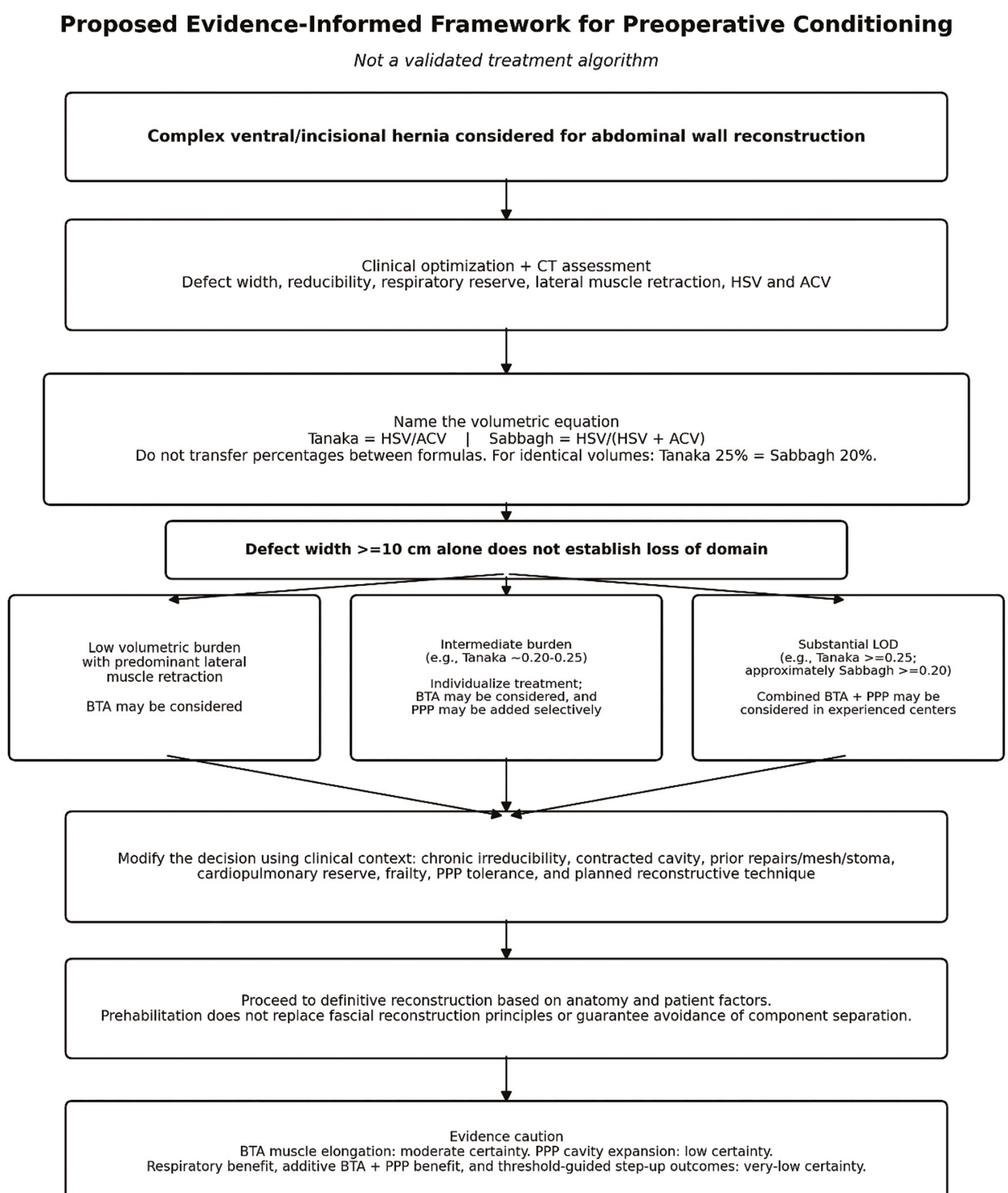
Proposed evidence-informed framework for CT-based selection of preoperative conditioning in complex ventral/incisional hernia. The framework is not a validated treatment algorithm. A transverse defect ≥10 cm does not by itself establish LOD. Volumetric thresholds must be tied to a named equation: Tanaka=HSV/ACV and Sabbagh=HSV/(HSV+ACV). For identical volumes, Tanaka 25% corresponds to Sabbagh 20%. BTA and PPP are considered selectively according to CT phenotype, reducibility, physiologic reserve, procedural tolerance, and reconstructive requirements.
BTA: Botulinum toxin type A, ACV: Abdominal cavity volume, CT: Computed tomography, HSV: Hernia sac volume, LOD: Loss of domain, PPP: Progressive preoperative pneumoperitoneum.
For a wide defect without clear volumetric LOD, BTA may be considered when lateral muscle retraction is a major barrier to medialization, but current comparative evidence does not prove that BTA alone is sufficient. For intermediate Tanaka HSV/ACV values around 0.20-0.25, management should be individualized; PPP may be considered when chronic irreducibility, a contracted abdominal cavity, poor predicted tolerance of reduction, or other morphofunctional features raise concern. For substantial volumetric LOD, for example Tanaka HSV/ACV ≥0.25, combined BTA+PPP may be considered in experienced centers, but this cut-off remains protocol-derived rather than universally validated. A Sabbagh ratio of 20% corresponds approximately to a Tanaka ratio of 25% when based on the same HSV and ACV and should be labeled as such. The decision to use PPP should also account for its procedure-specific morbidity and the patient’s ability to tolerate serial insufflation.
The certainty supporting these inferences is summarized in . The strongest and most consistent signal is the imaging/anatomic effect of BTA on lateral muscle length. Evidence that PPP expands cavity volume is also directionally consistent, but the evidence that either intervention improves durable outcomes is lower. Evidence for respiratory benefit from PPP and for a threshold-guided BTA-alone versus BTA+PPP strategy is very low because of small non-comparative physiologic studies and the absence of direct threshold-based comparisons.
Table 6. Qualitative certainty appraisal for principal clinical inferences
Clinical inference | Evidence base | Main certainty concerns | Qualitative certainty | Appropriate conclusion |
|---|---|---|---|---|
BTA elongates lateral abdominal wall | Multiple observational imaging studies + systematic/meta-analysis | Low randomization relevance but consistent objective imaging effect | Moderate | BTA reliably increases lateral muscle length in the short preoperative interval. |
BTA improves fascial closure/reduces recurrence or wound morbidity | Propensity-matched/weighted cohorts + 2025 PSM meta-analysis | Selection bias; residual confounding; mixed results; TSA underpowered | Low | Clinical benefit remains uncertain; routine use cannot be justified solely by defect size. |
PPP increases abdominal cavity capacity/facilitates reintegration | Prospective and retrospective series + systematic review | No untreated controls; heterogeneous protocols; historical data | Low | PPP can expand cavity volume and facilitate reintegration in selected patients. |
PPP improves respiratory tolerance or reduces pulmonary complications | Small prospective/observational physiologic studies | Small samples; mixed spirometric direction; no robust comparative postoperative data | Very low | Respiratory adaptation is a plausible rationale, not a proven clinical benefit. |
Adding BTA to PPP improves outcomes vs. PPP alone | One small multicenter non-randomized comparison + heterogeneous combined series | Very small comparative sample; no added volumetric effect; possible SSO signal; confounding | Very low | Additive clinical benefit is unproven. |
Tanaka-threshold-guided BTA alone vs. BTA+PPP step-up improves outcomes | Single-center protocol proposal; 220-patient cohort all received combined therapy | No direct threshold-based comparison; serial overlapping cohorts | Very low | Use only as a proposed evidence-informed framework, not a validated algorithm. |
Qualitative certainty categories use GRADE domains (risk of bias, consistency, directness, precision) as a structured narrative appraisal, not as formal guideline recommendations. GRADE-domain definitions: risk of bias is the likelihood that study design or conduct systematically distorts an effect estimate; consistency is the agreement in direction and magnitude of findings across studies; directness is the applicability of the evidence to the population, intervention/comparator, and outcome of interest; and precision is the certainty around an effect estimate, including sample size and confidence-interval width. These domains were used qualitatively and do not constitute a formal guideline GRADE assessment. TSA: Trial sequential analysis, BTA: Botulinum toxin type A, PPP: Progressive preoperative pneumoperitoneum, SSO: Surgical-site occurrence.
Technical Implementation
BTA is generally administered three to six weeks before surgery to allow maximal neuromuscular effect. Injection should be image-guided and performed by clinicians familiar with abdominal wall anatomy. The external oblique, internal oblique, and transversus abdominis are identified lateral to the semilunar line; bilateral injection patterns vary by protocol. Dose and product should be documented explicitly, and anticoagulation, neuromuscular disorders, prior denervation, pregnancy, and relevant drug interactions should be reviewed before treatment (,).
PPP requires secure intraperitoneal access and a patient-specific, symptom-limited insufflation schedule rather than a rigid volume target. Published regimens vary substantially, commonly using several hundred milliliters to approximately 1 L of air per session. Monitoring should include pain, dyspnea, oxygen saturation, respiratory rate, hemodynamics, abdominal distension, catheter-site findings, and symptoms suggesting excessive pressure or extra-peritoneal gas. Insufflation should be reduced or stopped for clinically important intolerance. The optimal total volume and duration have not been established (,,).
Integration with Definitive Reconstruction
Prehabilitation does not determine the operative plane or replace established reconstructive principles. The definitive repair should be selected according to defect anatomy, contamination risk, prior mesh, stomas, tissue quality, and surgeon expertise. When posterior component separation with transversus abdominis release is required, preoperative muscle relaxation may facilitate medial advancement, but prehabilitation should not be interpreted as a guarantee that surgical component separation can be avoided. Mesh reinforcement in a well-vascularized retromuscular plane remains a common strategy when feasible. The operative endpoint should be a durable, low-tension fascial reconstruction rather than achievement of a preoperative volumetric target alone.
Safety and Patient Counseling
BTA is generally well tolerated, but its use for abdominal wall prehabilitation is off-label in many jurisdictions. Patients should be counseled about local pain, bruising, transient truncal weakness, and rare systemic diffusion effects. PPP carries a broader procedure-specific risk profile and requires explicit counseling regarding pain, subcutaneous emphysema, thoracic gas complications, catheter-related problems, bleeding/solid-organ puncture, and bowel injury. Advanced age, frailty, severe pulmonary disease, inability to attend repeated insufflation sessions, or poor tolerance during early insufflations should lower the threshold to stop or avoid PPP. Patient selection should therefore be multidisciplinary rather than ratio-driven.
Research Priorities
Future studies should separate anatomic effects from patient-important outcomes and report the exact volumetric formula, acquisition condition, segmentation method, baseline and post-prehabilitation values, absolute and relative changes, closure denominator/definition, reconstructive technique, SSI/SSO definitions, and follow-up distribution. Multicenter prospective comparative studies are particularly needed to test BTA versus no BTA, PPP versus no PPP in comparable LOD phenotypes, and combined treatment versus PPP alone. Threshold studies should prospectively stratify patients by a named Tanaka or Sabbagh ratio rather than infer a treatment rule retrospectively from a single-arm cohort. Reporting patient-level cohort overlap across serial institutional publications would also reduce the risk of double-counting apparently independent evidence. Future prospective studies should use standardized percentage-change terminology, explicitly distinguishing absolute percentage-point changes from relative percentage changes and reporting the underlying pre- and post-intervention values to facilitate valid cross-study comparison and future meta-analysis.
CONCLUSION
BTA, PPP, and CT volumetry are useful tools in the preoperative assessment and conditioning of selected patients undergoing complex ventral/incisional hernia reconstruction, but the certainty of evidence differs markedly among outcomes. CT provides an anatomic framework, provided that the Tanaka HSV/ACV and Sabbagh HSV/(HSV+ACV) formulas are named and not treated as interchangeable. BTA has a reproducible lateral muscle-lengthening effect, whereas comparative evidence for improved closure or recurrence remains inconclusive. PPP expands abdominal capacity, but direct evidence for improved respiratory tolerance is limited and mixed, and procedure-related morbidity is relevant. The available data do not validate a universal Tanaka HSV/ACV treatment threshold in the 0.20-0.25 range (nor a numerically identical Sabbagh threshold) or prove that BTA alone is sufficient below such a cut-off. The proposed framework therefore uses cautious language: BTA and PPP may be considered according to the individual CT phenotype, reducibility, physiologic reserve, and reconstructive plan, with combined therapy reserved selectively rather than applied automatically. High-quality prospective comparative studies are required before threshold-based pathways can be regarded as validated algorithms. Standardized distinction between absolute percentage-point and relative percentage changes, together with the underlying values, will also be necessary for valid cross-study comparisons and future meta-analyses.
Footnotes
Acknowledgments
Generative artificial intelligence tools were used for language editing, literature-assistance workflow support, and manuscript organization. All literature selections, numerical data, interpretations, references, and the final text were reviewed and verified by the authors, who accept full responsibility for the content.
Author Contributions
Concept - S.M.S.F.; Design - S.M.S.F.; Data Collection or Processing - S.M.S.F.; Analysis or Interpretation - S.M.S.F., M.A.C.R., L.F.H.G., J.J.C.d.A., A.P.P.E., A.R.O.C., R.Y.T.D.R.; Literature Search - S.M.S.F., M.A.C.R., L.F.H.G., J.J.C.d.A., A.P.P.E., A.R.O.C., R.Y.T.D.R.; Writing - S.M.S.F., M.A.C.R., L.F.H.G., J.J.C.d.A., A.P.P.E., A.R.O.C., R.Y.T.D.R.
Conflict of Interest
No conflict of interest was declared by the authors.
Financial Disclosure
The authors declared that this study received no financial support.
References
Sanders DL, Pawlak MM, Simons MP, Aufenacker T, Balla A, Berger C, et al. Midline incisional hernia guidelines: the European Hernia Society. Br J Surg. 2023;110:1732-1768. Erratum in: Br J Surg. 2024;111:znad349.
Parker SG, Halligan S, Liang MK, Muysoms FE, Adrales GL, Boutall A, et al. Definitions for loss of domain: an international Delphi consensus of expert surgeons. World J Surg. 2020;44:1070-1078.
Tanaka EY, Yoo JH, Rodrigues AJ, Utiyama EM, Birolini D, Rasslan S. A computerized tomography scan method for calculating the hernia sac and abdominal cavity volume in complex large incisional hernia with loss of domain. Hernia. 2010;14:63-69.
Sabbagh C, Dumont F, Robert B, Badaoui R, Verhaeghe P, Regimbeau JM. Peritoneal volume is predictive of tension-free fascia closure of large incisional hernias with loss of domain: a prospective study. Hernia. 2011;15:559-565.
Ghafoor S, Hoppe AT, Lange M, Tognella A, Bueter M, Lehmann K, et al. Computed tomography for evaluation of abdominal wall hernias-what is the value of the valsalva maneuver? Hernia. 2024;28:1709-1718.
Boermeester MA, Lobé NHJ, Engelbrecht MRW, Timmer AS. Comparison of two-dimensional measurement with three-dimensional volume rendering for the assessment of loss of domain in incisional hernia patients. Hernia. 2023;27:379-385.
Martre P, Sarsam M, Tuech JJ, Coget J, Schwarz L, Khalil H. New, simple and reliable volumetric calculation technique in incisional hernias with loss of domain. Hernia. 2020;24:403-409.
Ramaswamy A. Preoperative optimization for abdominal wall reconstruction. Surg Clin North Am. 2023;103:917-933.
Timmer AS, Claessen JJM, Atema JJ, Rutten MVH, Hompes R, Boermeester MA. A systematic review and meta-analysis of technical aspects and clinical outcomes of botulinum toxin prior to abdominal wall reconstruction. Hernia. 2021;25:1413-1425.
Dias ERM, Rondini GZ, Amaral PHF, Macret JZ, Carvalho JPV, Pivetta LGA, et al. Systematic review and meta-analysis of the pre-operative application of botulinum toxin for ventral hernia repair. Hernia. 2023;27:807-818.
Niu EF, Kozak GM, McAuliffe PB, Amro C, Bascone C, Honig SE, et al. Preoperative botulinum toxin for abdominal wall reconstruction in massive hernia defects-a propensity-matched analysis. Ann Plast Surg. 2023;90(6S Suppl 5):S543-S546.
Marturano MN, Ayuso SA, Ku D, Raible R, Lopez R, Scarola GT, et al. Preoperative botulinum toxin A (BTA) injection versus component separation techniques (CST) in complex abdominal wall reconstruction (AWR): a propensity-scored matched study. Surgery. 2023;173:756-764.
Jahangiri Y, Goldsmith D, Banks-Venegoni A, Fritz G, Zambito G, Jiao A, et al. Effectiveness of pre-operative chemical component separation with computed tomography-guided intramuscular injection of OnabotulinumtoxinA in outcomes of large complex incisional ventral abdominal hernia repair: a propensity score-weighted comparative analysis. Hernia. 2025;29:171.
Florencio de Mesquita C, Prajiante Bertolino E, Godoi A, Graziani E Sousa A, Quisiguina SIC, Mazzola Poli de Figueiredo S. Preoperative botulinum toxin for complex abdominal wall reconstruction: a meta-analysis of propensity-score matched studies with trial sequential analysis. Hernia. 2025;29:101.
Martínez-Hoed J, Bonafe-Diana S, Bueno-Lledó J. A systematic review of the use of progressive preoperative pneumoperitoneum since its inception. Hernia. 2021;25:1443-1458.
Sabbagh C, Dumont F, Fuks D, Yzet T, Verhaeghe P, Regimbeau JM. Progressive preoperative pneumoperitoneum preparation (the Goni Moreno protocol) prior to large incisional hernia surgery: volumetric, respiratory and clinical impacts. A prospective study. Hernia. 2012;16:33-40.
Valezi AC, de Melo BGF, Marson AC, Liberatti M, Lopes AG. Preoperative progressive pneumoperitoneum in obese patients with loss of domain hernias. Surg Obes Relat Dis. 2018;14:138-142.
Bueno-Lledó J, Martínez-Hoed J, Bonafé-Diana S, García-Pastor P, Torregrosa-Gallud A, Pareja-Ibars V, et al. Complications related to the prehabilitation with preoperative pneumoperitoneum in loss of domain hernias: our experience in 180 consecutive cases. Hernia. 2024;28:1591-1598.
Donadieu A, Alhammadi F, Mettoudi A, Garois A, Kianmanesh R, Tashkandi A, et al. Preoperative progressive pneumoperitoneum: insights on implementation in an ambulatory care setting. How I do it? Hernia. 2025;29:82.
Giuffrida M, Biolchini F, Capelli P, Banchini F, Perrone G. Botulinum toxin and progressive pneumoperitoneum in loss of domain ventral hernias: a systematic review. J Abdom Wall Surg. 2024;3:12650.
Tashkandi A, Bueno-Lledó J, Durtette-Guzylack J, Cayeux A, Bukhari R, Rhaeim R, et al. Adjunct botox to preoperative progressive pneumoperitoneum for incisional hernia with loss of domain: no additional effect but may improve outcomes. Hernia. 2021;25:1507-1517.
Bueno-Lledó J, Carreño-Saenz O, Torregrosa-Gallud A, Pous-Serrano S. Preoperative botulinum toxin and progressive pneumoperitoneum in loss of domain hernias-our first 100 cases. Front Surg. 2020;7:3.
Bueno-Lledó J, Carreño-Sáenz O, Quevedo-Cruz D, Serrano-Molina A, Martinez-Hoed J, Bonafé-Diana S, et al. A practical algorithm for the combined use of preoperative progressive pneumoperitoneum and botulinum toxin A in large incisional hernia repair: learnings after 15 years of experience. Hernia. 2026;30:122.